
CUET UG Economics Booster Test 3 - Product Metrics and Laws
📌 Answers are locked once submitted — results and explanations appear at the end.
QUESTION 1 OF 20
In a production schedule where capital is fixed at K = 4, the series of output values corresponding to increasing levels of labour represents:
QUESTION 2 OF 20
Which statements are analytically correct regarding the variable input relationship?
I. If any input becomes zero, there will be no production.
II. With both inputs positive, output will be positive.
III. Fixed inputs change proportionally with variable inputs in the short run.
QUESTION 3 OF 20
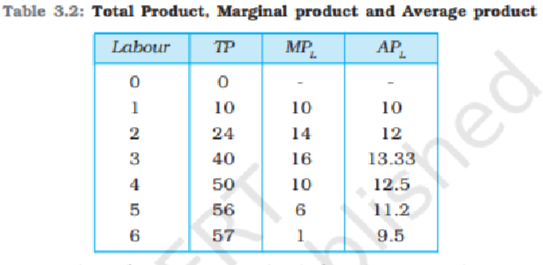
Based on the logic of Table 3.2, match Labour units to the Average Product (AP) trend.
| List I | List II |
|---|---|
| 1. L = 1 to L = 3 | a. AP is falling |
| 2. L = 4 to L = 6 | b. AP is rising |
| 3. MP is greater than AP | c. AP begins to fall. |
| 4. MP is less than AP | d. AP continues to rise. |
QUESTION 4 OF 20
Because average product is the average of all marginal products up to a given level, the AP curve will rise as long as the value of MP remains ________ than the value of AP.
QUESTION 5 OF 20
Assertion: MP is defined holding all other inputs constant.
Reason: When all other inputs are held constant, the change in output per unit of change in the input isolates the marginal contribution of that variable factor.
QUESTION 6 OF 20
Arrange the mathematical steps to derive the Marginal Product for the Lth unit:
I. Identify the Total Product at L units.
II. Identify the Total Product at (L - 1) units.
III. Subtract the value in Step II from Step I.
QUESTION 7 OF 20
If the marginal products for the first three units of labour are 10, 14, and 16 respectively, the Total Product at L = 3 is calculated by the equation:
QUESTION 8 OF 20
Regarding TP growth rates, which statements are true?
I. When MP increases, the rate at which TP increases is shown by the MP.
II. When MP falls but remains positive, TP continues to increase but at a slower rate.
III. Total product is the product of successive MPs.
QUESTION 9 OF 20
Match the phase of variable proportions to its description.
| List I | List II |
|---|---|
| 1. Initial employment phase | a. Crowding causes proportional output addition to be less. |
| 2. Later employment phase | b. Inputs are combined more suitably, increasing MP. |
| 3. Marginal Product in the initial stage | c. Rises due to better utilization of the fixed factor. |
| 4. Marginal Product in the later stage | d. Falls because the fixed factor becomes relatively scarce. |
QUESTION 10 OF 20
The fundamental cause of the law of variable proportions is that as one factor is held fixed and the other is increased, the ________ change.
QUESTION 11 OF 20
Assertion: Changing input ratios initially lead to increasing marginal product.
Reason: The increasing amount of the variable input makes the factor proportions more and more suitable for the production.
QUESTION 12 OF 20
Arrange the logical progression of changing input ratios:
I. Factor proportion becomes more and more suitable for production.
II. Ratio starts with an underutilized fixed factor.
III. The production process becomes too crowded with the variable input.
QUESTION 13 OF 20
Which of the following result from resource underutilization (e.g., 1 worker on 4 hectares)?
I. The single worker cannot cultivate the land efficiently alone.
II. Each subsequent worker adds proportionally more and more to total output.
III. Marginal product is falling in this phase.
QUESTION 14 OF 20
The efficiency loss from crowding occurs because each worker now has ________ land to work efficiently.
QUESTION 15 OF 20
QUESTION 16 OF 20
QUESTION 17 OF 20
Match the curve segment to its relative position.
| List I | List II |
|---|---|
| 1. AP curve left of its maximum | a. MP is greater than AP. |
| 2. AP curve right of its maximum | b. MP is less than AP. |
| 3. AP curve at its maximum point | c. MP is equal to AP. |
| 4. MP curve at the maximum point of AP | d. Intersects the AP curve from above. |
QUESTION 18 OF 20
The Average Product (AP) curve rises less sharply than the Marginal Product (MP) curve initially because AP is the ________ of marginal products up to that level.
QUESTION 19 OF 20
Assertion: Total physical product of a variable input can be derived by summing the marginal returns.
Reason: Total product is the sum of marginal products of every preceding unit of that input.
QUESTION 20 OF 20
Order the steps to accurately capture the Average Return (AP) at a specific employment level using Total Returns (TP):
I. Determine the Total Product (Total Return) for that level of variable input.
II. Divide the Total Product by the number of units of the variable input.
III. Ascertain the fixed amount of the other factor being held constant.
Test Complete!
Answer Review
1 In a production schedule where capital is fixed at K = 4, the series of output values corresponding to increasing levels of labour represents:
�� Capital is held fixed while labour is varied. �� Output is recorded for each level of labour. �� This schedule represents the Total Product (Total Return) of the variable input.
When capital (K) is fixed at 4 units and labour (L) is increased, the resulting output at each labour level is known as the Total Product (TP) or Total Return to the Variable Input. It measures the total output generated by successive units of the variable factor while other inputs remain constant. Therefore, Option B is correct. Option A is incorrect because Marginal Physical Product measures only the additional output from one extra unit of labour. Option C is incorrect because "Average Fixed Return" is not a production concept in NCERT. Option D is incorrect because isoquants represent combinations of two variable inputs producing the same output and are unrelated to a fixed-capital production schedule.
- �� Option A → Marginal Physical Product measures the extra output from one additional unit of labour, not total output.
- �� Option C → Average Fixed Return is not an NCERT production measure.
- �� Option D → Isoquants apply to two-variable input combinations, whereas this schedule keeps capital fixed.
Used
- Contextual/Tonal Matching
Application:
- Identify which input is fixed and determine the production concept represented by the output schedule.
Final Logic:
- Fixed Capital + Variable Labour = Total Return (Total Product).
Fixed K + Changing L = TP (Total Return)
2 Which statements are analytically correct regarding the variable input relationship?
I. If any input becomes zero, there will be no production.
II. With both inputs positive, output will be positive.
III. Fixed inputs change proportionally with variable inputs in the short run.
�� Both inputs are necessary for production. �� Positive inputs produce positive output. �� Fixed inputs do not change in the short run.
According to the NCERT production function: Statement I is correct because if any necessary input becomes zero, production becomes zero. Statement II is correct because when both labour and capital are positive, production is positive. Statement III is incorrect because in the short run, the fixed factor remains unchanged while only the variable factor changes. Therefore, Option D (I and II only) is correct.
- �� Option A → Statement III is false.
- �� Option B → Statement III is incorrect because fixed inputs do not vary in the short run.
- �� Option C → Statement II is also correct and cannot be omitted.
Used
- Option Grouping
Application:
- Evaluate each statement separately using the assumptions of the production function.
Final Logic:
- Statements I and II are true; Statement III is false.
Short Run = Fixed Means Fixed
3 Based on the logic of Table 3.2, match Labour units to the Average Product (AP) trend.
| List I | List II |
|---|---|
| 1. L = 1 to L = 3 | a. AP is falling |
| 2. L = 4 to L = 6 | b. AP is rising |
| 3. MP is greater than AP | c. AP begins to fall. |
| 4. MP is less than AP | d. AP continues to rise. |
�� Average Product initially rises as labour increases. �� After reaching its maximum, Average Product begins to fall. �� The relationship between AP and MP explains this trend.
According to Table 3.2 and the Law of Variable Proportions in NCERT, the Average Product (AP) first rises due to better utilization of the fixed factor and later falls because of diminishing marginal returns. 1 → b During the initial stage (L = 1 to L = 3), the combination of labour and the fixed factor becomes more efficient, causing Average Product to rise. Therefore, 1 → b. 2 → a During the later stage (L = 4 to L = 6), the fixed factor becomes relatively crowded, and Average Product starts to decline. Therefore, 2 → a. 3 → d When Marginal Product (MP) is greater than Average Product (AP), each additional unit contributes more than the current average, causing AP to continue rising. Therefore, 3 → d. 4 → c When Marginal Product becomes less than Average Product, it pulls the average downward, causing AP to begin falling. Therefore, 4 → c. Thus, the correct matching is: 1 → b 2 → a 3 → d 4 → c Hence, Option C is correct.
- �� Option A → Incorrect because the AP trends during the initial and later stages are reversed.
- �� Option B → Incorrect because AP does not continue falling throughout both stages, and the MP–AP relationships are incorrectly matched.
- �� Option D → Incorrect because AP does not continue rising after reaching its maximum, and the MP–AP relationships are incorrect.
Used: Option Grouping
Application:
- Recall the behaviour of the AP curve and its relationship with the MP curve as explained in NCERT and match each stage accordingly.
Final Logic:
- Early Stage → AP Rises.
- Later Stage → AP Falls.
- MP > AP → AP Rises.
- MP < AP → AP Falls.
MP Below → AP Down
4 Because average product is the average of all marginal products up to a given level, the AP curve will rise as long as the value of MP remains ________ than the value of AP.
�� MP influences the movement of AP. �� AP rises when MP exceeds AP. �� AP reaches its maximum when MP equals AP.
Average Product (AP) is the average output produced per unit of the variable input. Since AP is the average of all Marginal Products up to a given level of employment: If MP > AP, the average is pulled upward, so AP rises. If MP = AP, AP reaches its maximum. If MP < AP, AP begins to fall. Therefore, the blank should be filled with "Higher", making Option C correct. Option A is incorrect because MP lower than AP causes AP to fall. Option B is incorrect because AP is maximum, not rising, when MP equals AP. Option D is incorrect because a negative MP would reduce AP rather than increase it.
- �� Option A → When MP is lower than AP, AP declines instead of rising.
- �� Option B → MP equal to AP indicates the maximum point of AP, not a rising AP.
- �� Option D → A negative MP cannot cause AP to rise.
Used
- Contextual/Tonal Matching
Application:
- Recall the standard relationship between Average Product and Marginal Product.
Final Logic:
- MP > AP → AP Rises
(MP Above AP = AP Rises)
5 Assertion: MP is defined holding all other inputs constant.
Reason: When all other inputs are held constant, the change in output per unit of change in the input isolates the marginal contribution of that variable factor.
�� MP measures the additional output from one more unit of a variable input. �� Other inputs must remain constant. �� The Reason correctly explains why this assumption is necessary.
The Assertion is true because Marginal Product (MP) measures the additional output obtained from employing one extra unit of a variable input, while all other inputs remain constant. The Reason is also true because keeping other inputs fixed ensures that any change in output is caused only by the additional unit of the variable input. This isolates the true marginal contribution of that factor. Thus, the Reason correctly explains the Assertion. Therefore, Option A is correct.
- �� Option B → The Reason directly explains why MP is measured with other inputs held constant.
- �� Option C → The Reason is true according to the NCERT definition of Marginal Product.
- �� Option D → Both the Assertion and the Reason are true.
Used
- Elimination
Application:
- Verify the truth of both statements and determine whether the Reason explains the Assertion.
Final Logic:
- Hold Other Inputs Constant → Measure True Marginal Contribution
Only One Changes → MP Measures It
6 Arrange the mathematical steps to derive the Marginal Product for the Lth unit:
I. Identify the Total Product at L units.
II. Identify the Total Product at (L - 1) units.
III. Subtract the value in Step II from Step I.
�� Find Total Product at L units. �� Find Total Product at (L − 1) units. �� Subtract to obtain Marginal Product.
The Marginal Product (MP) of the Lth unit measures the additional output produced by employing one more unit of the variable input. Mathematically, MP = TP(L) − TP(L − 1) The correct sequence is: 1. Identify the Total Product at L units (I). 2. Identify the Total Product at (L − 1) units (II). 3. Subtract the second value from the first (III). Thus, the correct order is: I → II → III Therefore, Option B is correct.
- �� Option A → The TP at the current labour level is normally identified first before comparing it with the previous level.
- �� Option C → Subtraction cannot be performed before identifying both Total Product values.
- �� Option D → The previous Total Product must be known before subtraction.
Used
- Substitution
Application:
- Recall the NCERT formula for Marginal Product and arrange the steps accordingly.
Final Logic:
- Current TP → Previous TP → Difference = MP.
Current TP − Previous TP = MP
7 If the marginal products for the first three units of labour are 10, 14, and 16 respectively, the Total Product at L = 3 is calculated by the equation:
�� Total Product equals the cumulative Marginal Products. �� Add the MP of each labour unit. �� TP at 3 units equals 40.
According to the relationship between Total Product and Marginal Product, Total Product is obtained by adding the Marginal Products of all units employed. Given: MP₁ = 10 MP₂ = 14 MP₃ = 16 Therefore, TP = 10 + 14 + 16 = 40 Hence, Option A is correct. Option B calculates Average Product, not Total Product. Option C finds only the difference between two MPs. Option D incorrectly multiplies the Marginal Products.
- �� Option B → Dividing by 3 gives Average Product, not Total Product.
- �� Option C → Subtracting MPs does not calculate Total Product.
- �� Option D → Total Product is obtained by summation, not multiplication.
Used
- Substitution
Application:
- Apply the TP summation rule directly to the given Marginal Products.
Final Logic:
- TP = ΣMP.
TP = Add All MPs
8 Regarding TP growth rates, which statements are true?
I. When MP increases, the rate at which TP increases is shown by the MP.
II. When MP falls but remains positive, TP continues to increase but at a slower rate.
III. Total product is the product of successive MPs.
�� MP measures the rate of increase in TP. �� TP continues increasing while MP remains positive. �� TP is the sum, not the product, of MPs.
Statement I is correct because Marginal Product measures the rate at which Total Product increases. Statement II is correct because when MP is positive but falling, Total Product continues to increase, although at a decreasing rate. Statement III is incorrect because Total Product is the sum of Marginal Products, not their product. Therefore, Option A (I and II only) is correct.
- �� Option B → Statement III is incorrect.
- �� Option C → Statement II is also correct.
- �� Option D → Statement III is false.
Used
- Option Grouping
Application:
- Evaluate each statement independently using the TP–MP relationship.
Final Logic:
- MP shows TP growth; TP = Sum of MPs.
TP = Sum, Not Product
9 Match the phase of variable proportions to its description.
| List I | List II |
|---|---|
| 1. Initial employment phase | a. Crowding causes proportional output addition to be less. |
| 2. Later employment phase | b. Inputs are combined more suitably, increasing MP. |
| 3. Marginal Product in the initial stage | c. Rises due to better utilization of the fixed factor. |
| 4. Marginal Product in the later stage | d. Falls because the fixed factor becomes relatively scarce. |
�� Initially, factor proportions become more suitable. �� Later, the fixed factor becomes crowded. �� Marginal Product first rises and then falls.
According to the Law of Variable Proportions explained in NCERT, increasing the variable factor while keeping the fixed factor constant passes through different stages of production. 1 → b During the initial employment phase, additional units of labour are combined more efficiently with the fixed factor. This improves factor proportions and increases Marginal Product. Therefore, 1 → b. 2 → a During the later employment phase, the fixed factor becomes crowded as more labour is employed. Consequently, each additional worker contributes proportionally less output. Therefore, 2 → a. 3 → c In the initial stage of production, Marginal Product rises because the fixed factor is utilized more efficiently. Therefore, 3 → c. 4 → d In the later stage, the fixed factor becomes relatively scarce compared to labour, causing Marginal Product to fall due to diminishing marginal returns. Therefore, 4 → d. Thus, the correct matching is: 1 → b 2 → a 3 → c 4 → d Hence, Option C is correct.
- �� Option A → Incorrect because the characteristics of the initial and later employment phases are interchanged.
- �� Option B → Incorrect because crowding does not occur during the initial phase, and the MP stages are incorrectly matched.
- �� Option D → Incorrect because the later phase is characterized by crowding and diminishing marginal returns, not improving factor proportions.
Used: Option Grouping
Application:
- Recall the stages of the Law of Variable Proportions and match each phase with its corresponding characteristic.
Final Logic:
- Initial Phase → Better Factor Proportions.
- Later Phase → Crowding of the Fixed Factor.
- MP Initially → Rises.
- MP Later → Falls.
Better First → Crowded Later
10 The fundamental cause of the law of variable proportions is that as one factor is held fixed and the other is increased, the ________ change.
�� One input is fixed. �� The other input varies. �� Therefore, the ratio between inputs changes.
The Law of Variable Proportions arises because one factor of production is fixed while another factor is varied. As more units of the variable factor are employed, the proportion (ratio) between the fixed and variable inputs changes, leading to changes in Marginal Product. Therefore, Option B is correct. Option A is incorrect because changes in factor prices do not explain this law. Option C is incorrect because fixed costs are not the fundamental cause. Option D is incorrect because long-run returns involve changes in all inputs.
- �� Option A → The law depends on input ratios, not prices.
- �� Option C → Fixed costs are consequences of fixed factors, not the cause of the law.
- �� Option D → Long-run returns apply when all inputs vary.
Used
- Contextual/Tonal Matching
Application:
- Recall the central idea behind the Law of Variable Proportions.
Final Logic:
- Fixed One Input + Variable Other Input = Changing Factor Proportions.
Fixed One → Ratio Changes
11 Assertion: Changing input ratios initially lead to increasing marginal product.
Reason: The increasing amount of the variable input makes the factor proportions more and more suitable for the production.
�� Initially, factor proportions improve. �� Better input combinations increase efficiency. �� The Reason correctly explains the Assertion.
The Assertion is true because, in the initial stage of the Law of Variable Proportions, increasing the variable input while keeping the fixed input constant improves productivity, causing Marginal Product (MP) to rise. The Reason is also true because adding more units of the variable input makes the factor proportions more suitable. The fixed factor is utilized more efficiently, allowing each additional unit of labour to contribute more output. Thus, the Reason correctly explains the Assertion. Therefore, Option A is correct.
- �� Option B → The Reason directly explains why Marginal Product initially increases.
- �� Option C → The Reason is true according to the NCERT explanation.
- �� Option D → Both the Assertion and the Reason are true.
Used
- Elimination
Application:
- Check whether both statements are true and verify whether the Reason explains the Assertion.
Final Logic:
- Better Factor Proportions → Higher Marginal Product.
Better Ratio = Rising MP
12 Arrange the logical progression of changing input ratios:
I. Factor proportion becomes more and more suitable for production.
II. Ratio starts with an underutilized fixed factor.
III. The production process becomes too crowded with the variable input.
�� Initially, the fixed factor is underutilized. �� Adding labour improves factor proportions. �� Eventually, excessive labour causes crowding.
According to the Law of Variable Proportions: Initially, the fixed factor is underutilized because too little labour is employed (II). As more labour is added, factor proportions become more suitable, increasing productivity (I). After a certain stage, additional labour causes the production process to become crowded, reducing Marginal Product (III). Thus, the correct sequence is: II → I → III Therefore, Option A is correct.
- �� Option B → Factor proportions cannot improve before the initial underutilization stage.
- �� Option C → Crowding occurs only after factor proportions improve.
- �� Option D → Crowding is the final stage, not the second stage.
Used
- Contextual/Tonal Matching
Application:
- Arrange the stages according to the NCERT explanation of the Law of Variable Proportions.
Final Logic:
- Underutilization → Better Proportions → Crowding.
Empty → Better → Crowded
13 Which of the following result from resource underutilization (e.g., 1 worker on 4 hectares)?
I. The single worker cannot cultivate the land efficiently alone.
II. Each subsequent worker adds proportionally more and more to total output.
III. Marginal product is falling in this phase.
�� One worker cannot fully utilize the land. �� Additional workers initially increase productivity. �� Marginal Product rises, not falls.
In the initial stage of production: Statement I is correct because one worker cannot efficiently cultivate four hectares of land. Statement II is correct because each additional worker improves the utilization of land, causing Marginal Product to increase. Statement III is incorrect because Marginal Product falls only after the fixed factor becomes crowded, not during underutilization. Therefore, Option B is correct.
- �� Option A → Statement III is incorrect because MP is rising during this stage.
- �� Option C → Statement III is false.
- �� Option D → All three statements are not correct because Statement III is incorrect.
Used
- Option Grouping
Application:
- Evaluate each statement separately using the stages of the Law of Variable Proportions.
Final Logic:
- Underutilization → Rising MP, Not Falling MP.
Empty Land → Rising MP
14 The efficiency loss from crowding occurs because each worker now has ________ land to work efficiently.
�� Land is the fixed factor. �� More workers reduce land available per worker. �� Less land per worker lowers productivity.
When additional workers are employed while land remains fixed, each worker receives less land to cultivate. After a certain point, the land becomes insufficient for each worker to operate efficiently. This crowding causes the Marginal Product of labour to decline. Therefore, Option B is correct. Option A is incorrect because excessive land characterizes the initial stage. Option C is incorrect because proportional land allocation does not explain crowding. Option D is incorrect because optimal land allocation would maximize efficiency rather than reduce it.
- �� Option A → Excessive land exists during the underutilization stage.
- �� Option C → Proportional allocation does not explain diminishing productivity.
- �� Option D → Optimal land allocation would not lead to efficiency loss.
Used
- Contextual/Tonal Matching
Application:
- Recall the farmer example where land becomes crowded.
Final Logic:
- Crowding → Insufficient Land per Worker.
Crowding = Less Land
15
�� MP intersects AP only once. �� At that point, MP equals AP. �� AP reaches its highest value.
The passage explains that: MP > AP causes AP to rise. MP < AP causes AP to fall. Therefore, when MP = AP, the AP curve changes from rising to falling. This means AP is at its maximum exactly where the MP curve intersects it from above. Therefore, Option B is correct. Option A is incorrect because AP is no longer rising at that point. Option C is incorrect because AP starts falling only after the intersection. Option D is incorrect because AP is well-defined at the intersection.
- �� Option A → AP stops rising when MP equals AP.
- �� Option C → AP begins to fall only after the intersection point.
- �� Option D → AP has a definite maximum value at the intersection.
Used
- Contextual/Tonal Matching
Application:
- Use the passage's explanation of the AP–MP relationship to identify the significance of the intersection.
Final Logic:
- MP = AP ⇒ AP Maximum
(MP = AP = AP Maximum)
16
�� AP falls only when MP is below AP. �� MP determines the movement of AP. �� The passage directly states this relationship.
The passage explains the relationship between Average Product (AP) and Marginal Product (MP): If MP > AP, AP rises. If MP = AP, AP reaches its maximum. If MP < AP, AP falls. Therefore, when AP is falling, MP must be less than AP. Otherwise, AP would either continue rising or remain at its maximum. Hence, Option A is correct. Option B is incorrect because MP below AP pulls the average down, not up. Option C is incorrect because AP is directly influenced by MP. Option D is incorrect because Total Product does not become negative.
- �� Option B → MP raises AP only when it is greater than AP, not below it.
- �� Option C → AP and MP are directly related throughout the production process.
- �� Option D → Total Product remains positive; AP falling does not imply negative Total Product.
Used
- Contextual/Tonal Matching
Application:
- Use the passage to determine the condition under which AP declines.
Final Logic:
- MP Below AP → AP Falls
Below Average → Average Falls
17 Match the curve segment to its relative position.
| List I | List II |
|---|---|
| 1. AP curve left of its maximum | a. MP is greater than AP. |
| 2. AP curve right of its maximum | b. MP is less than AP. |
| 3. AP curve at its maximum point | c. MP is equal to AP. |
| 4. MP curve at the maximum point of AP | d. Intersects the AP curve from above. |
�� Before AP reaches its maximum, MP is greater than AP. �� At the maximum point of AP, MP equals AP. �� After the maximum point, MP becomes less than AP.
According to NCERT, the relationship between Average Product (AP) and Marginal Product (MP) determines the movement of the AP curve. 1 → a To the left of the maximum point of the AP curve, Marginal Product is greater than Average Product. Therefore, AP continues to rise. Hence, 1 → a. 2 → b To the right of the maximum point of the AP curve, Marginal Product becomes less than Average Product, causing AP to decline. Hence, 2 → b. 3 → c At the maximum point of the AP curve, Marginal Product becomes exactly equal to Average Product. Hence, 3 → c. 4 → d The MP curve intersects the AP curve from above precisely at the point where AP is at its maximum. Hence, 4 → d. Thus, the correct matching is: 1 → a 2 → b 3 → c 4 → d Hence, Option C is correct.
- �� Option A → Incorrect because MP cannot remain greater than AP on both sides of the maximum point.
- �� Option B → Incorrect because the relationships between MP and AP before and after the maximum point are reversed, and the last two concepts are also interchanged.
- �� Option D → Incorrect because MP is not below AP before AP reaches its maximum.
Used: Option Grouping
Application:
- Recall the standard NCERT graphical relationship between the AP and MP curves and identify the position of MP relative to AP at different stages.
Final Logic:
- Left of Maximum → MP > AP.
- At Maximum → MP = AP.
- Right of Maximum → MP < AP.
- MP cuts AP from Above.
Right → Below
18 The Average Product (AP) curve rises less sharply than the Marginal Product (MP) curve initially because AP is the ________ of marginal products up to that level.
�� AP represents the average of all MPs. �� An average changes more gradually than individual values. �� Therefore, AP rises less sharply than MP.
Average Product (AP) is calculated as: AP = Total Product ÷ Labour Since Total Product is the cumulative sum of Marginal Products, AP represents the average of all Marginal Products up to a given level of employment. An average changes more gradually than individual marginal values. Hence, the AP curve rises less sharply than the MP curve during the initial stages. Therefore, Option C is correct.
- �� Option A → AP is not the difference between Marginal Products.
- �� Option B → AP is not a multiple of Marginal Products.
- �� Option D → Total Product is the sum of Marginal Products, not Average Product.
Used
- Contextual/Tonal Matching
Application:
- Recall the mathematical meaning of Average Product.
Final Logic:
- AP = Average of MPs.
AP = Average of MPs
19 Assertion: Total physical product of a variable input can be derived by summing the marginal returns.
Reason: Total product is the sum of marginal products of every preceding unit of that input.
�� Total Physical Product is another name for Total Product. �� Total Product equals the cumulative Marginal Products. �� The Reason correctly explains the Assertion.
The Assertion is true because Total Physical Product (TPP) is another name for Total Product (TP). Total Product can be obtained by adding the Marginal Products contributed by each unit of the variable input. The Reason is also true because this cumulative addition of Marginal Products directly gives Total Product. Therefore, the Reason correctly explains the Assertion. Hence, Option A is correct.
- �� Option B → The Reason directly explains the Assertion.
- �� Option C → The Reason is true according to NCERT.
- �� Option D → Both statements are true.
Used
- Elimination
Application:
- Evaluate both statements and determine whether the Reason explains the Assertion.
Final Logic:
- TP = Sum of MPs
Add MPs = TP
20 Order the steps to accurately capture the Average Return (AP) at a specific employment level using Total Returns (TP):
I. Determine the Total Product (Total Return) for that level of variable input.
II. Divide the Total Product by the number of units of the variable input.
III. Ascertain the fixed amount of the other factor being held constant.
�� First identify the fixed factor. �� Then determine Total Product. �� Finally calculate Average Product by dividing TP by labour.
To calculate Average Product (Average Return) correctly: 1. Ascertain the fixed amount of the other factor so that production is analyzed in the short run (III). 2. Determine the Total Product (Total Return) corresponding to the given level of the variable input (I). 3. Divide Total Product by the number of units of the variable input to obtain Average Product (II). Thus, the correct sequence is: III → I → II Therefore, Option A is correct.
- �� Option B → The production conditions must first specify the fixed factor.
- �� Option C → Division cannot be performed before Total Product is known.
- �� Option D → Average Product cannot be calculated before determining Total Product.
Used
- Contextual/Tonal Matching
Application:
- Arrange the production analysis steps in the logical order used by NCERT.
Final Logic:
- Fix Other Input → Find TP → Calculate AP.
Fix → TP → AP