
CUET UG Biology Booster Test 3-Recombinant DNA Processes
📌 Answers are locked once submitted — results and explanations appear at the end.
QUESTION 1 OF 20
QUESTION 2 OF 20
QUESTION 3 OF 20
Which of the following scenarios incorrectly pairs the biological sample with the enzyme fundamentally required to disrupt its cellular boundary?
QUESTION 4 OF 20
If a researcher isolates DNA from a eukaryotic cell but intentionally skips the protease treatment step, what will be the most significant biochemical consequence in the final isolate?
QUESTION 5 OF 20
Reconstruct the chronological flow of achieving a recombinant DNA molecule starting from intact cells:
1. Mixing of 'gene of interest' and vector with DNA ligase.
2. Incubation of purified DNA with restriction endonuclease.
3. Addition of chilled ethanol for DNA precipitation.
4. Treatment of cells with lysozyme/cellulase.
QUESTION 6 OF 20
When monitoring restriction digestion via agarose gel electrophoresis, you observe that the DNA from the reaction tube remains entirely within the loading well and has not migrated towards the anode. What is the most analytical conclusion?
QUESTION 7 OF 20
Evaluate the principles governing in vitro gene synthesis (PCR):
Statement I: It synthesizes DNA by extending primers using RNA polymerase.
Statement II: It necessitates two sets of chemically synthesized oligonucleotide primers complementary to the DNA regions.
Statement III: Genomic DNA acts as the template for the polymerase.
QUESTION 8 OF 20
Why are two sets of oligonucleotide primers indispensable for the PCR mechanism rather than just one?
QUESTION 9 OF 20
Match the dynamic events of PCR to their corresponding biochemical purpose:
| PCR Dynamic | Biochemical Purpose |
|---|---|
| I. High temperature (>90°C) | P. Extension of the nucleotide chain |
| II. Cooling to lower temp | Q. Induces denaturation of double-stranded DNA |
| III. Action of DNA Polymerase | R. Permits annealing of oligonucleotide primers |
| IV. Addition of deoxynucleotides | S. Acts as the building blocks for the new strand |
QUESTION 10 OF 20
Which of the following represents an incorrect molecular event during the annealing and extension stages of PCR?
QUESTION 11 OF 20
Assess the following statements regarding the biological advantage of utilizing Thermus aquaticus as a source for PCR polymerase:
Statement I: It is an organism that has naturally evolved enzymes capable of withstanding extreme heat.
Statement II: Its DNA polymerase does not undergo high-temperature induced denaturation, allowing continuous thermal cycling.
QUESTION 12 OF 20
If human DNA polymerase were substituted for Taq polymerase in a standard PCR protocol, what would be the analytical bottleneck?
QUESTION 13 OF 20
Arrange the following complex recombinant techniques from isolation to expression:
1. Transformation into competent E. coli cells.
2. Repeated amplification cycles via PCR to yield a billion copies.
3. Ligation of the amplified fragment into a vector.
4. Culturing host cells to express the desirable protein.
QUESTION 14 OF 20
The billion-fold increase of a gene segment during PCR is fundamentally based on which mathematical replication logic?
QUESTION 15 OF 20
Match the molecular components of ligation to their respective roles:
| Component | Role |
|---|---|
| I. Source DNA | P. The autonomously replicating carrier DNA |
| II. Vector DNA | Q. The enzyme that forms phosphodiester bonds to join ends |
| III. Restriction Enzyme | R. Contains the specific 'gene of interest' |
| IV. DNA Ligase | S. Creates compatible sticky ends |
QUESTION 16 OF 20
Which of the following statements does NOT correctly describe the process of creating new DNA combinations via ligation?
QUESTION 17 OF 20
How does the presence of the ampicillin resistance gene mechanistically serve as a selectable marker when plating on agar?
QUESTION 18 OF 20
When evaluating the survival of cells on an ampicillin-agar plate, which biological characteristic is NOT associated with the untransformed recipient cells?
QUESTION 19 OF 20
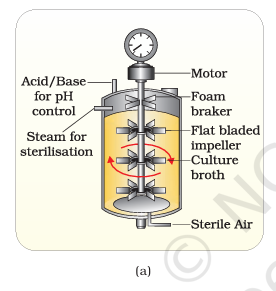
To fulfill the ultimate aim of producing a desirable protein on a massive scale, the bioreactor shown must biologically convert raw materials by providing optimum growth conditions. Which of the following is NOT one of those optimized conditions provided?
QUESTION 20 OF 20
To optimize cell expression and prevent physiological localized depletion in a 1000-litre culture, which structural feature of the bioreactor ensures even oxygen availability and mixing throughout?
Test Complete!
Answer Review
1
Restriction enzymes require direct access to the DNA double helix. Cellular membranes and cytoplasm act as physical and chemical barriers. Purification is required to prevent enzymes from binding to wrong targets or being inhibited.
Restriction endonucleases are specific proteins that recognize and cleave precise DNA sequences. Because DNA is trapped inside the nucleus/cytoplasm within cell membranes, the restriction enzyme cannot reach it unless the cell is lysed. Furthermore, "pure form" is essential because other macromolecules (like proteins or polysaccharides) can interfere with the enzyme's binding or catalytic efficiency.
- Option A → Restriction enzymes work in vitro (outside the cell), but the "prerequisite" is getting the DNA out, not the location of the enzyme's function.
- Option C → While ligase is involved in a later step, membrane presence isn't the primary inhibitor of ligase; rather, it's the lack of purified DNA.
- Option D → Membranes do not perform enzymatic synthesis of RNA from DNA.
Used Contextual/Tonal Matching
Application: Identifying the fundamental logical premise stated in the provided passage.
Final Logic: Access to DNA = Lysis.
"Free the DNA to let the enzyme cut."
2
Ethanol lowers the dielectric constant of the solution. DNA loses its hydration shell and becomes insoluble. Ethanol precipitation is the standard technique for collecting DNA.
The passage explicitly states that "purified DNA ultimately precipitates out after the addition of chilled ethanol." This is a standard laboratory procedure where the addition of a cold alcohol solvent disrupts the solubility of DNA, forcing it to aggregate into visible threads.
- Option A → Lysis releases DNA into solution, it doesn't precipitate it.
- Option B → Restriction enzymes cut DNA, they do not precipitate it.
- Option D → RNAse degrades RNA, it does not precipitate DNA.
Used Substitution
Application: Locating the direct cause-effect relationship described in the text.
Final Logic: Text states "precipitates out after the addition of chilled ethanol."
"Ethanol makes DNA fall out."
3 Which of the following scenarios incorrectly pairs the biological sample with the enzyme fundamentally required to disrupt its cellular boundary?
Human cells lack cell walls; they have only a cell membrane. Cellulase breaks cellulose (plant cell walls). A detergent (like SDS) is used to disrupt animal cell membranes, not cellulase.
Animal cells (like human cheek cells) do not possess cell walls; they are bound only by a plasma membrane, which is disrupted using detergents. Cellulase is an enzyme specifically used to degrade cellulose-based cell walls found in plant tissues. Thus, pairing human cells with cellulase is incorrect.
- Option A → Bacteria have peptidoglycan walls; Lysozyme is the correct enzyme.
- Option B → Plants have cellulose walls; Cellulase is the correct enzyme.
- Option C → Fungi have chitin walls; Chitinase is the correct enzyme.
Used Elimination
Application: Categorizing organisms by cell wall composition: Plants (Cellulose), Fungi (Chitin), Bacteria (Peptidoglycan), Animals (No wall).
Final Logic: Humans have no cellulose.
"Humans = No Cell Wall."
4 If a researcher isolates DNA from a eukaryotic cell but intentionally skips the protease treatment step, what will be the most significant biochemical consequence in the final isolate?
Eukaryotic DNA is organized into chromatin with histones. Protease is specifically added to digest these proteins. Skipping protease leaves these proteins attached to DNA.
In eukaryotic cells, DNA is densely packed around histone proteins to form nucleosomes. To isolate pure DNA, these proteins must be removed. Skipping protease treatment means these proteins remain bound to the DNA, which prevents the DNA from being truly pure for downstream applications like restriction digestion.
- Option A → Protease removes proteins, not RNA. RNAse removes RNA.
- Option C → Protease is not a nuclease; it does not break DNA into nucleotides.
- Option D → Cell wall lysis occurs before protease treatment.
Used Substitution
Application: Defining the role of Protease in eukaryotic DNA extraction.
Final Logic: Eukaryotic DNA + Histones = Chromatin. Protease removes histones.
"Protease cleans the protein coat."
5 Reconstruct the chronological flow of achieving a recombinant DNA molecule starting from intact cells:
1. Mixing of 'gene of interest' and vector with DNA ligase.
2. Incubation of purified DNA with restriction endonuclease.
3. Addition of chilled ethanol for DNA precipitation.
4. Treatment of cells with lysozyme/cellulase.
Start: Break cells (4). Then: Precipitate DNA (3) to collect it. Then: Cut with enzymes (2). Finally: Join with ligase (1).
The correct flow is: (4) Lysis to get the DNA out, (3) Precipitation/purification to obtain pure DNA, (2) Restriction digestion to prepare the specific fragments for cloning, and (1) Ligation to join the foreign gene into the vector.
- Options B, C, D → Misorder the fundamental dependency of each step (e.g., cutting requires purified DNA).
Used Contextual/Tonal Matching
Application: Defining the workflow: Cell -> Pure DNA -> Digested DNA -> Recombinant Molecule.
Final Logic: The biological order of operations: Isolation -> Purification -> Preparation -> Ligation.
"Lysis, Purify, Cut, Ligate."
6 When monitoring restriction digestion via agarose gel electrophoresis, you observe that the DNA from the reaction tube remains entirely within the loading well and has not migrated towards the anode. What is the most analytical conclusion?
DNA has a constant negative charge. It must move if voltage is applied. Staying in the well means it didn't enter the gel (digestion failed) or the circuit is broken.
Under electrophoresis, DNA always migrates toward the anode because it is negatively charged. If the DNA stays in the well, the most likely reasons are: the gel/loading error, a lack of power, or the DNA was not properly released/digested in a way that allows it to enter the matrix. It definitely does not mean it was "cut perfectly."
- Option A → If cut perfectly, you would see multiple bands.
- Option B → Even destroyed DNA would migrate.
- Option C → DNA is inherently negatively charged.
Used Elimination
Application: Eliminate based on the fundamental principles of electrophoresis.
Final Logic: DNA + Electric Field = Movement. No movement = Failed setup/failed digestion.
"DNA in the well? Something didn't go well."
7 Evaluate the principles governing in vitro gene synthesis (PCR):
Statement I: It synthesizes DNA by extending primers using RNA polymerase.
Statement II: It necessitates two sets of chemically synthesized oligonucleotide primers complementary to the DNA regions.
Statement III: Genomic DNA acts as the template for the polymerase.
Statement I is false: PCR uses DNA polymerase, not RNA polymerase. Statement II is true: PCR uses two synthetic primers. Statement III is true: Genomic DNA acts as the template.
Statement I is incorrect because PCR uses a thermostable DNA polymerase to synthesize DNA, not RNA polymerase. Statements II and III are standard accurate descriptions of the requirements for PCR (primers and template).
- Options A, C, D → All contain the false Statement I.
Used Elimination
Application: Identify the false statement regarding the enzyme used.
Final Logic: PCR = DNA Synthesis = DNA Polymerase.
"PCR uses DNA Builder (Polymerase), not RNA builder."
8 Why are two sets of oligonucleotide primers indispensable for the PCR mechanism rather than just one?
Double-stranded DNA has two strands running in opposite directions (antiparallel). PCR copies both strands simultaneously. Two primers are needed for the two ends.
DNA is double-stranded and antiparallel ($5' \rightarrow 3'$ and $3' \rightarrow 5'$). To amplify a specific segment, primers must bind to the opposite ends of the target on each strand. Two primers are needed to initiate synthesis on these two separate strands simultaneously in opposite directions.
- Option A → Primers do not break DNA.
- Option C → Primers are not enzymes (protease/ligase).
- Option D → Primers do not create heat.
Used Substitution
Application: Using the principle of "antiparallel DNA strands" to justify the need for two primers.
Final Logic: DNA has two sides; you need a starter for both.
"Two strands = Two primers."
9 Match the dynamic events of PCR to their corresponding biochemical purpose:
| PCR Dynamic | Biochemical Purpose |
|---|---|
| I. High temperature (>90°C) | P. Extension of the nucleotide chain |
| II. Cooling to lower temp | Q. Induces denaturation of double-stranded DNA |
| III. Action of DNA Polymerase | R. Permits annealing of oligonucleotide primers |
| IV. Addition of deoxynucleotides | S. Acts as the building blocks for the new strand |
I-Q: High heat denatures. II-R: Cooling allows annealing. III-P: Polymerase extends. IV-S: Nucleotides are building blocks.
The biochemical stages are: (I) High temperature causes denaturation (Q). (II) Cooling allows primer binding (annealing) (R). (III) DNA polymerase extends the chain (P). (IV) Deoxynucleotides are the raw materials (building blocks) for the strand (S).
- Options B, C, D → Misalign the mechanisms of the stages.
Used Option Grouping
Application: Mapping every PCR step to its specific function.
Final Logic: A is the only logically correct mapping.
"I-Q (Heat-Denature), II-R (Cool-Anneal), III-P (Polymer-Extend), IV-S (Nucleotide-Blocks)."
10 Which of the following represents an incorrect molecular event during the annealing and extension stages of PCR?
The template DNA is not consumed/degraded in PCR. It remains as the blueprint for the synthesis. Option B describes a destructive process that does not occur in PCR.
During PCR, the template DNA is used to guide synthesis; it is never degraded into waste. It remains intact throughout the cycles. Options A, C, and D are standard correct events that occur during annealing and extension.
- Option A → Annealing involves H-bonding of primers.
- Option C → dNTPs are necessary building blocks.
- Option D → Polymerase extension is the core activity.
Used Extreme Word Filter
Application: The phrase "permanently degraded into waste" is the direct opposite of the role of a "template."
Final Logic: Template = Blueprint (reused), not fuel (consumed/degraded).
"Template = Reused, not destroyed."
11 Assess the following statements regarding the biological advantage of utilizing Thermus aquaticus as a source for PCR polymerase:
Statement I: It is an organism that has naturally evolved enzymes capable of withstanding extreme heat.
Statement II: Its DNA polymerase does not undergo high-temperature induced denaturation, allowing continuous thermal cycling.
Thermus aquaticus is a thermophilic bacterium. Its enzymes (like Taq polymerase) are thermally stable. This stability is the key to automating the PCR cycles.
Statement I is correct because Thermus aquaticus thrives in hot springs, evolving heat-stable proteins. Statement II is correct because this heat stability allows the polymerase to survive the high temperatures ($94\text{°C}$+) required for denaturation in every cycle of PCR, thus facilitating continuous amplification without needing to add fresh enzyme.
- Option A, B, D → These are incorrect because both premises regarding the source and the function of the enzyme are biologically accurate.
Used Contextual/Tonal Matching
Application: Validating the biological necessity of thermostability for PCR.
Final Logic: Adaptation to heat = Stability = PCR efficiency.
"Thermus = Thermal-stable."
12 If human DNA polymerase were substituted for Taq polymerase in a standard PCR protocol, what would be the analytical bottleneck?
PCR requires $94\text{–}95\text{°C}$ to melt DNA. Human enzymes are optimized for $37\text{°C}$ (body temp). Human enzymes denature (unfold/break) at PCR temperatures.
Human DNA polymerase is optimized for physiological temperatures. At the high temperatures used in PCR denaturation ($94\text{–}95\text{°C}$), human proteins lose their tertiary structure—they denature—and become non-functional. Therefore, the enzyme would be destroyed in the very first cycle, halting the PCR process.
- Option A → DNA polymerase replicates DNA, regardless of origin.
- Option C → The issue is heat stability, not speed or error rate.
- Option D → Primers bind to the template, not the enzyme.
Used Substitution
Application: Replace "human enzyme" with "non-thermophilic enzyme" to see why it fails.
Final Logic: PCR heat requirement > Human enzyme heat limit.
"PCR heat kills human proteins."
13 Arrange the following complex recombinant techniques from isolation to expression:
1. Transformation into competent E. coli cells.
2. Repeated amplification cycles via PCR to yield a billion copies.
3. Ligation of the amplified fragment into a vector.
4. Culturing host cells to express the desirable protein.
First: Amplify DNA (PCR-2). Second: Join into vector (Ligation-3). Third: Insert into host (Transformation-1). Fourth: Grow cells to produce protein (Expression-4).
The logical sequence for rDNA technology is: (2) Amplify the desired gene segment using PCR, (3) Ligate this fragment into a suitable vector to create a recombinant molecule, (1) Transform the host cell (e.g., E. coli) with this molecule, and (4) Culture the host cells under optimized conditions to produce the protein.
- Options B, C, D → All misorder the essential steps of preparation, insertion, and expression.
Used Elimination
Application: Ordering the workflow by dependence (you can't transform before ligation, you can't express before transformation).
Final Logic: Amplification > Ligation > Transformation > Expression.
"Amplify, Ligate, Transform, Express."
14 The billion-fold increase of a gene segment during PCR is fundamentally based on which mathematical replication logic?
Each cycle produces two copies from one template. $2^n$ where $n$ is the number of cycles. This is exponential, not linear.
PCR amplifies DNA exponentially. In each cycle, the newly synthesized strands serve as templates for the next cycle, causing the total amount of DNA to double ($2, 4, 8, 16...$). This is why it reaches "billions" of copies so rapidly.
- Option A → Linear addition would only result in a few hundred copies, not billions.
- Option C & D → These processes do not describe DNA replication.
Used Substitution
Application: Defining "PCR amplification" as $2^n$ growth.
Final Logic: Double per cycle = Exponential.
"Exponential = Double the trouble (and the DNA)."
15 Match the molecular components of ligation to their respective roles:
| Component | Role |
|---|---|
| I. Source DNA | P. The autonomously replicating carrier DNA |
| II. Vector DNA | Q. The enzyme that forms phosphodiester bonds to join ends |
| III. Restriction Enzyme | R. Contains the specific 'gene of interest' |
| IV. DNA Ligase | S. Creates compatible sticky ends |
I (Source) = R (Gene of interest). II (Vector) = P (Carrier DNA). III (Restriction) = S (Creates sticky ends). IV (Ligase) = Q (Joins fragments).
The correct functional roles are: Source DNA contains the target gene (R), Vector DNA is the carrier (P), Restriction enzyme acts as "molecular scissors" to create sticky ends (S), and DNA Ligase acts as "molecular glue" to form phosphodiester bonds (Q).
- Options B, C, D → Incorrectly pair the tool with the functional outcome.
Used Option Grouping
Application: Aligning tools with their specific recombinant function.
Final Logic: Only Option A aligns all components with their correct biological roles.
"Ligase = Glue; Restriction Enzyme = Scissors."
16 Which of the following statements does NOT correctly describe the process of creating new DNA combinations via ligation?
Ligation happens in vitro (in the test tube). It is done to create the recombinant molecule. It is not something the host cell does on its own.
Ligation occurs in vitro (in a lab tube), not in vivo (inside the host cell). You mix the DNA fragments and ligase in a tube to join them; only after ligation is the recombinant molecule transformed into the host.
- Option B, C, D → These are all correct descriptions of the ligation process.
Used Elimination
Application: Contrast in vitro vs. in vivo processes in rDNA tech.
Final Logic: Ligation is a lab-bench technique, not a cytoplasmic event.
"Ligation = Test tube (in vitro)."
17 How does the presence of the ampicillin resistance gene mechanistically serve as a selectable marker when plating on agar?
Resistance gene = enzyme production (e.g., beta-lactamase). Enzyme destroys antibiotic. Cells survive in presence of antibiotic.
The resistance gene encodes an enzyme that degrades the antibiotic (ampicillin) in the surrounding medium. This detoxifies the area, allowing the cell carrying the plasmid to survive and grow. Cells lacking this gene cannot neutralize the antibiotic and thus die.
- Option A → Color change is for "blue/white" screening (LacZ), not antibiotic resistance.
- Option C → No physical blocking occurs.
- Option D → The cell is resistant, it does not produce the antibiotic itself.
Used Substitution
Application: Define the biochemical action of "selectable marker" (antibiotic resistance).
Final Logic: Marker = Antibiotic defense = Survival.
"Resistance = Defense against antibiotic."
18 When evaluating the survival of cells on an ampicillin-agar plate, which biological characteristic is NOT associated with the untransformed recipient cells?
Untransformed = No plasmid = No gene = No protein. Untransformed cells are "blank slates." They die on the plate.
Untransformed cells have not received the plasmid vector. Therefore, they have no resistance gene (they die) and no gene of interest (they cannot express the protein). Thus, claiming they "successfully express the protein" is false.
- Option A, B, D → These are accurate descriptions of untransformed cells.
Used Elimination
Application: Check the status of untransformed cells against the properties of transformants.
Final Logic: Untransformed = No vector = No expression.
"Untransformed = Empty."
19 To fulfill the ultimate aim of producing a desirable protein on a massive scale, the bioreactor shown must biologically convert raw materials by providing optimum growth conditions. Which of the following is NOT one of those optimized conditions provided?
Bioreactors are for culturing/production. Agarose is for electrophoresis (analytical). Production needs growth media.
Bioreactors provide conditions conducive to cell growth (temp, pH, substrate, oxygen, etc.). Agarose gel is an analytical tool used in the lab to separate DNA by size; it is not a component of a bioreactor used for protein production.
- Option A, B, C → All are essential parameters optimized in a bioreactor for cell culture.
Used Odd One Out
Application: Categorize the list into "Production Requirements" vs. "Laboratory Analysis Tools."
Final Logic: Agarose is for gels, not for large-scale growth.
"Bioreactor = Growth; Gel = Analytical."
20 To optimize cell expression and prevent physiological localized depletion in a 1000-litre culture, which structural feature of the bioreactor ensures even oxygen availability and mixing throughout?
Large volumes need uniform distribution. Agitators/stirrers move the liquid. This keeps oxygen/nutrients balanced.
In a large bioreactor (100–1000 liters), constant stirring by an agitator is required to keep the medium homogeneous. This ensures that oxygen and nutrients are distributed evenly, preventing localized depletion that would kill cells.
- Option A → Used for DNA prep.
- Option C → Chilled ethanol is used for DNA extraction, not bioreactor function.
- Option D → Polymerase is for PCR, not bioreactor culture.
Used Substitution
Application: Define the physical function of a "stirrer" in a large tank.
Final Logic: Large tank + Mixing = Homogeneity = Proper growth.
"Stirrer = Even mixture."