
CUET UG Biology Booster Test 3-Large Scale Production and Refining
📌 Answers are locked once submitted — results and explanations appear at the end.
QUESTION 1 OF 20
Arrange the following steps necessary to express a recombinant protein in a heterologous host:
I. Culturing the host cells in a medium at large scale.
II. Introduction of the ligated DNA into recipient competent cells.
III. Ligation of the DNA fragment into a vector. IV. Extraction of the desired recombinant protein.
QUESTION 2 OF 20
Consider the following statements regarding the expression of foreign genes:
I. The ultimate aim of recombinant technologies is to produce a desirable protein.
II. The expression of foreign genes in host cells requires optimizing conditions to induce target protein production.
III. Plasmids in the host cell must be eliminated before the recombinant protein can be produced. Which of the statements is/are correct?
QUESTION 3 OF 20
Match the state of the culture system with its resultant cell phase:
| Column I | Column II |
|---|---|
| 1. Closed system, no nutrients added | P. Cells die or fail to grow |
| 2. Fresh medium continuously added, used drained | Q. Cells enter active exponential phase |
| 3. Sudden heat shock (42°C) applied | R. Cells eventually reach stationary/decline phase |
| 4. Addition of ampicillin to non-recombinants | S. Cells temporarily open membrane pores |
QUESTION 4 OF 20
Consider the following statements:
I. Maintaining cells in the log phase ensures they are metabolically most active.
II. A continuous culture system produces a lower biomass than a batch culture.
III. The exponential phase leads to higher yields of desired protein. Which of the statements above is/are true?
QUESTION 5 OF 20
Which of the following does NOT represent a direct limitation of small volume cultures compared to large bioreactors?
QUESTION 6 OF 20
A biotechnology company wants to scale up an enzyme production process. If they switch from a 5-litre flask to a 500-litre bioreactor, what fundamental shift occurs in the process dynamics?
QUESTION 7 OF 20
Which of the following parameters, if NOT carefully controlled by a bioreactor, would result in the immediate denaturation of the recombinant proteins being synthesized?
QUESTION 8 OF 20
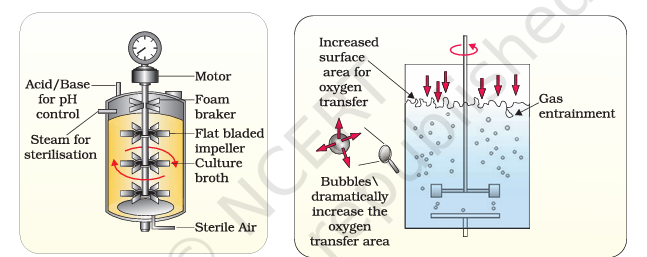
Consider the bioreactor environment. Why is the precise provision of substrates and salts critical for achieving the desired product?
QUESTION 9 OF 20
Based on the image and your understanding, which of the following is NOT an advantage of the cylindrical/curved shape of the stirred-tank bioreactor?
QUESTION 10 OF 20
Analyzing the image of the simple stirred-tank bioreactor, the flat-bladed impeller serves primarily to:
QUESTION 11 OF 20
A scientist uses the sampling port of a bioreactor midway through the log phase. What analytical outcome is she most likely checking? Options:
QUESTION 1 OF 20
2
Match the bioreactor monitoring system with the negative consequence of its failure:
| Column I | Column II |
|---|---|
| 1. Foam control failure | P. Cells die due to anaerobic conditions |
| 2. pH control failure | Q. Inability to monitor active growth phase progress |
| 3. Oxygen delivery failure | R. Culture overflows or blocks exhaust filters |
| 4. Sampling port failure | S. Denaturation of enzymes or halted metabolism |
QUESTION 13 OF 20
QUESTION 14 OF 20
QUESTION 15 OF 20
Arrange the steps of obtaining a marketed biotechnological product logically: Options:
QUESTION 16 OF 20
Why are separation and purification collectively critical (downstream processing) before product formulation? Options:
QUESTION 17 OF 20
Which of the following statements about product formulation is NOT true? Options:
QUESTION 18 OF 20
Consider the journey of a recombinant protein from DNA insertion to a finished marketing material. Which step represents the transition from a 'purified biochemical' to a 'market-ready drug'? Options:
QUESTION 19 OF 20
Clinical trials for biotechnological products like drugs are mandatory. What analytical deduction can be made if a recombinant drug fails clinical trials despite perfect downstream processing? Options:
QUESTION 20 OF 20
The NCERT text states, "The downstream processing and quality control testing vary from product to product." If a scientist produces both a recombinant industrial enzyme (e.g., for detergents) and a recombinant human hormone (e.g., insulin), how will their quality control testing realistically differ based on this principle? Options:
Test Complete!
Answer Review
1 Arrange the following steps necessary to express a recombinant protein in a heterologous host:
I. Culturing the host cells in a medium at large scale.
II. Introduction of the ligated DNA into recipient competent cells.
III. Ligation of the DNA fragment into a vector. IV. Extraction of the desired recombinant protein.
First, create the recombinant DNA (Ligation). Second, transform the host (Introduction). Third, grow the host (Culturing). Finally, recover the product (Extraction).
The standard workflow for recombinant protein production starts with constructing the recombinant vector (Ligation, III). Next, this DNA is introduced into a host cell (Transformation/Introduction, II). Once transformed, these cells are cultured at scale (I) to produce the protein, which is then harvested and purified (Extraction, IV).
- Option B → Suggests introducing DNA before creating the recombinant vector.
- Option C → Suggests culturing before introducing the DNA.
- Option D → Suggests culturing before even creating the recombinant vector.
Used Substitution
Application: Order the steps based on the logical progression from gene manipulation to final product.
Final Logic: Vector Construction → Transformation → Scale-up → Product Recovery.
"Ligate → Transform → Grow → Harvest."
2 Consider the following statements regarding the expression of foreign genes:
I. The ultimate aim of recombinant technologies is to produce a desirable protein.
II. The expression of foreign genes in host cells requires optimizing conditions to induce target protein production.
III. Plasmids in the host cell must be eliminated before the recombinant protein can be produced. Which of the statements is/are correct?
Statement I: Correct, goal is product. Statement II: Correct, optimal conditions are needed. Statement III: Incorrect, plasmids are the vectors carrying the gene; they are required.
The goal of biotechnology is the production of functional proteins (I). Host cells require specific conditions (pH, temp, nutrients) to maximize protein expression (II). Statement III is false because the plasmid (vector) is essential for maintaining and expressing the foreign gene inside the host cell.
- Option A → Fails to include the correct statement II.
- Option B → Includes the incorrect statement III.
- Option D → Includes the incorrect statement III.
Used Elimination
Application: Eliminate statements containing biological inaccuracies (Statement III).
Final Logic: Plasmids are the vehicle for expression, not an impurity to be removed.
"Goal = Protein; Condition = Optimized; Vector = Essential."
3 Match the state of the culture system with its resultant cell phase:
| Column I | Column II |
|---|---|
| 1. Closed system, no nutrients added | P. Cells die or fail to grow |
| 2. Fresh medium continuously added, used drained | Q. Cells enter active exponential phase |
| 3. Sudden heat shock (42°C) applied | R. Cells eventually reach stationary/decline phase |
| 4. Addition of ampicillin to non-recombinants | S. Cells temporarily open membrane pores |
1-R: Batch culture exhaustion leads to decline. 2-Q: Continuous culture maintains log phase. 3-S: Heat shock creates competence. 4-P: Antibiotics kill non-transformants.
Batch systems (1) eventually run out of resources and enter decline (R). Continuous culture systems (2) are designed to maintain the log phase (Q). Heat shock (3) is the standard method to induce DNA uptake (competence) by opening membrane pores (S). Non-recombinants lack resistance and die in the presence of antibiotics (P).
- Options B, C, D → Incorrect mappings that contradict standard biotechnological principles.
Used Option Grouping
Application: Match each process to its well-defined biological outcome.
Final Logic: Logical cause-and-effect pairing.
"Batch=Decline; Continuous=Log; Heat=Pores; Antibiotic=Kill."
4 Consider the following statements:
I. Maintaining cells in the log phase ensures they are metabolically most active.
II. A continuous culture system produces a lower biomass than a batch culture.
III. The exponential phase leads to higher yields of desired protein. Which of the statements above is/are true?
Statement I: Correct, log phase is high-growth. Statement II: Incorrect, continuous culture produces more biomass. Statement III: Correct, log phase correlates with high yield.
Log phase is the period of maximal growth/metabolic activity (I). Continuous culture is specifically used to produce higher biomass (II is false). Higher biomass and metabolic activity correlate with increased protein yield (III).
- Option A → Includes the false statement II.
- Option C → Includes the false statement II.
- Option D → Includes the false statement II.
Used Elimination
Application: Eliminate the statement regarding biomass that contradicts the passage/text (Statement II).
Final Logic: Continuous = High Biomass; Batch = Limited Biomass.
"Log = Active/Yield; Continuous = More Biomass."
5 Which of the following does NOT represent a direct limitation of small volume cultures compared to large bioreactors?
The host's translation machinery is functional in both small and large volumes. Volume does not change the internal biology of the cell. A, B, and D are real limitations of scale.
Host cells are capable of translation in any volume. The limitations of small volumes are purely physical and operational (yield, automation, maintenance of conditions). Protein synthesis failure would be a genetic issue, not a volume issue.
- Option A → Commercial volume requires liters, not milliliters.
- Option B → Manual maintenance of large batches is impractical.
- Option D → Automation is essential for high-volume consistency.
Used Odd One Out
Application: Categorize options as "Engineering/Scale limitations" vs. "Biological/Genetic limitations."
Final Logic: The biology works the same; only the environment changes.
"Scale changes environment, not translation."
6 A biotechnology company wants to scale up an enzyme production process. If they switch from a 5-litre flask to a 500-litre bioreactor, what fundamental shift occurs in the process dynamics?
Scaling up is about control, not changing the genetics or organism. Bioreactors are defined by their "controlled conditions." Downstream processing remains essential.
The primary function of a bioreactor is to transform raw materials into products by optimizing and controlling environmental parameters like pH, temperature, and aeration at a scale that is impossible to achieve in a flask.
- Option A → You use the same engineered strain.
- Option C → The construct remains the same.
- Option D → DSP is always required to isolate the protein.
Used Substitution
Application: Replace "scale-up" with "process optimization/control."
Final Logic: Scale-up = Better Control/Environment.
"Bioreactor = Environment Optimizer."
7 Which of the following parameters, if NOT carefully controlled by a bioreactor, would result in the immediate denaturation of the recombinant proteins being synthesized?
Denaturation is the loss of 3D protein structure. Temperature is the primary physical factor that causes denaturation. Vitamins and substrates affect growth, not necessarily folding stability.
Proteins are highly sensitive to thermal energy. If the temperature exceeds the specific optimal threshold, the weak bonds holding the 3D protein structure together break, causing the protein to unfold (denature) and become non-functional.
- Option A → Affects metabolic health/growth.
- Option B → Affects respiration/yield.
- Option D → Affects nutritional state/biomass.
Used Extreme Word Filter
Application: Link the term "denaturation" specifically to its physical cause, which is heat.
Final Logic: Denaturation = Heat sensitivity.
"Too hot = Denatured."
8 Consider the bioreactor environment. Why is the precise provision of substrates and salts critical for achieving the desired product?
Substrates = Food (Energy). Salts = Essential for enzymatic activity (cofactors/osmolarity). This is standard cellular biology.
Substrates (like glucose) are the fuel for cellular respiration and biosynthetic pathways. Salts (ions) are essential for osmotic balance and as critical cofactors for many enzymes involved in the expression of the recombinant gene.
- Option A → Incorrect, enzymes/vectors are biological tools, not nutrients.
- Option C → Irrelevant to the bioreactor growth phase.
- Option D → Incorrect, heat shock is a transformation method, not a growth result.
Used Substitution
Application: Connect "Substrate/Salt" with "Cellular metabolic needs."
Final Logic: Substrate = Energy; Salts = Enzyme Cofactors.
"Substrate = Fuel; Salts = Helpers."
9 Based on the image and your understanding, which of the following is NOT an advantage of the cylindrical/curved shape of the stirred-tank bioreactor?
Plasmids are created through genetic engineering, not by the shape of the tank. The shape is for physical mixing (fluid dynamics). A, B, and D are legitimate fluid dynamic advantages.
The cylindrical shape is an engineering solution for liquid management. It has no biological capacity to generate DNA or plasmids—that is an intracellular genetic event that the bioreactor supports, not creates.
- Options A, B, D → These are all standard engineering reasons for utilizing a curved/cylindrical tank.
Used Elimination
Application: Eliminate engineering/mixing advantages to find the biological impossibility.
Final Logic: Shape = Fluid mixing; Plasmid creation = Genetic engineering.
"Curved = Mixing; Not DNA creation."
10 Analyzing the image of the simple stirred-tank bioreactor, the flat-bladed impeller serves primarily to:
Impeller = Mixing tool. Mixing helps distribute $O_2$ and foam control. A, C, and D are unrelated lab procedures.
The agitator (impeller) serves two major mechanical purposes: ensuring homogeneity of nutrients and oxygen throughout the tank and physically disrupting large bubbles/foam to prevent buildup at the top of the reactor.
- Option A → Function of restriction enzymes.
- Option C → Function of a gene gun.
- Option D → Function of chromatography/filtration.
Used Substitution
Application: Define "Impeller" as a "mechanical mixer."
Final Logic: Impeller = Mixing + Foam disruption.
"Impeller = Mix + Foam-break."
11 A scientist uses the sampling port of a bioreactor midway through the log phase. What analytical outcome is she most likely checking? Options:
Sampling allows monitoring growth progress. Log phase is when protein production is active. Testing density confirms the culture is healthy and productive.
The sampling port is used to withdraw small aliquots during the biosynthetic stage. Checking biomass (cell count) and protein concentration confirms that the cells are healthy and producing the target protein as expected, which is essential to determine when to harvest.
- Option A → Restriction enzymes are used in the initial "tools" stage, not during bioreactor growth.
- Option C → Downstream processing happens after harvesting, not midway through growth.
- Option D → Clinical testing is performed on the final, formulated drug, not midway through culture.
Used Contextual/Tonal Matching Application: Align "sampling" with the "Biosynthetic/Growth stage" of the workflow. Final Logic: Sampling = Checking the status of the ongoing growth.
"Sampling = Checking the pulse of the culture."
1 2
Match the bioreactor monitoring system with the negative consequence of its failure:
| Column I | Column II |
|---|---|
| 1. Foam control failure | P. Cells die due to anaerobic conditions |
| 2. pH control failure | Q. Inability to monitor active growth phase progress |
| 3. Oxygen delivery failure | R. Culture overflows or blocks exhaust filters |
| 4. Sampling port failure | S. Denaturation of enzymes or halted metabolism |
Foam failure (R) leads to overflow. pH failure (S) denatures proteins. Oxygen failure (P) leads to anaerobic death. Sampling failure (Q) stops monitoring.
Each component has a critical role: foam control prevents overflow (R), pH maintenance prevents denaturation/metabolic halt (S), aeration prevents anaerobic conditions (P), and the sampling port is the only way to monitor progress (Q).
- Options B, C, D → Misalign the physical control failure with its logical biological/process impact.
Used Option Grouping Application: Direct mapping of control systems to their respective process outcomes. Final Logic: A is the only mapping that follows logical bioreactor dynamics.
"Foam=Overflow; pH=Metabolism; Oxygen=Anaerobic; Sampling=Monitor."
13
The passage states: "Alternatively air can be bubbled through the reactor." This is a direct extraction of the text. Bubbling is a method for aeration.
The passage explicitly identifies air bubbling as an alternative to the mechanical stirrer for enhancing oxygen transfer and ensuring uniform availability of oxygen throughout the culture medium.
- Option A → Continuous drainage is for nutrition/toxin management, not primarily for oxygen.
- Option C → Extraction is a harvest step, not a growth condition.
- Option D → Foam control manages surface levels, not oxygen supply.
Used Substitution Application: Quote-check the provided passage for the keyword "alternative" regarding oxygen. Final Logic: Passage = "Alternatively air can be bubbled".
"Passage says: Bubble = Oxygen."
14
The passage discusses the growth phase (bioreactor). It does not mention downstream processing (purification). Downstream processing is a separate chapter/stage.
The passage limits its scope to the bioreactor environment: providing growth conditions (A), the shape of the tank (B), and mixing/aeration functions (D). Downstream purification is a process that occurs after the contents leave the bioreactor; it is not a feature of the reactor itself.
- Options A, B, D → All are explicitly stated in the provided passage.
Used Elimination Application: Verify each option against the specific text of the provided passage. Final Logic: Passage covers growth, not downstream purification.
"Passage = Growth Tank, not Purification."
15 Arrange the steps of obtaining a marketed biotechnological product logically: Options:
IV: Small scale extraction/preparation. I: Expression at scale in bioreactor. II: Separation (Downstream). III: Formulation.
The workflow begins with small-scale extraction/cloning (IV), followed by expression in the bioreactor at scale (I). The product is then separated/purified (II), and finally formulated for the market (III).
- Options B, C, D → Incorrect logical sequences of the biotechnology pipeline.
Used Substitution Application: Order the steps based on the standard Biotechnology workflow. Final Logic: Lab Work → Bioreactor → Cleanup → Formulation.
"Lab -> Reactor -> Cleanup -> Market."
16 Why are separation and purification collectively critical (downstream processing) before product formulation? Options:
The bioreactor broth is a "dirty" mixture. The product must be isolated from waste. Purification is the only way to get pure protein.
The bioreactor output is not a pure drug; it is a complex soup of cellular debris, metabolites, and medium residues. Downstream processing (DSP) is the systematic recovery and purification of the target protein from this complex mixture.
- Option B → Selectable markers (antibiotics) are used in the early cloning stage.
- Option C → This refers to transformation.
- Option D → This is a genetic cloning technique, not purification.
Used Substitution Application: Define "Downstream Processing" as "cleaning up a complex mixture." Final Logic: Bioreactor output = Mixture; DSP = Isolation.
"Bioreactor = Mixture; DSP = Pure."
17 Which of the following statements about product formulation is NOT true? Options:
Upstream is the "getting it ready/growing" phase. Formulation is the "end/finish" phase (Downstream). So, C is false.
Upstream processing refers to the stages before and during the growth of the cell culture (e.g., cloning, bioreactor growth). Product formulation is a final, post-purification step, making it part of the downstream processing sequence, not upstream.
- Option A → Formulation happens after purification (True).
- Option B → Preservatives are needed for stability (True).
- Option D → The product must be formulated before final testing (True).
Used Extreme Word Filter Application: Distinguish "Upstream" (Growth/Preparation) from "Downstream" (Final Product/Purification). Final Logic: Formulation is Downstream, not Upstream.
"Upstream = Growth; Downstream = Cleanup/Finishing."
18 Consider the journey of a recombinant protein from DNA insertion to a finished marketing material. Which step represents the transition from a 'purified biochemical' to a 'market-ready drug'? Options:
Formulation and testing turn a chemical into a drug. Other options are lab tools or growth steps.
A purified protein is just a biochemical. To be a "market-ready drug," it must be stabilized for human storage (Formulation) and verified for safety in humans (Clinical Trials).
- Option A → Early genetic engineering tool.
- Option B → Biosynthetic growth phase.
- Option D → Laboratory analytical step.
Used Contextual/Tonal Matching Application: Match "market-ready" with the steps involving patient safety and storage (Formulation/Trials). Final Logic: Formulation + Trials = Drug safety.
"Formulation + Trials = Market."
19 Clinical trials for biotechnological products like drugs are mandatory. What analytical deduction can be made if a recombinant drug fails clinical trials despite perfect downstream processing? Options:
Clinical trials test the drug in human systems. A drug can be pure (DSP) but still not work or be toxic. Other options are irrelevant to clinical trial outcomes.
Clinical trials assess the therapeutic impact and safety in a living human system. A protein might be perfectly pure but still cause an immune response, fail to perform its biological function in vivo, or show side effects that weren't visible in pure chemical form.
- Option A, C, D → These are early process issues, not clinical trial issues.
Used Substitution Application: Define the purpose of clinical trials as "human-level safety and efficacy." Final Logic: Clinical failure = Efficacy or toxicity issues in the patient.
"Clinical Fail = Doesn't work or causes harm."
20 The NCERT text states, "The downstream processing and quality control testing vary from product to product." If a scientist produces both a recombinant industrial enzyme (e.g., for detergents) and a recombinant human hormone (e.g., insulin), how will their quality control testing realistically differ based on this principle? Options:
Drug products must meet human safety standards. Industrial products must meet performance standards. The end-use dictates the testing rigor.
Quality control is context-dependent. Human-administered drugs (insulin) must pass stringent clinical safety and purity tests to ensure they don't harm the human immune system. Industrial products (detergent enzymes) prioritize performance (catalytic efficiency) and physical stability (shelf-life in detergents).
- Option A → Detergents don't need clinical trials.
- Option C → QC is mandatory for everything.
- Option D → DSP varies significantly by target product.
Used Substitution Application: Distinguish "Human drug requirements" vs. "Industrial product requirements." Final Logic: Human use = High safety barrier; Industrial = High performance barrier.
"Human = Safety; Industrial = Performance."