
CUET UG Biology Booster Test 3 Adaptive Radiation and Population Genetics
📌 Answers are locked once submitted — results and explanations appear at the end.
QUESTION 1 OF 20
Match the evolutionary concept with its corresponding role:
| List I | List II |
|---|---|
| 1. Built-in variation | a. Enabled finches to radiate into vegetarian and insectivorous forms |
| 2. Adaptive radiation | b. Formed the basis for varying characteristics within a population |
| 3. Common ancestor | c. Gave rise to multiple species adapted to different ecological niches |
| 4. Natural selection | d. Favoured individuals best suited to their environment |
QUESTION 2 OF 20
The rapid evolution of multiple beak types in Darwin's finches starting from a single seed-eating ancestor is the evolutionary consequence of which Darwinian principle?
QUESTION 3 OF 20
Which of the following statements does NOT correctly describe the geographical necessity for adaptive radiation?
QUESTION 4 OF 20
Analytically speaking, if two distinct ancestral lines undergo adaptive radiation in the same isolated geography but occupy similar ecological niches, the end result is termed:
QUESTION 5 OF 20
Arrange the factors that sequentially led to the modern diversity of Australian marsupials:
I. Separation of the Australian landmass (Continental drift).
II. Adaptive radiation within different habitats.
III. Survival and divergence due to lack of placental mammal competition.
IV. Presence of a single ancestral marsupial stock.
QUESTION 6 OF 20
Consider the following statements regarding geographical isolation and evolution:
Statement I: The isolated geographical development of Australia prevented placental mammals from out-competing marsupials.
Statement II: Australian marsupials underwent adaptive radiation identically to placental mammals in South America.
QUESTION 7 OF 20
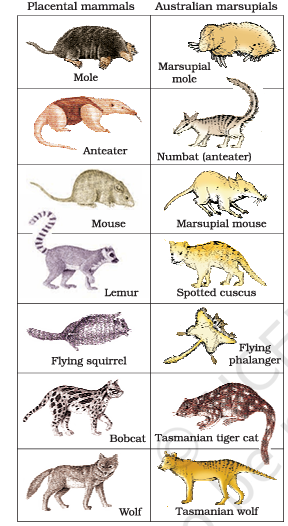
Based on Figure, the parallel evolution of forms like the flying squirrel and the flying phalanger exemplifies:
QUESTION 8 OF 20
According to Figure, the Tasmanian wolf (a marsupial) demonstrates morphological similarities to the placental wolf. This similarity indicates that they:
QUESTION 9 OF 20
Match the Hardy–Weinberg algebraic component with its biological representation in a diploid population.
| List I | List II |
|---|---|
| 1. p² | a. Homozygous recessive genotype (aa) |
| 2. 2pq | b. Homozygous dominant genotype (AA) |
| 3. q² | c. Heterozygous genotype (Aa) |
| 4. p + q | d. Sum of allele frequencies |
QUESTION 10 OF 20
Which of the following is NOT a true implication if the allele frequencies in a population consistently equal 1 (i.e., (p^2 + 2pq + q^2 = 1)) and match expected values exactly?
QUESTION 11 OF 20
Arrange the steps used to deduce evolutionary change using Hardy-Weinberg algebraic foundations:
I. Calculate the expected genotypic frequencies using ((p+q)^2 = 1).
II. Measure the actual frequency of alleles and genotypes in the given population.
III. Interpret the difference (direction) between measured and expected values.
IV. Determine the extent of evolutionary change.
QUESTION 12 OF 20
If the frequency of allele A ((p)) is 0.6 and allele a ((q)) is 0.4, the mathematical difference between the expected frequency of the heterozygous genotype and the homozygous recessive genotype is: (Note: Application of (2pq) vs (q^2))
QUESTION 13 OF 20
Consider the following statements about gene migration:
Statement I: Migration uniquely alters the allele frequency of the new population while maintaining the exact allele frequencies of the old population.
Statement II: If gene migration happens multiple times, it creates a constant gene flow between populations.
QUESTION 14 OF 20
Which of the following conditions is NOT associated with the continuous process of gene flow?
QUESTION 15 OF 20
QUESTION 16 OF 20
QUESTION 17 OF 20
Analytically, stabilizing selection acts to restrict evolutionary change by:
QUESTION 18 OF 20
Which of the following is NOT true regarding disruptive selection?
QUESTION 19 OF 20
While genetic recombination generates variations, how does natural selection ultimately interface with these variations to produce a seemingly "different population"?
QUESTION 20 OF 20
According to the perspectives of early 20th-century population genetics, why did Hugo deVries refer to mutation-driven speciation as "saltation"?
Test Complete!
Answer Review
1 Match the evolutionary concept with its corresponding role:
| List I | List II |
|---|---|
| 1. Built-in variation | a. Enabled finches to radiate into vegetarian and insectivorous forms |
| 2. Adaptive radiation | b. Formed the basis for varying characteristics within a population |
| 3. Common ancestor | c. Gave rise to multiple species adapted to different ecological niches |
| 4. Natural selection | d. Favoured individuals best suited to their environment |
Built-in variation provides the raw material for evolution. Adaptive radiation results in diversification into different ecological niches. A common ancestor gives rise to related species. Natural selection favours individuals with advantageous traits.
The correct matching is: According to NCERT, built-in variation among individuals provides the raw material on which evolution acts. Adaptive radiation is the evolution of different species from a common ancestor to occupy diverse ecological niches, as seen in Darwin's finches on the Galápagos Islands. These finches evolved different beak types suited to various food sources such as seeds, insects, and vegetation. Natural selection preserves favourable variations, leading to the survival and reproduction of the fittest individuals. Therefore, the correct matching is 1-b, 2-a, 3-c, 4-d.
- Option B → Incorrectly reverses the roles of built-in variation and adaptive radiation.
- Option C → Incorrectly matches common ancestor and natural selection.
- Option D → Misaligns all the evolutionary concepts with their functions.
Used: Concept Matching
Application: Associate each evolutionary concept with its specific role in Darwin's explanation of adaptive radiation.
Final Logic:
- Variation → Raw material
- Adaptive radiation → Diversification
- Common ancestor → Origin of related species
- Natural selection → Survival of the fittest
"Variation Begins, Radiation Branches, Ancestor Starts, Selection Sustains."
2 The rapid evolution of multiple beak types in Darwin's finches starting from a single seed-eating ancestor is the evolutionary consequence of which Darwinian principle?
Natural selection favors individuals who utilize resources efficiently. Resource competition drives niche specialization (beak types). Fitness increases in new niches, leading to speciation.
Darwin's theory of natural selection is centered on competition. When finches faced competition for seeds, those with beak variations capable of exploiting other resources (insects, fruits) had better survival and reproductive success. This is a classic example of adaptive radiation driven by competitive exclusion and resource partitioning.
- Option A → Saltation is De Vries' theory of single-step large mutations, not gradual adaptive radiation.
- Option C → Spontaneous generation is a disproven theory of life's origin, not evolution.
- Option D → Mutations are random, not "intentional" acts by the organism.
Used: Elimination
Application: Options A, C, and D are scientifically incorrect or irrelevant to Darwinian natural selection principles.
Final Logic: Natural selection is driven by survival and reproductive fitness based on niche exploitation.
"Darwin = Survival of the fittest" through "Resource utilization."
3 Which of the following statements does NOT correctly describe the geographical necessity for adaptive radiation?
Adaptive radiation usually requires isolation or distinct niches, not necessarily migration across "connected mega-continents." Continental connection usually leads to homogenization, not radiation. Radiation is most successful in isolated areas (e.g., Galapagos, Australia).
Adaptive radiation is the development of many species from a common ancestor in a specific geographic area (like an island). Migration across connected continents would likely lead to competition or interbreeding, not the specific habitat-driven radiation seen in isolated environments.
- Option A → A starting point (ancestor) is essential for radiation.
- Option C → Occupying different habitats is the definition of the process.
- Option D → Repeated radiations can occur in isolated clusters.
Used: Extreme Word Filter
Application: The phrase "globally connected mega-continents" contrasts sharply with the "isolated" or "niche-specific" nature of radiation.
Final Logic: Isolation is the primary driver; connection is the opposite of isolation.
"Radiation needs Isolation": Keep them apart to evolve apart.
4 Analytically speaking, if two distinct ancestral lines undergo adaptive radiation in the same isolated geography but occupy similar ecological niches, the end result is termed:
Different ancestors (distinct lines). Same environment/niche. Similar adaptations = Convergent evolution.
When different species (from different ancestors) evolve similar traits to suit the same ecological niche, it is known as convergent evolution. This is distinct from adaptive radiation, which describes how one ancestor becomes many species.
- Option A → Genetic equilibrium refers to Hardy-Weinberg stability.
- Option B → Branching descent is the result of adaptive radiation from one ancestor.
- Option D → Founder effect refers to the loss of genetic variation in a new, small population.
Used: Substitution
Application: Substitute "distinct ancestral lines" + "same niche" with the classic example: "Placental and Marsupial mammals." This equates to convergent evolution.
Final Logic: Convergent evolution is defined by different origins + similar end-points.
"Convergent = Coming together" in form, despite starting apart.
5 Arrange the factors that sequentially led to the modern diversity of Australian marsupials:
I. Separation of the Australian landmass (Continental drift).
II. Adaptive radiation within different habitats.
III. Survival and divergence due to lack of placental mammal competition.
IV. Presence of a single ancestral marsupial stock.
Step 1: Start with the ancestor (IV). Step 2: Isolate the area via drift (I). Step 3: Lack of competition allows survival (III). Step 4: Diversify into niches (II).
First, you must have an ancestral stock (IV). Then, the separation of Australia (I) acts as the catalyst for isolation. In this isolation, because placental mammals are absent (III), the marsupials are free to fill all ecological niches, leading to adaptive radiation (II).
- Options B, C, D → Misorder the causal flow of the evolutionary process.
Used: Contextual/Tonal Matching
Application: Logically order the evolutionary narrative: Ancestor -> Barrier -> Niche freedom -> Diversification.
Final Logic: Evolution requires an ancestor, a barrier, and then a mechanism for diversification.
"A-I-S-D" (Ancestor, Isolation, Survival, Diversification).
6 Consider the following statements regarding geographical isolation and evolution:
Statement I: The isolated geographical development of Australia prevented placental mammals from out-competing marsupials.
Statement II: Australian marsupials underwent adaptive radiation identically to placental mammals in South America.
Statement I: Correct, isolation is the reason marsupials exist today. Statement II: Incorrect, the radiation was parallel (convergent), but not "identical" (different groups).
Statement I is accurate: isolation provided a refuge. Statement II is incorrect because marsupials and placentals are different groups; while they show convergent evolution, their evolutionary pathways and developmental mechanisms are unique to their respective groups.
- Option B → Incorrectly labels Statement I as false.
- Option C → Incorrectly assumes identical evolutionary pathways.
- Option D → Incorrectly assumes both are false.
Used: Elimination
Application: Statement I is a foundational evolutionary fact (True). Statement II claims "identically," which is a hallmark of false absolute statements in biology.
Final Logic: T + F = A.
"Identical = Impossible in evolution."
7 Based on Figure, the parallel evolution of forms like the flying squirrel and the flying phalanger exemplifies:
Flying squirrel (Placental) and Flying phalanger (Marsupial) are different lines. They share similar adaptations (gliding). This is the definition of convergent evolution.
This is the textbook example of convergent evolution. Two different subclasses of mammals (Placentals and Marsupials) evolved to solve the same ecological problem (getting around in trees) using the same solution (gliding), proving that similar selective pressures lead to similar morphologies.
- Option A → Genetic drift is a random change, not a selective adaptation.
- Option C → Founder effect is about the genetic bottleneck at colonization.
- Option D → Migration does not explain the convergent morphological similarity.
Used: Substitution
Application: The "flying squirrel vs. phalanger" example is the standard visual aid for Convergent Evolution in NCERT.
Final Logic: Different lineages + Similar environment = Convergence.
"Squirrel vs. Phalanger = Convergent Pair."
8 According to Figure, the Tasmanian wolf (a marsupial) demonstrates morphological similarities to the placental wolf. This similarity indicates that they:
Tasmanian wolf and placental wolf are not closely related (analogous). Similar niches create similar body shapes (selective pressure). This is the definition of analogy in convergent evolution.
These organisms are unrelated; their similarity is "analogous" (similar function/shape, different underlying structure). This occurs because they both function as predators in their respective environments, subjecting them to the same evolutionary "selective pressures."
- Option A → They are very distant relatives (Marsupials vs Placentals diverged long ago).
- Option B → They were separated by continental drift.
- Option D → Adaptive radiation from a single ancestor would mean they are related, which they are not.
Used: Contextual/Tonal Matching
Application: The term "analogous" is the key to identifying evolution in distant groups.
Final Logic: Analogous = Different origin, similar function (convergent).
"Analogous = Adapted" (by pressure, not by blood).
9 Match the Hardy–Weinberg algebraic component with its biological representation in a diploid population.
| List I | List II |
|---|---|
| 1. p² | a. Homozygous recessive genotype (aa) |
| 2. 2pq | b. Homozygous dominant genotype (AA) |
| 3. q² | c. Heterozygous genotype (Aa) |
| 4. p + q | d. Sum of allele frequencies |
p² represents the frequency of homozygous dominant individuals. 2pq represents the frequency of heterozygotes. q² represents the frequency of homozygous recessive individuals. p + q = 1 represents the total allele frequency.
The Hardy–Weinberg principle states that in a large, randomly mating population with no mutation, migration, natural selection, or genetic drift, allele frequencies remain constant from generation to generation. The equilibrium is expressed as: (p + q)² = p² + 2pq + q² = 1
- Option B → Incorrectly assigns genotype frequencies to the wrong algebraic terms.
- Option C → Incorrectly matches allele frequency and genotype frequency.
- Option D → Incorrectly associates heterozygous and recessive genotype frequencies.
Used: Formula Interpretation
Application: Interpret each term of the Hardy–Weinberg equation biologically.
Final Logic:
- p² → AA
- 2pq → Aa
- q² → aa
- p + q → Total allele frequency
p + q = Sum of Alleles
10 Which of the following is NOT a true implication if the allele frequencies in a population consistently equal 1 (i.e., (p^2 + 2pq + q^2 = 1)) and match expected values exactly?
Equilibrium means no change. If frequencies match expected values, no evolution is happening. Statement B claims change is happening, which contradicts equilibrium.
When Hardy-Weinberg conditions are met, the allele frequencies and genotype frequencies remain constant. If they remain constant, evolution is not occurring. Thus, claiming evolution is "actively taking place" is false.
- Option A → The math confirms the equilibrium.
- Option C → "Constant gene pool" is the definition of H-W.
- Option D → If natural selection/drift were active, the frequencies would shift, violating the equilibrium.
Used: Elimination
Application: Look for the statement that contradicts the definition of equilibrium. B is the direct contradiction.
Final Logic: Equilibrium = Static = No Evolution.
"H-W Equilibrium = No Evolution."
11 Arrange the steps used to deduce evolutionary change using Hardy-Weinberg algebraic foundations:
I. Calculate the expected genotypic frequencies using ((p+q)^2 = 1).
II. Measure the actual frequency of alleles and genotypes in the given population.
III. Interpret the difference (direction) between measured and expected values.
IV. Determine the extent of evolutionary change.
First, collect real-world data (II). Second, calculate the theoretical H-W expectation (I). Third, compare them (III). Fourth, conclude how much the population has evolved (IV).
To identify evolutionary change, you must first establish the "actual" (measured) state of the population (II). You then use the H-W model to calculate what the population would look like if it were in equilibrium (I). By comparing the difference between actual and expected (III), you can quantitatively determine the extent of the deviation, which equates to the magnitude of evolutionary change (IV).
- Option A → Starting with calculation (I) before having actual population data (II) is impossible.
- Option C → Interpreting differences (III) before calculating the expectation (I) is illogical.
- Option D → Again, places the theory (I) before the observation (II).
Used: Substitution
Application: Follow the scientific method: Observation -> Model -> Comparison -> Conclusion.
Final Logic: Real-world observation (II) must precede theoretical calculation (I).
"Observe -> Predict -> Compare -> Conclude."
12 If the frequency of allele A ((p)) is 0.6 and allele a ((q)) is 0.4, the mathematical difference between the expected frequency of the heterozygous genotype and the homozygous recessive genotype is: (Note: Application of (2pq) vs (q^2))
p = 0.6, q = 0.4. Heterozygous frequency (2pq) = 2 × 0.6 × 0.4 = 0.48. Homozygous recessive frequency (q²) = 0.4 × 0.4 = 0.16. Difference = 0.48 − 0.16 = 0.32.
Using the Hardy–Weinberg formula, 2pq = 2 × 0.6 × 0.4 = 0.48. The homozygous recessive genotype frequency is q² = 0.4 × 0.4 = 0.16. Therefore, the required difference is: 2pq − q² = 0.48 − 0.16 = 0.32.
- Option B, C, and D → Represent incorrect calculations of 2pq or q².
Used: Dimensional/Unit Analysis
Application: Apply the algebra directly: p = 0.6 and q = 0.4. Then, 2(0.6)(0.4) = 0.48 and (0.4)² = 0.16. Subtracting gives 0.32.
Final Logic: Precise application of H-W values confirms A.
"2pq = 0.48, q^2 = 0.16": Simple multiplication.
13 Consider the following statements about gene migration:
Statement I: Migration uniquely alters the allele frequency of the new population while maintaining the exact allele frequencies of the old population.
Statement II: If gene migration happens multiple times, it creates a constant gene flow between populations.
Statement I: False, migration changes allele frequencies in both the donor and recipient populations (gene pool shifts). Statement II: True, repeating migration equals continuous gene flow.
Statement I is incorrect because migration involves moving individuals (and their alleles) out of one group and into another. This loss in the old population must change its allele frequency. Statement II is correct: frequent migration between two populations is the literal definition of continuous gene flow.
- Option A → Incorrectly validates Statement I.
- Option C → Incorrectly assumes migration doesn't affect the donor.
- Option D → Fails to acknowledge the accuracy of Statement II.
Used: Elimination
Application: Analyze Statement I: Does moving people out affect the source? Yes, it changes the ratio. Therefore I is false. Eliminate A and C.
Final Logic: If I is false and II is logically sound, B is the only path.
"Migration = Change for both sides."
14 Which of the following conditions is NOT associated with the continuous process of gene flow?
Gene flow is the mixing of populations. Strict isolation is the prevention of gene flow. C describes the opposite of gene flow.
Gene flow acts to homogenize populations (make them more similar) by transferring alleles. Strict isolation prevents this transfer, keeping the gene pool static. Therefore, C is fundamentally incompatible with the concept of gene flow.
- Option A, B, D → These are all direct characteristics/consequences of gene flow.
Used: Odd One Out
Application: A, B, and D all describe "moving/mixing" (flow). C describes "staying still" (isolation).
Final Logic: Isolation contradicts Flow.
"Flow = Mixing; Isolation = Static."
15
Natural selection = Adaptive, fitness-based. Genetic drift = Stochastic, chance-based. The passage defines drift as "happening by chance."
The passage explicitly states, "If the same change occurs by chance, it is called genetic drift." Natural selection, by contrast, is not random; it selects for traits that enhance survival and reproduction.
- Option B → Genetic drift is more common in small populations, often isolated, not necessarily high gene flow.
- Option C → The passage states drift can lead to new species.
- Option D → Genetic drift is habitat-independent.
Used: Contextual/Tonal Matching
Application: Match the passage's definition ("by chance") with Option A.
Final Logic: Chance = Drift; Fitness = Selection.
"Drift = Luck (Chance); Selection = Skill (Fitness)."
16
Founder effect = A small group starts a new population. Their limited allele set becomes the "new normal." This facilitates speciation (as noted in the passage).
The passage states, "The original drifted population becomes founders... change in allele frequency is so different... they become a different species." This means the unique, chance-driven allele mix of this small group acts as the genetic foundation for the emerging species.
- Option A → Drift creates deviation, it does not mirror the original exactly.
- Option C → Founders are usually geographically or reproductively isolated, preventing interbreeding.
- Option D → Drift disrupts H-W equilibrium; it doesn't stabilize it.
Used: Contextual/Tonal Matching
Application: Look at the passage's concluding sentence linking "founders" to "different species."
Final Logic: Founders create the baseline for the new group.
"Founder = New Baseline."
17 Analytically, stabilizing selection acts to restrict evolutionary change by:
Stabilizing selection = "Middle is best." It eliminates extremes (too big/too small). Result: Population stays at the mean.
Stabilizing selection is a mode of natural selection that reduces variation. It selects against the extremes (periphery) and supports the central phenotype (the mean), effectively preventing significant shifts in the population mean.
- Option A → Describes directional selection.
- Option C → Describes disruptive selection.
- Option D → Describes disruptive selection (selecting against the mean).
Used: Substitution
Application: Substitute "Stabilizing" with "Average-supporting."
Final Logic: Stabilizing = Selecting the average.
"Stabilizing = Sticking to the middle."
18 Which of the following is NOT true regarding disruptive selection?
Disruptive selection = "Extremes are best." Mean is selected against. D describes stabilizing selection, not disruptive.
Disruptive selection favors both ends of the spectrum and selects against the mean. Therefore, saying it leads to convergence on the mean is the opposite of the truth.
- Option A, B, C → These are all true descriptions of the disruptive process.
Used: Extreme Word Filter
Application: Disruptive selection disrupts the mean, so D is clearly the incorrect statement requested by the question.
Final Logic: Disruptive = Extremes; Stabilizing = Mean.
"Disruptive = Split the middle."
19 While genetic recombination generates variations, how does natural selection ultimately interface with these variations to produce a seemingly "different population"?
Recombination = Source of raw variety. Selection = Sieve that chooses variety. Selection works by promoting survival and reproduction of specific variants.
Natural selection acts as the filter. It works by identifying which variations (generated by recombination) provide a survival or reproductive advantage, effectively increasing the frequency of those specific variants in the next generation.
- Option A → Random survival is drift, not selection.
- Option B → Mutations/recombination aren't "mutated back."
- Option D → Migration is gene flow, not natural selection.
Used: Contextual/Tonal Matching
Application: Select the option that defines Natural Selection (Differential reproductive success).
Final Logic: Variation + Reproductive Advantage = Selection.
"Selection = Success."
20 According to the perspectives of early 20th-century population genetics, why did Hugo deVries refer to mutation-driven speciation as "saltation"?
De Vries' Mutation Theory = "Saltation" (Leaping). Evolution happens in big jumps (mutations), not small steps. These are random and large.
Hugo de Vries believed that evolution was not gradual. He coined "saltation" (meaning "jump" or "leap") to explain his view that a single, large-scale mutation could suddenly create a new species in one generation.
- Option A → Darwin proposed gradualism; De Vries opposed it.
- Option C → Mutations disrupt, not create, equilibrium.
- Option D → Crossing over is recombination; mutations are distinct events.
Used: Contextual/Tonal Matching
Application: Recall the term "Saltation" = "Leaping/Jump" in evolutionary context.
Final Logic: Saltation = Large, sudden change.
"Saltation = Saltare (Latin for 'to jump') = Mutation Leap."