
CUET UG Biology Booster Test 2- Foundations and Principles of Biotechnology
📌 Answers are locked once submitted — results and explanations appear at the end.
QUESTION 1 OF 20
Concept-Based Single Correct: Why was the traditional approach to understanding natural phenomena, dating back to Rene Descartes, described as "anthropocentric"?
QUESTION 2 OF 20
Match the elements of the EFB definition of biotechnology to their conceptual equivalents:
| Column I | Column II |
|---|---|
| 1. Natural science integration | i. The core processes replacing traditional chemistry |
| 2. Molecular analogues | ii. Applying foundational biology to technological processes |
| 3. Products and services | iii. Artificial or synthesized genetic materials/genes |
| 4. Organisms/Cells | iv. The end goal of biological manufacturing |
QUESTION 3 OF 20
Concept-Based Single Correct: Herbert Boyer's critical observation regarding restriction enzymes from E. coli was that they cut DNA strands in a particular fashion. How did this specific cutting fashion facilitate genetic engineering?
QUESTION 4 OF 20
Negative / Not Associated Type: Which of the following does NOT correctly characterize the contribution of Stanley Cohen to the birth of biotechnology?
QUESTION 5 OF 20
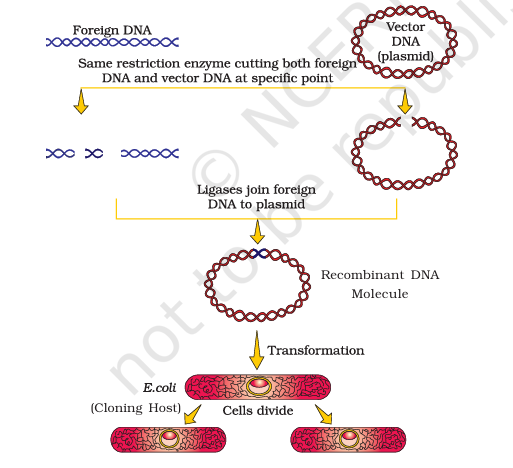
Image-Based MCQ 1: Looking at Figure, which core genetic engineering action is depicted when both the foreign DNA and vector DNA are cleaved before joining?
QUESTION 6 OF 20
Image-Based MCQ 2: Based on Figure, once the recombinant DNA is transferred into E. coli (Cloning Host), why does the subsequent large-scale division (Cells divide) mandate 'bioprocess engineering'?
QUESTION 7 OF 20
Multiple Statement Type: Evaluate the following statements comparing reproduction methods in the context of biotechnology:
I. Asexual reproduction preserves existing genetic information.
II. Sexual reproduction permits variation.
III. Genetic engineering is a subset of sexual reproduction Strategy Used to create unique setups. Which of the statements is/are correct?
QUESTION 8 OF 20
Arrange in Correct Order: Arrange the sequence that demonstrates how genetic engineering overcomes the limitation of traditional hybridization:
1. Introduction of only the desirable set of genes into the target organism.
2. Isolation of one or a specific set of desirable genes.
3. Creation of recombinant DNA and use of gene cloning.
QUESTION 9 OF 20
QUESTION 10 OF 20
QUESTION 11 OF 20
In identifying DNA with desirable genes, which constraints apply to the selected alien DNA piece?
I. It must inherently possess its own 'origin of replication' regardless of the vector.
II. It cannot multiply in progeny cells unless integrated into a replicating chromosome or vector.
III. It will always automatically multiply in any alien organism it is placed in.
QUESTION 12 OF 20
Concept-Based Single Correct: Maintenance of introduced DNA in a host implies that the DNA must not only survive but also be transferred to progeny. This is biologically achieved when the DNA:
QUESTION 13 OF 20
Negative / Not Associated Type: Which of the following outcomes is NOT a direct result of linking an alien DNA to an origin of replication?
QUESTION 14 OF 20
Concept-Based Single Correct: Why is genomic integration (or integration into a replicating plasmid vector) fundamentally important for an alien piece of DNA?
QUESTION 15 OF 20
Negative / Not Associated Type: When utilizing bacterial cells as manufacturing factories, which of the following is NOT a required condition based on bioprocess engineering principles?
QUESTION 16 OF 20
Match the biotechnology step with its corresponding objective in specific protein production:
| Column I | Column II |
|---|---|
| 1. Recombinant DNA formation | i. Isolating the desired protein from large cultures |
| 2. Gene transfer | ii. Making multiple copies of the specific gene inside a host |
| 3. Cloning in Host | iii. Linking a specific gene to a plasmid vector |
| 4. Downstream processing | iv. Introducing the plasmid into a bacterial factory |
QUESTION 17 OF 20
Arrange in Correct Order: While the text lists various applications, logically arrange the underlying conceptual steps that mirror the precision of modern biotech Strategy Used in complex applications like IVF or gene therapy:
Manipulation or precise handling of biological material outside the natural body environment.
Introduction of the biological material back into a target system to achieve a clinical/biological outcome.
Selection of the most viable biological material.
QUESTION 18 OF 20
Negative / Not Associated Type: Which of the following statements misrepresents the scope of modern applications like DNA vaccine development as outlined by EFB's comprehensive view?
QUESTION 19 OF 20
Concept-Based Single Correct: Synthesizing a gene and using it falls under the scope of biotechnology because:
QUESTION 20 OF 20
Concept-Based Single Correct: Correcting a defective gene requires the precise application of genetic engineering. What core technique discussed in the chapter makes this exactness possible?
Test Complete!
Answer Review
1 Concept-Based Single Correct: Why was the traditional approach to understanding natural phenomena, dating back to Rene Descartes, described as "anthropocentric"?
Anthropocentric means human-centered. Traditional science sought to harness nature for human utility. This mindset paved the way for modern technological interventions.
- The anthropocentric approach views nature as a resource to be mastered for human benefit. By directing natural sciences toward developing technologies that increase human comfort and value, humanity laid the foundational conceptual framework that eventually evolved into modern biotechnology.
- Option A → Anthropocentrism is about human benefit, not the conservation of nature for nature's sake.
- Option C → This contradicts the "human-centered" nature of the philosophy.
- Option D → Genetically modified organisms are a modern development, not a feature of traditional philosophy.
Used Contextual/Tonal Matching
Application: Match the definition of "anthropocentric" (human-centered utility) with the option discussing human comfort and value.
Final Logic: B defines the human-centric goal described in the NCERT historical context.
"Anthropocentric = Humans are the Center (of utility)."
2 Match the elements of the EFB definition of biotechnology to their conceptual equivalents:
| Column I | Column II |
|---|---|
| 1. Natural science integration | i. The core processes replacing traditional chemistry |
| 2. Molecular analogues | ii. Applying foundational biology to technological processes |
| 3. Products and services | iii. Artificial or synthesized genetic materials/genes |
| 4. Organisms/Cells | iv. The end goal of biological manufacturing |
Integration = Applying science to tech. Molecular analogues = Synthesized parts/DNA. Products/Services = Result. Organisms/Cells = The "factory" or core process.
- The EFB definition integrates natural science with life forms and molecular tools to create products/services. Mapping: (1-ii) Integration bridges biology and technology; (2-iii) Molecular analogues are synthetic genetic counterparts; (3-iv) Products/Services are the final output; (4-i) Organisms/Cells act as the core manufacturing unit.
- Options B, C, D → These misalign the specific EFB components with their functional definitions provided in the context of biotechnology.
Used Substitution
Application: Identify the clearest link first (e.g., "Products and services" as the goal/output of the process).
Final Logic: A is the only sequence that logically assigns the definitions to the EFB terms.
"Integration-Science, Analogues-Parts, Products-Goal, Cells-Factory."
3 Concept-Based Single Correct: Herbert Boyer's critical observation regarding restriction enzymes from E. coli was that they cut DNA strands in a particular fashion. How did this specific cutting fashion facilitate genetic engineering?
Restriction enzymes cut at specific sites. They often create staggered cuts called "sticky ends." These ends allow DNA ligase to join DNA fragments precisely.
- The discovery of restriction enzymes that produce "sticky ends" (staggered cuts) was monumental because these ends can base-pair with complementary sequences on other DNA fragments. This allows for the precise, site-specific insertion of foreign DNA into a vector.
- Option A → Degrading DNA into nucleotides is the opposite of preserving the gene for engineering.
- Option C → Restriction enzymes act on DNA inside the cell, not the cell wall.
- Option D → DNA replication requires an origin, not just a cut.
Used Substitution
Application: Recall the defining characteristic of restriction enzymes (molecular scissors) creating complementary "sticky ends" for cloning.
Final Logic: B accurately describes the utility of "sticky ends" in genetic engineering.
"Sticky Ends = Molecular Velcro/Paste."
4 Negative / Not Associated Type: Which of the following does NOT correctly characterize the contribution of Stanley Cohen to the birth of biotechnology?
Stanley Cohen worked on plasmids (isolation/insertion). Herbert Boyer discovered the restriction enzyme "sticky end" behavior. This is a classic distinction in the "Cohen & Boyer" history.
- While Cohen and Boyer collaborated, their roles were specific. Herbert Boyer is credited with the restriction enzyme/sticky ends discovery (C), whereas Cohen's primary expertise was in plasmid biology (isolation, reinsertion, and independent replication).
- Option A → Cohen did study plasmid replication independence.
- Option B → Cohen did develop plasmid isolation methods.
- Option D → Cohen did develop plasmid reinsertion techniques.
Used Odd One Out
Application: Recognize the historical division of labor between Cohen (plasmids) and Boyer (enzymes).
Final Logic: C is the contribution attributed to Boyer, not Cohen.
"Cohen = Plasmids, Boyer = Enzymes."
5 Image-Based MCQ 1: Looking at Figure, which core genetic engineering action is depicted when both the foreign DNA and vector DNA are cleaved before joining?
Cutting both with the same enzyme ensures complementary ends. This is the chemical/structural modification step of DNA.
- Using the same restriction enzyme to cleave both the foreign DNA and the plasmid vector ensures that they have complementary, compatible sticky ends. This allows DNA ligase to efficiently join them, effectively altering the DNA chemistry to form a recombinant molecule.
- Option B → Unmodified DNA doesn't form recombinant molecules.
- Option C → This refers to bioreactor conditions, not molecular cutting.
- Option D → Natural replication doesn't involve external cutting/joining of foreign DNA.
Used Contextual/Tonal Matching
Application: Match the process of "cleaving both" to the concept of molecular modification (Genetic Engineering).
Final Logic: A describes the purpose and mechanism of using restriction enzymes in RDT.
"Same Enzyme = Compatible Sticky Ends."
6 Image-Based MCQ 2: Based on Figure, once the recombinant DNA is transferred into E. coli (Cloning Host), why does the subsequent large-scale division (Cells divide) mandate 'bioprocess engineering'?
Bioprocess engineering = Large-scale growth. Needs sterility. Needs to prevent contamination by other microbes.
- Bioprocess engineering is required to provide optimal conditions (sterile, nutrient-rich, oxygenated) for the growth of the engineered host. Maintaining a contamination-free environment is essential to ensure that only the host cells producing the desired protein dominate the bioreactor.
- Option A → Ligase works during the recombinant DNA construction step, not during large-scale fermentation.
- Option C → We don't want or need sexual reproduction for cloning.
- Option D → This is a downstream processing step, not the goal of large-scale division/manufacturing.
Used Substitution
Application: Link "bioprocess engineering" to the goal of "large-scale manufacturing" and "sterility" mentioned in the NCERT.
Final Logic: B addresses the core necessity of maintaining culture purity in large-scale production.
"Bioprocess = Sterile Factory = Pure Culture."
7 Multiple Statement Type: Evaluate the following statements comparing reproduction methods in the context of biotechnology:
I. Asexual reproduction preserves existing genetic information.
II. Sexual reproduction permits variation.
III. Genetic engineering is a subset of sexual reproduction Strategy Used to create unique setups. Which of the statements is/are correct?
Asexual = Clones (preservation). Sexual = Meiosis/Recombination (variation). Genetic engineering is not a subset of sexual reproduction; it's a molecular technique.
- Asexual reproduction preserves clonal identity (I). Sexual reproduction, involving meiosis and fertilization, creates variation (II). Genetic engineering, however, is a deliberate in vitro manipulation of DNA, not a subset of sexual reproduction (III is false).
- Option B, C, D → All include statement III, which incorrectly defines genetic engineering as a subset of sexual reproduction.
Used Elimination
Application: Statement III is false because genetic engineering is an artificial, targeted, lab-based process, not a naturally occurring reproductive .
Final Logic: A is correct because both biological definitions in I and II are accurate.
"GE $\ne$ Sexual Reproduction; GE = Engineering."
8 Arrange in Correct Order: Arrange the sequence that demonstrates how genetic engineering overcomes the limitation of traditional hybridization:
1. Introduction of only the desirable set of genes into the target organism.
2. Isolation of one or a specific set of desirable genes.
3. Creation of recombinant DNA and use of gene cloning.
Step 1: Isolate specific gene (2). Step 2: Combine in vector/Clone (3). Step 3: Introduce (1).
- To overcome the "pollution" of undesirable genes in traditional breeding, we must first isolate the specific desired gene (2). We then clone it or create a recombinant construct (3) and finally introduce only this specific construct into the target (1).
- Option B → You must isolate the gene before creating a recombinant.
- Option C → You cannot introduce genes before isolating and cloning them.
- Option D → Recombinant creation (cloning) occurs between isolation and introduction.
Used Substitution
Application: Follow the logical flow of manipulating genetic material: isolate $\rightarrow$ build/clone $\rightarrow$ deliver.
Final Logic: A correctly sequences the technological steps that allow for specificity.
"Isolate -> Clone/Recombine -> Introduce."
9
The passage states they isolated the gene by "cutting out a piece of DNA from a plasmid." This was enabled by restriction enzymes.
- The passage clearly states: "Stanley Cohen and Herbert Boyer accomplished this in 1972 by isolating the antibiotic resistance gene by cutting out a piece of DNA from a plasmid... The cutting of DNA at specific locations became possible with the discovery of the so-called 'molecular scissors'– restriction enzymes."
- Option A → The passage describes isolation, not autonomous replication as the isolation step.
- Option C → The transfer followed the construction; it wasn't the isolation step.
- Option D → The passage specifically mentions "cutting out" a piece, not chemical synthesis.
Used Contextual/Tonal Matching
Application: Locate the key sentence in the provided passage and match it to option B.
Final Logic: B is the literal definition provided in the passage for the isolation method.
"Passage = Molecular Scissors = Cutting."
10
The passage explicitly defines the plasmid within parentheses. "autonomously replicating circular extra-chromosomal DNA."
- The passage provides a direct definition: "a native plasmid (autonomously replicating circular extra-chromosomal DNA) of Salmonella typhimurium."
- Option A → Plasmids replicate autonomously.
- Option B → Plasmids are extra-chromosomal, not the main chromosome.
- Option D → A plasmid is not a virus.
Used Contextual/Tonal Matching
Application: Extract the parenthetical definition of "plasmid" directly from the passage text.
Final Logic: C is the provided definition in the passage.
"Plasmid = Extra-Chromosomal Circular DNA."
11 In identifying DNA with desirable genes, which constraints apply to the selected alien DNA piece?
I. It must inherently possess its own 'origin of replication' regardless of the vector.
II. It cannot multiply in progeny cells unless integrated into a replicating chromosome or vector.
III. It will always automatically multiply in any alien organism it is placed in.
DNA pieces lack autonomy. Integration is required for persistence. 'ori' is typically provided by the vector.
�� Alien DNA does not necessarily have its own 'ori' (I is false). It cannot multiply unless it integrates into the host genome or is linked to a vector's 'ori' (II is correct). It does not "automatically" multiply in any alien organism (III is false).
- Option A → I is false; the 'ori' is usually supplied by the vector.
- Option C → III is false; replication is highly host-specific.
- Option D → I is false.
Used Elimination Application: Eliminate options containing I or III as they describe incorrect biological mechanisms. Final Logic: II is the only accurate description of alien DNA behavior in genetic engineering.
"Alien DNA = Needs Help (Vector/Integration) to Replicate."
12 Concept-Based Single Correct: Maintenance of introduced DNA in a host implies that the DNA must not only survive but also be transferred to progeny. This is biologically achieved when the DNA:
Inheritance requires stable replication. Integration into a host chromosome (containing 'ori') ensures this.
�� For DNA to be maintained through generations, it must be replicated alongside the host genome. Integration into a chromosome containing an 'ori' (origin of replication) ensures that the alien DNA is copied and passed to all daughter cells during cell division.
- Option B → Replacing the whole genome is impossible and not the goal.
- Option C → Converting to protein is the outcome of expression, not a mechanism for DNA replication.
- Option D → Destroying host plasmids would kill the cell and prevent progeny.
Used Substitution Application: Identify the mechanism that ensures stable inheritance: chromosome integration. Final Logic: A represents the standard biotechnological goal for gene stability.
"Stable Inheritance = Integration into Chromosomal ori."
13 Negative / Not Associated Type: Which of the following outcomes is NOT a direct result of linking an alien DNA to an origin of replication?
'ori' initiates replication. It creates clones. It does not mutate DNA.
�� Linking DNA to an 'ori' allows for replication and cloning (creating identical copies). Mutation is an unintended change, not a function of the 'ori' or the cloning process.
- Option A → 'ori' permits replication.
- Option B → 'ori' permits cloning.
- Option D → Replication results in identical copies.
Used Extreme Word Filter Application: The term "spontaneously mutated" is the opposite of the fidelity required in cloning. Final Logic: C is the clearly incorrect function for a replication origin.
"ori = Copy, not Change."
14 Concept-Based Single Correct: Why is genomic integration (or integration into a replicating plasmid vector) fundamentally important for an alien piece of DNA?
Integration connects the alien DNA to the host's machinery. This link provides the 'ori' (replication initiation site).
�� Alien DNA is inert regarding replication on its own. Integration into the host genome or a vector brings it into proximity with the necessary 'ori' sequence required to recruit replication enzymes and initiate the copy process.
- Option A → Respiration is metabolic and unrelated to alien DNA integration.
- Option C → DNA does not turn into enzymes.
- Option D → Integration should not interfere with host reproduction.
Used Substitution Application: Recall why DNA needs to be "linked" (to the origin of replication). Final Logic: B defines the essential function of genomic/vector integration.
"Integration = Access to Replication Machinery."
15 Negative / Not Associated Type: When utilizing bacterial cells as manufacturing factories, which of the following is NOT a required condition based on bioprocess engineering principles?
Bioprocess = Pure culture. Competition reduces yields. "Multiple species" = Contamination.
�� Bioprocess engineering aims to optimize the yield of a specific product from a specific microbe. Allowing competing species ("contamination") would compromise product quality, purity, and overall efficiency, which is the opposite of the engineering goal.
- Option A → Sterility is a pillar of bioprocess engineering.
- Option B → Preventing contamination is essential for purity.
- Option D → Large-scale production is the goal.
Used Odd One Out Application: A, B, and D describe maintaining a controlled, pure environment; C describes a chaotic environment. Final Logic: C is the fundamental threat to a successful bioprocess.
"Bioprocess = Pure Culture (Zero Competition)."
16 Match the biotechnology step with its corresponding objective in specific protein production:
| Column I | Column II |
|---|---|
| 1. Recombinant DNA formation | i. Isolating the desired protein from large cultures |
| 2. Gene transfer | ii. Making multiple copies of the specific gene inside a host |
| 3. Cloning in Host | iii. Linking a specific gene to a plasmid vector |
| 4. Downstream processing | iv. Introducing the plasmid into a bacterial factory |
1-iii (Link gene to plasmd). 2-iv (Put plasmid into cell). 3-ii (Multiply/clone gene). 4-i (Purify protein).
�� Recombinant DNA formation creates the vector-gene construct (1-iii). Gene transfer is the act of putting it into the host (2-iv). Cloning in host is the mass replication of that gene inside the cell (3-ii). Downstream processing is the final stage of protein purification (4-i).
- Options B, C, D → Misalign the technical steps with their primary purposes in the biotechnological pipeline.
Used Substitution Application: Start with 4-i (Downstream processing = protein purification), which only fits A. Final Logic: A maps the standard biotech production workflow correctly.
"Formation -> Transfer -> Cloning -> Purification."
17 Arrange in Correct Order: While the text lists various applications, logically arrange the underlying conceptual steps that mirror the precision of modern biotech Strategy Used in complex applications like IVF or gene therapy:
Manipulation or precise handling of biological material outside the natural body environment.
Introduction of the biological material back into a target system to achieve a clinical/biological outcome.
Selection of the most viable biological material.
1: Initial handling/extraction. 3: Quality control (Selection). 2: Final delivery/introduction.
�� The process logically starts with extracting/handling the biological material (1). Before usage, we must select the healthiest/most viable samples (3). Finally, we introduce the selected, manipulated material back into the system (2).
- Option A → Selection must happen before final introduction.
- Option C → You need to handle/extract before you can select.
- Option D → Introduction is the final step.
Used Contextual/Tonal Matching Application: Think of a clinical application like IVF: extract, pick the good ones, implant. Final Logic: B follows the logical clinical workflow of "Handle -> Select -> Deliver."
"Handle -> Select -> Deliver."
18 Negative / Not Associated Type: Which of the following statements misrepresents the scope of modern applications like DNA vaccine development as outlined by EFB's comprehensive view?
DNA vaccines are a modern biotechnology application. They involve genetic engineering (DNA fragments), not "traditional breeding of weakened pathogens" (which is old-school immunology).
�� DNA vaccines represent modern biotechnology, utilizing genetically engineered DNA sequences to trigger immune responses. Option B describes traditional (attenuate D) vaccines, which is conceptually distinct from the "modern/genetically modified" focus of EFB-aligned biotechnology.
- Option A → EFB definition includes integration of natural science.
- Option C → EFB definition includes molecular analogues.
- Option D → EFB definition includes genetically modified processes.
Used Extreme Word Filter Application: The word "solely" and "traditional breeding" are inconsistent with the definition of a DNA vaccine. Final Logic: B is the false description of modern DNA-based vaccine development.
"DNA Vaccine = Modern/Genetic, not Traditional/Breeding."
19 Concept-Based Single Correct: Synthesizing a gene and using it falls under the scope of biotechnology because:
Synthetic genes = molecular parts. Service = biological output. This matches the EFB definition precisely.
�� The EFB definition characterizes biotechnology as the integration of natural science and molecular analogues for products and services. Synthesizing a gene is the quintessential creation of a "molecular analogue" to provide a service (the encoded protein).
- Option A → Biotech doesn't necessarily alter ecosystem geography.
- Option C → Gene synthesis is for therapeutics/research, not food production.
- Option D → Synthetic biology is the opposite of "traditional" techniques.
Used Contextual/Tonal Matching Application: Match the definition of the EFB (provided in the chapter) to the concept of synthesized gene "parts" (analogues). Final Logic: B aligns with the official NCERT definition provided at the start of the chapter.
"Synthetic Gene = Molecular Analogue Service."
20 Concept-Based Single Correct: Correcting a defective gene requires the precise application of genetic engineering. What core technique discussed in the chapter makes this exactness possible?
Precision in biotech comes from restriction enzymes. They cut at exact target sequences.
�� Genetic engineering achieves "exactness" by using restriction endonucleases that recognize and cut specific palindromic sequences in DNA. This allows scientists to remove a defective section and swap in a functional one precisely.
- Option A → Crossing is imprecise and traditional.
- Option B → Mutagenesis is random, not precise.
- Option D → Non-sterile environments are detrimental to engineering/biotech.
Used Substitution Application: Identify the key tool that provides the "precision" (exactness) in genetic engineering. Final Logic: C is the fundamental tool-based reason for biotech's ability to be precise.
"Precision = Restriction Enzymes."