
CUET UG Biology Booster Test 2- Cloning Vectors and Host Systems
📌 Answers are locked once submitted — results and explanations appear at the end.
QUESTION 1 OF 20
Match the biological entity with its defining characteristic regarding replication and vector capability:
| Column I | Column II |
|---|---|
| 1. Plasmid | P. Inherently possesses the sequence to initiate cellular division |
| 2. Bacteriophage | Q. Autonomously replicating circular extra-chromosomal DNA |
| 3. Chromosomal DNA | R. Provides very high copy numbers naturally within bacterial cells |
| 4. Origin of replication (ori) | S. The specific sequence responsible for initiating replication |
QUESTION 2 OF 20
Analyze the following statements about the copy numbers of different vectors:
Statement I: Bacteriophages naturally achieve very high copy numbers of their genome within bacterial cells.
Statement II: Plasmids universally maintain a strictly low copy number of only 1 or 2 copies per cell, limiting their use in biotechnology.
QUESTION 3 OF 20
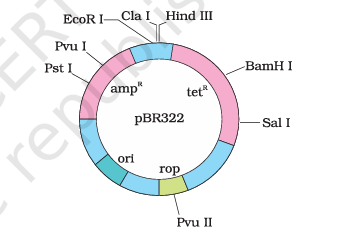
In the depicted pBR322 cloning vector, which specific labeled region ensures that any alien piece of DNA linked to it will successfully initiate replication within the host cell?
QUESTION 4 OF 20
If a biotechnologist requires the extraction of exceptionally large quantities of a target protein, they must clone their target DNA into a vector similar to the one depicted. What specific inherent property must the 'ori' sequence of such a vector support to achieve this goal?
QUESTION 5 OF 20
A recombinant vector containing an ampicillin resistance gene is introduced into competent E. coli cells. When plated on an agar medium containing ampicillin, only the transformants survive. What is the fundamental mechanism behind this elimination of non-transformants?
QUESTION 6 OF 20
Which of the following antibiotics is NOT explicitly mentioned as having a common resistance gene used as a selectable marker for E. coli vectors in recombinant DNA technology?
QUESTION 7 OF 20
QUESTION 8 OF 20
QUESTION 9 OF 20
In the alternative selectable marker method utilizing the beta-galactosidase gene, which of the following outcomes is NOT associated with the successful insertion of recombinant DNA?
QUESTION 10 OF 20
Match the state of the bacterial plasmid with its corresponding visual outcome on a chromogenic substrate medium:
| Column I | Column II |
|---|---|
| 1. Plasmid does not have an insert (Non-recombinant) | P. Insertional inactivation occurs |
| 2. Plasmid has a foreign DNA insert (Recombinant) | Q. Beta-galactosidase remains active |
| 3. Non-recombinant colonies | R. Colonies do not produce any color |
| 4. Recombinant colonies | S. Colonies produce a blue color |
QUESTION 11 OF 20
Arrange the sequence of events depicting the natural infection cycle of Agrobacterium tumifaciens in plants:
1. The T-DNA transforms normal plant cells into a tumor.
2. The tumor cells are directed to produce chemicals required by the pathogen.
3. The pathogen infects the dicot plant and delivers a piece of DNA known as 'T-DNA'.
QUESTION 12 OF 20
How does the disarmed Ti plasmid fundamentally differ from its naturally occurring counterpart in Agrobacterium tumifaciens?
QUESTION 13 OF 20
Which of the following statements is NOT accurate regarding the characteristics of retroviruses in biotechnology?
QUESTION 14 OF 20
Consider the following statements about disarmed animal pathogens used as vectors:
Statement I: Pathogens like retroviruses can be biologically modified so they lose their disease-causing ability but retain their gene delivery mechanisms.
Statement II: Once a desirable gene is ligated into a disarmed retroviral vector, it can be seamlessly transferred into a suitable animal host where it multiplies.
QUESTION 15 OF 20
The chemical nature of DNA directly dictates the necessity of the 'competent host' procedure. How does the hydrophilic property of DNA interact with the untreated bacterial cell membrane?
QUESTION 16 OF 20
Arrange the logical sequence outlining how divalent cation treatment affects bacterial transformation:
1. The efficiency with which DNA enters the bacterium through pores in its cell wall is increased.
2. Bacterial cells are treated with a specific concentration of a divalent cation, such as calcium.
3. Recombinant DNA is successfully taken up by the chemically altered 'competent' cells upon heat shock.
QUESTION 17 OF 20
In the micro-injection procedure, to ensure successful transformation, where is the recombinant DNA specifically and directly introduced?
QUESTION 18 OF 20
The biolistics method operates on a principle of physical bombardment. What specifically acts as the 'carrier' for the DNA in this technique?
QUESTION 19 OF 20
The heat shock protocol involves multiple precise temperature shifts. Which of the following is NOT an actual step in this established method?
QUESTION 20 OF 20
What is the primary physiological objective of subjecting competent bacterial cells to a brief heat exposure at 42°C during transformation?
Test Complete!
Answer Review
1 Match the biological entity with its defining characteristic regarding replication and vector capability:
| Column I | Column II |
|---|---|
| 1. Plasmid | P. Inherently possesses the sequence to initiate cellular division |
| 2. Bacteriophage | Q. Autonomously replicating circular extra-chromosomal DNA |
| 3. Chromosomal DNA | R. Provides very high copy numbers naturally within bacterial cells |
| 4. Origin of replication (ori) | S. The specific sequence responsible for initiating replication |
Plasmid is defined as autonomous, circular, extrachromosomal DNA. Bacteriophages are known for naturally high copy numbers. Chromosomal DNA initiates division (replication of the cell). Ori is the initiation site for replication.
Plasmid (1) matches with Q (autonomous extrachromosomal DN A). Bacteriophage (2) matches with R (high copy number). Chromosomal DNA (3) matches with P (initiates cellular/chromosomal replication). Origin of replication (4) matches with S (the specific sequence for starting replication). Option A correctly links all these definitions as established in NCERT.
- Option B → Incorrectly matches Plasmid to high copy numbers (R) instead of extrachromosomal definition (Q).
- Option C → Incorrectly matches Bacteriophage to cellular division (P).
- Option D → Incorrectly matches Plasmid to the initiation sequence (S).
Used Option Grouping Application: Grouping the clear definitions of Plasmid (Q) and Ori (S) helps narrow down to option A. Final Logic: Once 1-Q and 4-S are identified, Option A is the only consistent choice.
"Phage = High (R); Plasmid = Extra (Q)."
2 Analyze the following statements about the copy numbers of different vectors:
Statement I: Bacteriophages naturally achieve very high copy numbers of their genome within bacterial cells.
Statement II: Plasmids universally maintain a strictly low copy number of only 1 or 2 copies per cell, limiting their use in biotechnology.
Bacteriophages have high copy numbers. Plasmids have variable copy numbers (not just 1-2). High copy number plasmids are very useful.
Statement I is correct; phages produce many copies. Statement II is incorrect because plasmid copy numbers vary greatly; they are not limited to 1-2 copies, and they are highly useful precisely because they can maintain high copy numbers, facilitating gene cloning.
- Option B → Statement II is false, so this is incorrect.
- Option C → Statement II is false, so this is incorrect.
- Option D → Statement I is true, so this is incorrect.
Used Substitution Application: Substituting the knowledge that "high copy number plasmids exist" reveals that Statement II is definitively false. Final Logic: Plasmids are not restricted to low copy numbers.
"Plasmids = Variable copy (1 to hundreds)."
3 In the depicted pBR322 cloning vector, which specific labeled region ensures that any alien piece of DNA linked to it will successfully initiate replication within the host cell?
'ori' stands for Origin of Replication. It controls replication initiation. It is essential for DNA multiplication.
The 'ori' (Origin of Replication) is the specific DNA sequence from which replication starts. Linking any foreign DNA to this region allows the host's machinery to recognize it and initiate replication. Other regions like ampR and tetR are selectable markers, and rop codes for proteins involved in plasmid replication control but is not the initiation site itself.
- Option A → ampR is a selectable marker for ampicillin resistance.
- Option B → rop controls the replication protein; it is not the initiation site.
- Option D → tetR is a selectable marker for tetracycline resistance.
Used Substitution Application: Substituting the function "initiate replication" with the term "ori" (Origin of Replication) directly identifies the answer. Final Logic: Replication initiation = ori.
"Ori = Origin = Start."
4 If a biotechnologist requires the extraction of exceptionally large quantities of a target protein, they must clone their target DNA into a vector similar to the one depicted. What specific inherent property must the 'ori' sequence of such a vector support to achieve this goal?
High copy number = More plasmids. More plasmids = More gene dosage. More gene dosage = More protein product.
To obtain large quantities of a target protein, one needs a high expression level, which is achieved by having many copies of the gene within the host cell. The 'ori' sequence controls the copy number; therefore, choosing a vector with an 'ori' that supports a high copy number directly increases the yield of the target protein.
- Option A → Antibiotic resistance is for selection, not protein yield.
- Option C → Multiple restriction sites at the ori would likely destroy replication.
- Option D → Insertional inactivation is for screening, not increasing product quantity.
Used Contextual/Tonal Matching Application: Connecting "large quantities" to the concept of "gene dosage/copy number" makes B the logical choice. Final Logic: More copies = More product.
"High Copy = High Yield."
5 A recombinant vector containing an ampicillin resistance gene is introduced into competent E. coli cells. When plated on an agar medium containing ampicillin, only the transformants survive. What is the fundamental mechanism behind this elimination of non-transformants?
Transformants contain the vector. Vector contains resistance gene. Antibiotic kills susceptible (non-transformant) bacteria.
The selectable marker (ampicillin resistance) produces a protein that inactivates the antibiotic ampicillin. Transformants possess this gene and survive in the presence of the antibiotic. Non-transformants lack this gene and are killed by the antibiotic present in the agar.
- Option A → Non-transformants don't have the plasmid at all, but the selection is driven by the antibiotic.
- Option C → The DNA is not a poison; the lack of resistance is the issue.
- Option D → Competition is not the mechanism of selection by antibiotics.
Used Elimination Application: Eliminate choices that don't involve the antibiotic mechanism (A, C,
- D). Final Logic: Ampicillin kills sensitive bacteria; transformants are resistant.
"Antibiotic = Filter; Marker = Protection."
6 Which of the following antibiotics is NOT explicitly mentioned as having a common resistance gene used as a selectable marker for E. coli vectors in recombinant DNA technology?
NCERT lists ampicillin, chloramphenicol, tetracycline, and kanamycin. Penicillin is an antibiotic but not the standard marker listed.
In the context of NCERT biotechnology textbooks, the commonly cited antibiotics for E. coli selectable markers are Ampicillin, Chloramphenicol, Tetracycline, and Kanamycin. Penicillin is not listed as a standard marker for these vectors.
- Option A, B, D → These are explicitly mentioned in the NCERT text as markers.
Used Contextual/Tonal Matching Application: Recalling the specific list provided in the NCERT chapter. Final Logic: Penicillin is not in the "Standard Marker List."
"ACKT (Ampicillin, Chloramphenicol, Kanamycin, Tetracycline)."
7
Insertion interrupts the gene (inactivation). Inactivated gene = Loss of antibiotic resistance. This allows screening of transformants vs recombinants.
Inserting alien DNA into an antibiotic resistance gene causes insertional inactivation. If the gene is inactivated, the bacteria lose resistance to that antibiotic. This is used to differentiate cells containing the recombinant plasmid from those containing the original vector.
- Option A → It decreases activity (inactivation), not increases.
- Option C → Alien DNA must link to the 'ori' to replicate.
- Option D → Restriction enzymes bind to specific palindromic sequences, not necessarily resistance genes.
Used Substitution Application: Replace "ligation in resistance gene" with "insertional inactivation" to see the logic. Final Logic: Ligation inside = Inactivation = Selection Tool.
"Inside = Inactivate."
8
One site = Clean break (linear). Multiple sites = Many pieces. Many pieces = Recombination is impossible/very difficult.
If an enzyme has multiple recognition sites, cutting the vector will produce multiple fragments. This makes it impossible to cleanly insert the gene of interest at one site and re-circularize the vector properly, thus complicating the entire cloning process.
- Option A → Host cell rejection is not the issue; fragment assembly is.
- Option B → Self-ligation happens, but the fragmentation is the primary problem described.
- Option D → Fragmentation does not affect replication speed.
Used Substitution Application: The passage itself states that "Presence of more than one recognition site will generate several fragments." Final Logic: Multiple sites = Multiple fragments = Cloning failure.
"Multiple sites = Multiple cuts = Messy fragments."
9 In the alternative selectable marker method utilizing the beta-galactosidase gene, which of the following outcomes is NOT associated with the successful insertion of recombinant DNA?
Successful insertion (recombinant) = Blue-White screen. Recombinants are White (colorless). Blue colonies are non-recombinants.
When recombinant DNA is inserted, the beta-galactosidase gene is inactivated (Option A). Consequently, the enzyme is not produced, and the colonies remain white (colorless) instead of blue (Option A). Therefore, producing blue colonies (Option D) is the outcome of non-recombinants, not recombinants.
- Option A → This is associated with successful insertion.
- Option B → This is associated with successful insertion.
- Option C → This is the purpose of the method.
Used Extreme Word Filter Application: Identifying that "Blue" is the label for "No Insertion" makes Option D the "NOT" statement. Final Logic: Recombinant = Inactive enzyme = Colorless = Not Blue.
"Recombinant = White (Empty)."
10 Match the state of the bacterial plasmid with its corresponding visual outcome on a chromogenic substrate medium:
| Column I | Column II |
|---|---|
| 1. Plasmid does not have an insert (Non-recombinant) | P. Insertional inactivation occurs |
| 2. Plasmid has a foreign DNA insert (Recombinant) | Q. Beta-galactosidase remains active |
| 3. Non-recombinant colonies | R. Colonies do not produce any color |
| 4. Recombinant colonies | S. Colonies produce a blue color |
Non-recombinant (1) = Functional gene = Blue (Q, S). Recombinant (2) = Inactivated gene = White (P, R).
Non-recombinant plasmids (1) have an active beta-galactosidase gene (Q) and produce blue colonies (S). Recombinant plasmids (2) undergo insertional inactivation (P) and do not produce color (R). Option A matches these perfectly.
- Option B, C, D → Misalign the functional and non-functional states with the phenotypes.
Used Option Grouping Application: Match 1 to S (Blue) and 2 to R (White). Only Option A holds this pair. Final Logic: Blue = Active, No Color = Inactive.
"Blue = Active; White = Inactive."
11 Arrange the sequence of events depicting the natural infection cycle of Agrobacterium tumifaciens in plants:
1. The T-DNA transforms normal plant cells into a tumor.
2. The tumor cells are directed to produce chemicals required by the pathogen.
3. The pathogen infects the dicot plant and delivers a piece of DNA known as 'T-DNA'.
Infection must happen first. DNA transfer causes transformation. Transformed cells produce the required chemicals.
The infection cycle begins with the pathogen infecting the plant and delivering T-DNA (3). This T-DNA then integrates and transforms normal plant cells into tumor cells (1). Finally, these resulting tumor cells are programmed to synthesize the specific nutrients or chemicals that the pathogen requires for its own survival (2).
- Option B → Suggests tumor formation before infection.
- Option C → Suggests chemical production before infection.
- Option D → Suggests chemical production before transformation.
Used Contextual/Tonal Matching Application: Logical progression of a pathogen's infection strategy: Entry -> Effect -> Exploitation. Final Logic: Pathogen enters (3), induces growth (1), and harvests resources (2).
"Infect -> Transform -> Harvest."
12 How does the disarmed Ti plasmid fundamentally differ from its naturally occurring counterpart in Agrobacterium tumifaciens?
Ti plasmid is naturally a pathogen. Disarming means removing tumor-inducing (pathogeni A) genes. It still transfers DNA (making it a useful vector).
A "disarmed" Ti plasmid has been genetically engineered to remove the specific segments of T-DNA that cause tumor growth. This makes the bacterium safe, but it still maintains the crucial ability to transfer DNA into the host plant's genome, allowing us to insert beneficial genes instead of pathogenic ones.
- Option A → If it could no longer deliver DNA, it would not be a vector.
- Option B → It is a bacterial system, not a retroviral one.
- Option D → It remains a plant-targeting system.
Used Substitution Application: Substituting "disarmed" with "removed pathogenicity while keeping mechanism" perfectly describes the biotechnology goal. Final Logic: Disarmed = Harmless but effective delivery.
"Disarmed = No tumors, just transit."
13 Which of the following statements is NOT accurate regarding the characteristics of retroviruses in biotechnology?
Retroviruses infect animals, not plants. Agrobacterium infects dicot plants. This is a fundamental taxonomic distinction.
Retroviruses are specialized animal viruses; they do not naturally infect plants. The statement claiming they are used to transform dicot plant cells is factually incorrect, as that is the specific domain of the Agrobacterium-Ti plasmid system.
- Option A → Correct; this is a known natural pathology of retroviruses.
- Option B → Correct; understanding the mechanism is the basis of biotechnology.
- Option D → Correct; safety is the priority in gene therapy.
Used Extreme Word Filter Application: The word "exclusively" in relation to "dicot plant cells" is a major red flag when discussing retroviruses (animal pathogens). Final Logic: Retrovirus = Animal; Ti Plasmid = Plant.
"Retrovirus = Animal; Agro = Plant."
14 Consider the following statements about disarmed animal pathogens used as vectors:
Statement I: Pathogens like retroviruses can be biologically modified so they lose their disease-causing ability but retain their gene delivery mechanisms.
Statement II: Once a desirable gene is ligated into a disarmed retroviral vector, it can be seamlessly transferred into a suitable animal host where it multiplies.
Statement I: Describes the definition of a disarmed vector. Statement II: Describes the operational use of a disarmed vector in gene therapy.
Both statements describe the standard process and rationale for using viruses in biotechnology. Modification (Statement I) makes them safe, and the ligation of target genes (Statement II) allows for therapeutic or experimental gene delivery into animals.
- Option B, C, D → All contradict the well-established principles of using viral vectors for gene transfer.
Used Contextual/Tonal Matching Application: Both statements align with the standard scientific principles taught regarding viral vector modification. Final Logic: Safety (disarming) + Utility (gene delivery) = Successful Biotechnology.
"Disarmed + Ligated = Successful Vector."
15 The chemical nature of DNA directly dictates the necessity of the 'competent host' procedure. How does the hydrophilic property of DNA interact with the untreated bacterial cell membrane?
Lipid bilayer is hydrophobic. DNA is charged (hydrophiliA). Charge/Hydrophobic repulsion blocks entry.
Because DNA is a negatively charged and hydrophilic molecule, it cannot pass through the hydrophobic, non-polar lipid core of the bacterial cell membrane. The physical repulsion prevents the DNA from entering the host cell on its own, which is why artificial "competency" is required.
- Option A → Lipids are hydrophobic; DNA would not "dissolve" there.
- Option B → DNA is not a solvent.
- Option D → While DNA interacts with surfaces, the main barrier is the lipid interior repulsion.
Used Elimination Application: Eliminate choices that defy basic chemistry principles of membranes (hydrophobic interior). Final Logic: Hydrophilic DNA cannot cross hydrophobic membrane.
"Hydrophilic vs Hydrophobic = Repulsion."
16 Arrange the logical sequence outlining how divalent cation treatment affects bacterial transformation:
1. The efficiency with which DNA enters the bacterium through pores in its cell wall is increased.
2. Bacterial cells are treated with a specific concentration of a divalent cation, such as calcium.
3. Recombinant DNA is successfully taken up by the chemically altered 'competent' cells upon heat shock.
Treatment is the first step (2). Treatment leads to increased pore efficiency (1). Finally, the DNA is taken up (3).
The process begins with the chemical treatment of cells with divalent cations (2). This treatment modifies the membrane to increase the efficiency of DNA entry through pores (1). Only after these steps are completed is the host truly "competent," allowing for successful DNA uptake during the heat shock phase (3).
- Option A → Efficiency cannot increase before the chemical treatment occurs.
- Option C, D → DNA uptake must be the final consequence, not an intermediate step.
Used Substitution Application: Following the logical flow: Treatment (Cause) -> Increased Efficiency (Mechanism) -> Uptake (Effect). Final Logic: Treat -> Pores open -> Enter.
"Treat -> Open -> Enter."
17 In the micro-injection procedure, to ensure successful transformation, where is the recombinant DNA specifically and directly introduced?
Micro-injection is for animal cells. It requires placing the DNA inside the nucleus. Precise physical placement.
Micro-injection is a specialized technique used mainly for animal cells, where DNA is injected directly into the nucleus to ensure it is integrated into the host genome. This is distinct from bacterial transformation or plant cell biolistics.
- Option A → Bacteria are transformed via competency/heat shock, not micro-injection.
- Option B → Plant transformation uses biolistics or Agrobacterium.
- Option D → Not a standard biotechnology target for this technique.
Used Contextual/Tonal Matching Application: Defining the technique "Micro-injection" automatically points to the most precise cellular location (nucleus) in animal cells. Final Logic: Micro-injection targets the nucleus.
"Micro-inject = Direct to the Nucleus."
18 The biolistics method operates on a principle of physical bombardment. What specifically acts as the 'carrier' for the DNA in this technique?
Biolistics (Gene Gun). Heavy metal particles (Gold/Tungsten) coated with DNA. Physical impact drives them into cells.
In the biolistics method, microscopic particles (micro-projectiles) made of dense, inert metals like gold or tungsten are coated with the DNA of interest. These are then launched at high speed (bombarde D) into the host cells to overcome the cell wall barrier.
- Option A → Retroviruses are viral vectors, not physical carriers.
- Option C → Liposomes use fusion, not bombardment.
- Option D → Calcium chloride is used for chemical competency, not as a physical projectile.
Used Substitution Application: Identifying the key equipment for "biolistics" is the "Gene Gun," which uses physical particles (metal). Final Logic: Gene Gun = Metal Particles.
"Gun = Gold/Tungsten bullets."
19 The heat shock protocol involves multiple precise temperature shifts. Which of the following is NOT an actual step in this established method?
Heat shock is 42°C (not 100°A). 100°C is boiling (dead cells/denatured DNA). Standard protocol is Ice-42-Ice.
Boiling cells at 100°C would destroy the cell membranes, denature essential proteins, and kill the host bacteria, effectively ruining the experiment. The protocol strictly specifies 42°C to induce stress without killing the cells.
- Option A, B, C → These are the correct, standard steps of the transformation protocol.
Used Extreme Word Filter Application: The extreme temperature of 100°C is clearly inconsistent with maintaining living host cells. Final Logic: Boiling kills everything; 42°C is the correct "shock" temperature.
"42 is cool; 100 is for cooking."
20 What is the primary physiological objective of subjecting competent bacterial cells to a brief heat exposure at 42°C during transformation?
The heat shock creates a thermal differential. This imbalance drives the DNA through the cell wall/membrane pores. It is a physical method for entry.
The thermal shock (42° A) causes a sudden change in the temperature and pressure across the cell membrane, which drives the DNA that was bound to the surface into the interior of the bacterial cell through the pores. This is the mechanism for "transformation."
- Option A → Denaturing the host's DNA would be lethal.
- Option C → Heat-shock proteins are for stress, but their purpose isn't to degrade plasmids in this protocol.
- Option D → The goal is to keep pores open for entry, not to seal them while the DNA is outside.
Used Substitution Application: Substituting the purpose of "transformation protocol" directly leads to "uptake of DNA." Final Logic: Heat = Driving force for DNA entry.
"Shock = Entry."