
CUET UG Biology Booster Test 1 - Biological History and Human Evolution
📌 Answers are locked once submitted — results and explanations appear at the end.
QUESTION 1 OF 20
Consider the following statements regarding evolutionary timelines:
I. Seaweeds and few plants existed around 320 mya.
II. The first cellular form of life did not originate till about 2000 mya.
III. Dinosaurs suddenly disappeared from the earth about 200 mya. Which of the statements is/are correct?
QUESTION 2 OF 20
Paleontologists studying sedimentary rock layers deduce that earth's history correlates with biological history. Why is this correlation considered permissible?
QUESTION 3 OF 20
Based on the evolutionary history of plants, which of the following is NOT a direct or indirect descendant of the Tracheophyte ancestor?
QUESTION 4 OF 20
Arrange the following ancestral plant forms in the correct evolutionary sequence leading to angiosperms:
I. Seed ferns
II. Tracheophyte ancestor
III. Chlorophyte ancestor
IV. Rhynia-type plants
QUESTION 5 OF 20
By the time invertebrates were formed and active (500 mya), what was the fundamental state of biological evolution?
QUESTION 6 OF 20
Which of the following statements is INCORRECT regarding the Coelacanth?
QUESTION 7 OF 20
QUESTION 8 OF 20
QUESTION 9 OF 20
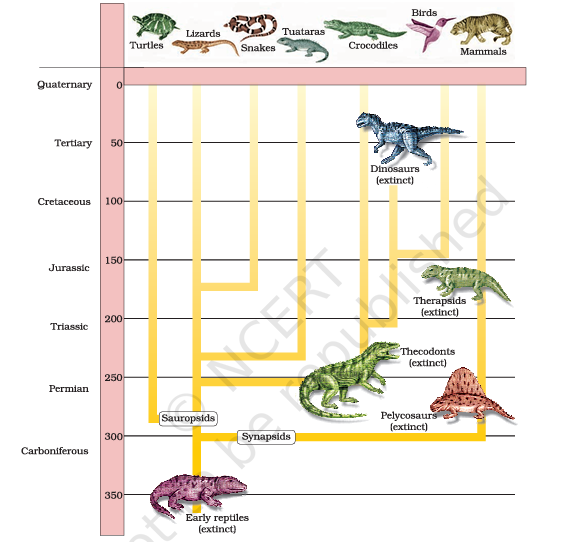
Based on the provided image showing vertebrate history, dinosaurs are shown to have existed in which period before going extinct?
QUESTION 10 OF 20
According to the provided vertebrate evolution diagram, crocodilians and birds evolved from a common reptilian lineage. Which specific extinct group is shown as sharing this close common ancestry with them?
QUESTION 11 OF 20
Match the following vertebrate groups to their significant evolutionary adaptation or feature described in the text:
| Column 1 | Column 2 |
|---|---|
| 1. Mammals | A. Ancestors of frogs and salamanders |
| 2. Amphibians | B. Lay thick-shelled eggs that do not dry up |
| 3. Reptiles | C. Viviparous and protect their unborn young inside mother |
| 4. Birds | D. Some scientists believe dinosaurs evolved into them |
QUESTION 12 OF 20
Which of the following was NOT cited as a reason for the successful rise of mammals when reptiles declined?
QUESTION 13 OF 20
Consider the following characteristics regarding early primates:
I. They existed about 15 million years ago.
II. Ramapithecus was more ape-like than Dryopithecus.
III. They were hairy and walked like gorillas and chimpanzees. Which of the statements given above are correct?
QUESTION 14 OF 20
The discovery of hominid bones in Ethiopia and Tanzania led to which of the following conclusions regarding hominid evolution?
QUESTION 15 OF 20
Arrange the following hominid ancestors based on their chronological appearance on Earth (oldest to newest):
I. Homo erectus
II. Australopithecines
III. Dryopithecus
IV. Homo habilis
QUESTION 16 OF 20
Match the hominid ancestor to their correct cranial capacity as provided in the NCERT text:
| Column 1 | Column 2 |
|---|---|
| 1. Homo habilis | A. 1400 cc |
| 2. Homo erectus | B. 900 cc |
| 3. Neanderthal man | C. 650-800 cc |
| 4. Homo sapiens | D. Not explicitly defined in this section, but larger than ancestors |
QUESTION 17 OF 20
Which of the following statements about Homo erectus is INCORRECT?
QUESTION 18 OF 20
The use of hides to protect the body and the practice of burying the dead by Neanderthal man indicates what evolutionary milestone?
QUESTION 19 OF 20
The emergence of modern Homo sapiens correlates chronologically with which significant climatic period?
QUESTION 20 OF 20
Pre-historic cave art found at Bhimbetka rock shelter in Madhya Pradesh serves as evidence for:
Test Complete!
Answer Review
1 Consider the following statements regarding evolutionary timelines:
I. Seaweeds and few plants existed around 320 mya.
II. The first cellular form of life did not originate till about 2000 mya.
III. Dinosaurs suddenly disappeared from the earth about 200 mya. Which of the statements is/are correct?
Statement I: Correct; simple plant life existed by ~320 mya. Statement II: Correct; cellular life is dated to roughly 2000 mya in the fossil record. Statement III: Incorrect; dinosaurs disappeared 65 mya, not 200 mya.
�� According to the NCERT evolutionary timeline, seaweed/plants are placed around 320 mya, and cellular life around 2000 mya. Dinosaurs, however, went extinct 65 million years ago, making statement III factually false. Thus, B is the only correct choice.
- Option A → Includes III, which is a significant error regarding the dinosaur extinction date.
- Option C → Includes III, which is incorrect.
- Option D → Includes III, which is incorrect.
Used: Elimination
Application: Eliminate all options containing statement III, as it is a well-known NCERT fact that dinosaurs went extinct 65 mya.
Final Logic: I and II are chronologically accurate based on NCERT data.
"Dino-Exit = 65mya (not 200)."
2 Paleontologists studying sedimentary rock layers deduce that earth's history correlates with biological history. Why is this correlation considered permissible?
Evolutionary biology relies on "index fossils" unique to specific periods. Life forms change (evolve) over millions of years. Layers (strata) act as a chronological record.
�� The correlation works because life forms evolve; therefore, specific organisms only appear in specific rock strata. By dating the rocks, we determine the age of the biological history contained within, confirming the temporal link between geological and biological change.
- Option A → False; rock layers have distinct, different fossils (faunal succession).
- Option C → False; dinosaur and human fossils are never found in the same sediment.
- Option D → False; spontaneous generation is not the basis for geological correlation.
Used: Contextual/Tonal Matching
Application: Match the scientific principle of "Biostratigraphy" with option B.
Final Logic: B accurately explains the fundamental concept of fossil-based dating.
"Different Time = Different Fossils."
3 Based on the evolutionary history of plants, which of the following is NOT a direct or indirect descendant of the Tracheophyte ancestor?
Chlorophytes (green algae) are the ancestors to Tracheophytes, not descendants. Tracheophytes (vascular plants) evolved from them. C is the correct answer to the "NOT a descendant" question.
�� The evolutionary tree shows Chlorophytes as the primitive group from which Tracheophytes (vascular plants) evolved. Therefore, they are the root/ancestor, while Zosterophyllum, Rhynia, and Psilophyton are downstream branches (descendants).
- Option A, B, D → All are examples of early vascular plants (Tracheophytes) and thus are descendants.
Used: Odd One Out
Application: Identify the group that precedes the others in the evolutionary tree.
Final Logic: Chlorophytes are the ancestral source, not a descendant of Tracheophytes.
"Chlorophyte = Start; Tracheophyte = After."
4 Arrange the following ancestral plant forms in the correct evolutionary sequence leading to angiosperms:
I. Seed ferns
II. Tracheophyte ancestor
III. Chlorophyte ancestor
IV. Rhynia-type plants
III: Chlorophyte (primitive). II: Tracheophyte (early vascular). IV: Rhynia (vascular). I: Seed ferns (advanced).
�� The evolutionary sequence progresses from primitive green algae (Chlorophytes) to early vascular plants (Tracheophyte ancestor), followed by specific early types like Rhynia, and finally to complex gymnosperm-ancestors like seed ferns.
- Option B, C, D → All place primitive forms after more advanced forms, violating the principle of evolutionary descent.
Used: Elimination
Application: Start with III (Chlorophyte) as the absolute earliest. Eliminate B, C, and D.
Final Logic: A represents the only biologically accurate sequence.
"Chloro -> Tracheo -> Rhynia -> Seed Fern."
5 By the time invertebrates were formed and active (500 mya), what was the fundamental state of biological evolution?
Invertebrates are multicellular. They evolved after single-celled life. Plants/Fish were later.
�� By 500 mya, the jump from simple unicellular life to complex multicellular life had already occurred, allowing for the formation of invertebrates. Land plants and vertebrate fish (jawless) appeared later in the timeline.
- Option A → Too early; this happened billions of years prior.
- Option C → Plants invaded land later (around 350-400 mya).
- Option D → Jawless fish appeared after invertebrates, not before.
Used: Substitution
Application: Replace "500 mya" with the key evolutionary milestone: The emergence of complex animals.
Final Logic: Multicellularity is the prerequisite for invertebrates.
"Invertebrates = Multicellular."
6 Which of the following statements is INCORRECT regarding the Coelacanth?
Lobefins are the link between Fish and Amphibians. Reptiles evolved from amphibians later. D is factually incorrect.
�� The Coelacanth (a lobefin) is considered an evolutionary bridge between fish and amphibians because it had fins capable of moving on land. Reptiles evolved from amphibians, not from Coelacanths.
- Option A, B, C → All are historically accurate facts stated in the NCERT.
Used: Extreme Word Filter
Application: "Direct evolutionary link between amphibians and reptiles" is a misidentification of the lobefin's actual role.
Final Logic: D incorrectly maps the phylogeny.
"Lobefin = Fish to Amphibian (not Reptile)."
7
Plants provide oxygen, food, and habitat. Animals are heterotrophs (need food). Colonization sequence requires food producers to arrive first.
�� As heterotrophs, animals cannot survive on barren land without established ecosystems. Plants (autotrophs) established land colonization first, creating the necessary food web and shelter infrastructure required for animal life to successfully invade land.
- Option A → Plants do not have lungs.
- Option C → Animals originated in water; this reverses the biological fact.
- Option D → Plants do not have fins.
Used: Contextual/Tonal Matching
Application: Apply the logic of trophic levels (Producers first, Consumers second).
Final Logic: B represents the logical environmental requirement.
"Plants (Producers) go first."
8
Amphibian literally means "dual life." The transition from water to land required adapting to both. B is the classic NCERT definition of an amphibian.
�� Lobefins evolved into amphibians, whose defining characteristic is their capacity to inhabit both aquatic and terrestrial environments. This duality allowed them to bridge the gap between water-bound fish and land-bound reptiles.
- Option A → Reptiles lay thick-shelled eggs, not early amphibians.
- Option C → Amphibians retain aquatic adaptations (e.g., eggs in water).
- Option D → This is not the defining evolutionary trait; it's a dietary habit.
Used: Substitution
Application: Define "Amphibian" (Amphi=Both, Bios=Life).
Final Logic: B matches the biological definition of an amphibian.
"Amphi = Both (Land/Water)."
9 Based on the provided image showing vertebrate history, dinosaurs are shown to have existed in which period before going extinct?
The "Age of Reptiles" is characterized by the Jurassic and Cretaceous periods. Dinosaur dominance peaked in these periods. C is the correct geological assignment.
�� In the vertebrate history diagram, dinosaurs appear prominently during the Jurassic and Cretaceous periods before their mass extinction at the end of the Cretaceous (~65 mya).
- Option A → Too early; the Carboniferous was the age of amphibians.
- Option B → The Permian was a transitional period; dinosaurs were not dominant.
- Option D → The Tertiary is the "Age of Mammals."
Used: Contextual/Tonal Matching
Application: Recognize "Jurassic" and "Cretaceous" as the synonymous periods for the Age of Dinosaurs.
Final Logic: C is the established timeline for dinosaur dominance.
"Age of Reptiles = Jurassic/Cretaceous."
10 According to the provided vertebrate evolution diagram, crocodilians and birds evolved from a common reptilian lineage. Which specific extinct group is shown as sharing this close common ancestry with them?
Dinosaurs are the common ancestors to modern birds and crocodilians. They are part of the archosaur lineage. C is the correct label from the evolutionary diagram.
�� Modern avian and crocodilian lineages are phylogenetically nested within the dinosaur lineage. The vertebrate diagram in the NCERT explicitly links them back to dinosaurs, confirming C as the correct group.
- Option A, B, D → These groups (Synapsids/Therapsids) are on the lineage leading to mammals, not birds/crocodiles.
Used: Substitution
Application: Link "Birds and Crocodilians" to "Dinosaurs."
Final Logic: Dinosaurs are the key taxonomic link in the provided diagram.
"Bird = Living Dinosaur."
11 Match the following vertebrate groups to their significant evolutionary adaptation or feature described in the text:
| Column 1 | Column 2 |
|---|---|
| 1. Mammals | A. Ancestors of frogs and salamanders |
| 2. Amphibians | B. Lay thick-shelled eggs that do not dry up |
| 3. Reptiles | C. Viviparous and protect their unborn young inside mother |
| 4. Birds | D. Some scientists believe dinosaurs evolved into them |
1 (Mammals) = C (Viviparous/Internal development). 2 (Amphibians) = A (Ancestors of frogs/salamanders). 3 (Reptiles) = B (Thick-shelled eggs). 4 (Birds) = D (Evolved from dinosaurs).
�� Mammals are characterized by viviparity (C). Modern amphibians (frogs/salamanders) are descendants of early amphibians (A). Reptiles evolved thick-shelled eggs to survive away from water (B). Birds are widely recognized in evolutionary biology as descendants of dinosaurs (D).
- Option A, C, D → All misalign the definitions of these vertebrate classes, which are standard definitions in the NCERT text.
Used: Option Grouping
Application: Match the most definitive trait first (e.g., Reptiles = Thick-shelled eggs = B). This leaves only option B.
Final Logic: Option B is the only set that accurately pairs the vertebrate group with its NCERT-defined adaptation.
"Mammal=Viviparous, Reptile=Shell, Bird=Dino."
12 Which of the following was NOT cited as a reason for the successful rise of mammals when reptiles declined?
While they were small, this was not the advantage for "taking over the Earth." The cited advantages are intelligence and viviparity. A is a description, not an evolutionary advantage for dominance.
�� The NCERT highlights that mammals rose to dominance because of their higher intelligence (sensing danger) and viviparity (protecting young). Being small was a survival trait during the dinosaur era, but not the specific "reason" for their subsequent takeover.
- Option B → This is a cited advantage.
- Option C → This is a cited advantage.
- Option D → This is a cited advantage.
Used: Contextual/Tonal Matching
Application: Distinguish between "characteristics" and "competitive advantages."
Final Logic: A describes the size/diet, not the competitive advantage for post-reptilian dominance.
"Advantages = Brains + Viviparity."
13 Consider the following characteristics regarding early primates:
I. They existed about 15 million years ago.
II. Ramapithecus was more ape-like than Dryopithecus.
III. They were hairy and walked like gorillas and chimpanzees. Which of the statements given above are correct?
I: Correct; timeline is ~15 mya. II: Incorrect; Dryopithecus was more ape-like, Ramapithecus was more man-like. III: Correct; physical appearance resembled modern great apes.
�� Primates like Dryopithecus and Ramapithecus existed around 15 million years ago (I) and had ape-like, hairy features (III). Statement II is false because the NCERT text defines Ramapithecus as "man-like" and Dryopithecus as "ape-like."
- Option A, C, D → All include Statement II, which reverses the NCERT distinction between Dryopithecus and Ramapithecus.
Used: Elimination
Application: Eliminate all options containing II.
Final Logic: I and III are supported by NCERT descriptions of early hominids.
"Ramapithecus = Man-like."
14 The discovery of hominid bones in Ethiopia and Tanzania led to which of the following conclusions regarding hominid evolution?
Fossil sites (Ethiopia/Tanzania) point to early bipedal hominids. Timeline is 3-4 mya. A is the correct finding.
�� The discovery of Australopithecine fossils in East Africa established that man-like primates were walking upright about 3-4 million years ago, a pivotal finding in human evolution.
- Option B → Early hominids had small brains; 1400cc is modern.
- Option C → Dryopithecus is an early primate, not a direct ancestor to Sapiens in Europe.
- Option D → They were not 6 feet tall, and their diet was fruit-based.
Used: Substitution
Application: Link "Hominid fossils in E. Africa" to "Upright walking/3-4 mya."
Final Logic: A is the standard factual summary from the NCERT.
"Ethiopia/Tanzania = Upright Hominids."
15 Arrange the following hominid ancestors based on their chronological appearance on Earth (oldest to newest):
I. Homo erectus
II. Australopithecines
III. Dryopithecus
IV. Homo habilis
III: Dryopithecus (15 mya). II: Australopithecines (3-4 mya). IV: Homo habilis (2 mya). I: Homo erectus (1.5 mya).
�� The evolutionary hierarchy starts with early primates like Dryopithecus, moves to Australopithecines, then to Homo habilis, and finally to Homo erectus. A follows this correct chronological sequence.
- Option B, C, D → All place Homo erectus or Homo habilis before the much older Dryopithecus/Australopithecines.
Used: Elimination
Application: Begin with Dryopithecus (the oldest) to narrow it to A or C. Then, distinguish between Habilis (IV) and Australopithecines (II).
Final Logic: A is the only option that keeps the evolutionary sequence correct.
"Dryo -> Austra -> Habilis -> Erectus."
16 Match the hominid ancestor to their correct cranial capacity as provided in the NCERT text:
| Column 1 | Column 2 |
|---|---|
| 1. Homo habilis | A. 1400 cc |
| 2. Homo erectus | B. 900 cc |
| 3. Neanderthal man | C. 650-800 cc |
| 4. Homo sapiens | D. Not explicitly defined in this section, but larger than ancestors |
1 (Habilis) = C (650-800 cc). 2 (Erectus) = B (900 cc). 3 (Neanderthal) = A (1400 cc). 4 (Sapiens) = D.
�� Habilis is the smallest (650-800 cc), Erectus is intermediate (900 cc), and Neanderthal is the largest (1400 cc). This matches the sequence of encephalization in the NCERT.
- Option B, C, D → All misalign the specific capacity numbers provided in the NCERT text.
Used: Option Grouping
Application: Anchor Habilis (650-800) and Neanderthal (1400) to find the only matching code (A).
Final Logic: Only Option A aligns the cranial capacities with the correct hominid ancestor.
"Habilis < 900 < 1400 (Neander)."
17 Which of the following statements about Homo erectus is INCORRECT?
Homo erectus brain (900 cc) was larger than Habilis (650-800 cc). C states it was smaller, which is false.
�� Homo erectus represents an evolutionary step toward larger brains. Since Homo habilis had a capacity of 650-800 cc and Homo erectus had 900 cc, the statement that erectus was smaller is incorrect.
- Option A → Factually correct for Java man discovery.
- Option B → Factually correct timeline.
- Option D → Supported by evidence of tool usage and hunting.
Used: Extreme Word Filter
Application: "Smaller" in option C triggers the error check against the "Evolutionary growth" principle.
Final Logic: C contradicts the trend of increasing brain size.
"Erectus = 900cc (Bigger than Habilis)."
18 The use of hides to protect the body and the practice of burying the dead by Neanderthal man indicates what evolutionary milestone?
Burying dead (ritual) + Hides (clothing) = Culture. This is higher-order thinking (Self-consciousness).
�� Ritualized behaviors like burial indicate abstract thinking and mourning, which are hallmarks of cultural evolution and self-consciousness, far removed from purely survival-based instincts.
- Option A → Chemical evolution refers to the origin of life (Oparin-Haldane).
- Option C → Agriculture is a late Homo sapiens development.
- Option D → This is a dietary shift, not the significance of burial.
Used: Contextual/Tonal Matching
Application: Map "Burial/Hides" to "Cultural development."
Final Logic: B is the conceptual significance given to Neanderthal behavior.
"Burial = Culture."
19 The emergence of modern Homo sapiens correlates chronologically with which significant climatic period?
Sapiens history is linked to the Ice Age. This period corresponds to 75k-10k years ago.
�� Modern humans evolved and spread during the most recent geological cooling period, known as the Ice Age. This time frame is explicitly provided in the NCERT for the appearance and migration of Homo sapiens.
- Option A → 300+ million years ago.
- Option B → 65 million years ago.
- Option D → Pre-dates life itself.
Used: Substitution
Application: Extract the specific timeline for Homo sapiens provided in the text.
Final Logic: C is the verbatim time range mentioned in the NCERT.
"Sapiens = Ice Age (75k-10k)."
20 Pre-historic cave art found at Bhimbetka rock shelter in Madhya Pradesh serves as evidence for:
Cave art = 18,000 years ago. Bhimbetka is the classic site example. Agriculture = 10,000 years ago.
�� Bhimbetka cave art demonstrates the advanced cognitive and cultural state of humans 18,000 years ago, highlighting the transition into symbolic culture before the adoption of sedentary agriculture (10k years ago).
- Option A → Australopithecines were not that advanced.
- Option C → Burial was Neanderthal, but art is Sapiens.
- Option D → Hunting strategy is not the primary purpose of cave art sites.
Used: Substitution
Application: Match the site (Bhimbetka) and time (18k) to the correct evolutionary event.
Final Logic: B is the accurate contextual description of the Bhimbetka finds.
"Bhimbetka = Art = 18k."