
CUET UG Categorised PYQ Economics Unit 9
Economics
📌 Answers are locked once submitted — results and explanations appear at the end.
QUESTION 1 OF 15
Given the following set of data calculate equilibrium income. C = 100 + 0.8Y Investment = ₹260 Cr (PYQ 2022)
QUESTION 2 OF 15
If MPC = 0.75, autonomous consumption = 100 crore, then find the level of consumption at income level = 8,000 crore : (PYQ 2022)
QUESTION 3 OF 15
Suppose the producers plans to add ₹100 cr worth of goods to her stock by the end of the year. However, due to an unforeseen upsurge in demands for her goods in the market, she had to sell goods worth ₹30 cr from her existing stock. Now, determine Ex-ante Investment and Ex-post Investment from the above information. (PYQ 2022)
QUESTION 4 OF 15
Which of the following is not a reason for excess demand ? (PYQ 2022)
QUESTION 5 OF 15
Identify the statement that states during deficient demand : (PYQ 2022)
Statements:
(A) Actual output falls short of potential output
(B) Potential output falls below actual demand
(C) Actual demand is less than expected demand
(D) Expected demand is less than actual demand
Choose the correct answer from the options given below :
QUESTION 6 OF 15
When consumption function starts from Y axis, it indicates that ? (PYQ 2022)
QUESTION 7 OF 15
Match List - I with List - II. (PYQ 2023)
| List-I | List-II |
|---|---|
| A. Ex-ante saving | I. Planned output |
| B. Multiplier | II. ΔY / ΔI |
| C. Aggregate supply | III. Direct relationship with investment multiplier |
| D. Marginal propensity to consume | IV. Desired saving |
QUESTION 8 OF 15
A change in investment in an economy by ₹2,000 crores leads to an increase in its national income by ₹8,000 crores. What will be the change in consumption ? (PYQ 2023)
QUESTION 9 OF 15
what will happen to aggregate demand curve when autonomous investment increases. (PYQ 2023)
QUESTION 10 OF 15
If the supply of final goods is assumed to be infinitely elastic at constant price over a short period of time, aggregate output is determined solely by the value of Aggregate demand. This is called __________ Principle. (PYQ 2024)
QUESTION 11 OF 15
Paradox of Thrift means : (PYQ 2024)
QUESTION 12 OF 15
_______________ depicts what has actually happened. (PYQ 2024)
QUESTION 13 OF 15
When there is unexpected rise in the sales ___________. (PYQ 2023)
QUESTION 14 OF 15
If aggregate demand exceeds aggregate supply at full employment level, the gap which occurs is known as : (PYQ 2023)
QUESTION 15 OF 15
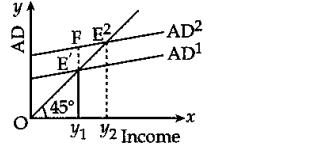
Based on the following diagram answer the question :
The gap E′F in the diagram indicate ________.
Test Complete!
Answer Review
1 Given the following set of data calculate equilibrium income. C = 100 + 0.8Y Investment = ₹260 Cr (PYQ 2022)
Equilibrium income is found where Y = C + I. Consumption function is C = 100 + 0.8Y. Investment is ₹260 Cr. Solving gives equilibrium income = ₹1,800 Cr.
(Detailed) → At equilibrium level of income, Aggregate Demand equals Aggregate Supply. → Therefore, Y = C + I. → Substitute the given values into the equation: → Y = 100 + 0.8Y + 260. → Y - 0.8Y = 360. → 0.2Y = 360. → Y = 360 / 0.2 = ₹1,800 Cr. → Hence, Option D is the correct answer.
- A) ₹1,500 Cr → This is incorrect because substituting it into Y = C + I does not satisfy the equilibrium condition.
- B) ₹2,300 Cr → This is incorrect because it overestimates the equilibrium income based on the given consumption function.
- C) ₹2,200 Cr → This is incorrect because it is not obtained from the correct multiplier calculation.
Used
- Option A → Incorrect because calculation does not give ₹1,500 Cr.
- Option B → Incorrect because it is higher than the calculated value.
- Option C → Incorrect because it is not obtained from Y = C + I.
- Option D → Correct because Y = 100 + 0.8Y + 260 gives ₹1,800 Cr.
- Final Answer → Option D.
2 If MPC = 0.75, autonomous consumption = 100 crore, then find the level of consumption at income level = 8,000 crore : (PYQ 2022)
Consumption function is C = C̄ + cY. Autonomous consumption = 100 crore. MPC = 0.75 and income = 8,000 crore. C = 100 + (0.75 × 8,000) = 6,100 crores.
(Detailed) → The algebraic relationship for consumption is expressed as C = C̄ + cY. → Here, C̄ is autonomous consumption and c is MPC. → Substitute the given values: → C = 100 + 0.75 × 8,000. → Induced consumption = 0.75 × 8,000 = 6,000. → Total consumption = 100 + 6,000 = 6,100 crores. → Hence, Option B is the correct answer.
- A) 7,000 crores → This is mathematically incorrect and does not follow the consumption function formula.
- C) 6,900 crores → This is a miscalculation of 0.75 × 8,000 plus 100.
- D) 7,100 crores → This overestimates the correct consumption level significantly.
Used
- Option A → Incorrect due to wrong substitution/calculation.
- Option B → Correct because C = 100 + 0.75 × 8,000 = 6,100 crores.
- Option C → Incorrect calculation error.
- Option D → Incorrect calculation error.
- Final Answer → Option B.
3 Suppose the producers plans to add ₹100 cr worth of goods to her stock by the end of the year. However, due to an unforeseen upsurge in demands for her goods in the market, she had to sell goods worth ₹30 cr from her existing stock. Now, determine Ex-ante Investment and Ex-post Investment from the above information. (PYQ 2022)
Ex-ante investment means planned investment. The producer planned to add ₹100 Cr to stock, so ex-ante investment is ₹100 Cr. Ex-post investment means actual investment. Actual stock addition = ₹100 Cr - ₹30 Cr = ₹70 Cr.
(Detailed) → Ex-ante investment refers to the planned investment by firms during a specific period. → Since the producer planned an addition of ₹100 Cr, the ex-ante investment is ₹100 Cr. → Ex-post investment refers to the actual investment realized after considering unplanned changes in inventories. → Due to an unexpected upsurge in demand, ₹30 Cr of existing stock was sold. → This resulted in unplanned decumulation of inventory. → Actual addition to stock = Planned addition - Unplanned decumulation. → Ex-post investment = 100 - 30 = ₹70 Cr. → Hence, Option B is the correct answer.
- A) 100 Cr, 100 Cr → This is incorrect because the actual investment fell by ₹30 Cr due to unforeseen sales.
- C) 70 Cr, 70 Cr → This is incorrect because the planned ex-ante investment was ₹100 Cr, not ₹70 Cr.
- D) 70 Cr, 100 Cr → This is incorrect because it interchanges planned and actual investment.
Used
- Option A → Incorrect because ex-post investment is not ₹100 Cr.
- Option B → Correct because planned investment is ₹100 Cr and actual investment is ₹70 Cr.
- Option C → Incorrect because ex-ante investment was ₹100 Cr.
- Option D → Incorrect because it reverses ex-ante and ex-post.
- Final Answer → Option B.
4 Which of the following is not a reason for excess demand ? (PYQ 2022)
Excess demand occurs when aggregate demand exceeds full employment output. Reduction in taxes increases aggregate demand. Increase in investment and government spending also increase aggregate demand. A fall in the propensity to consume reduces demand.
(Detailed) → Excess demand occurs when aggregate demand is greater than the aggregate supply corresponding to the full employment level. → A fall in the propensity to consume means people spend a smaller portion of their income on consumption. → This reduces consumption expenditure and overall aggregate demand. → Because it leads to lower demand, it is a reason for deficient demand, not excess demand. → Hence, Option B is the correct answer.
- A) Reduction in Taxes → Reduction in taxes increases disposable income and can increase consumption demand, causing excess demand.
- C) Increase in investments → Increase in investment raises aggregate demand and can create excess demand.
- D) Increase in government spending → Increase in government expenditure directly increases aggregate demand and can lead to excess demand.
Used
- Option A → Incorrect because tax reduction increases demand.
- Option B → Correct because fall in propensity to consume reduces demand.
- Option C → Incorrect because investment increase raises demand.
- Option D → Incorrect because government spending increase raises demand.
- Final Answer → Option B.
5 Identify the statement that states during deficient demand : (PYQ 2022)
Statements:
(A) Actual output falls short of potential output
(B) Potential output falls below actual demand
(C) Actual demand is less than expected demand
(D) Expected demand is less than actual demand
Choose the correct answer from the options given below :
Deficient demand occurs when aggregate demand is less than required at full employment. Because demand is low, producers reduce output and employment. Actual output falls short of potential output. Actual demand is less than expected/full employment demand.
(Detailed) → Deficient demand means aggregate demand is below the level required to maintain full employment in the economy. → Due to this lack of demand, actual output falls short of the economy's potential output. → Therefore, Statement (A) is correct. → The actual demand present in the economy is less than the expected or required demand to achieve full employment. → Therefore, Statement (C) is correct. → Hence, Option B is the correct answer.
- A) (D) only → Statement (D) is incorrect because expected demand being lower than actual demand describes excess demand, not deficient demand.
- C) (A) and (B) only → Statement (B) says potential output falls below actual demand, which suggests excess demand, not deficient demand.
- D) (B) only → Statement (B) is an incorrect description of deficient demand.
Used
- Option A → Incorrect because Statement (D) does not represent deficient demand.
- Option B → Correct because actual output and actual demand are both lower than potential/expected levels.
- Option C → Incorrect because Statement (B) is wrong.
- Option D → Incorrect because Statement (B) alone is wrong.
- Final Answer → Option B.
6 When consumption function starts from Y axis, it indicates that ? (PYQ 2022)
The consumption function shows the relationship between income and consumption. If it starts from the Y-axis above the origin, autonomous consumption exists. Autonomous consumption occurs even when income is zero. This means consumption is positive at zero income.
(Detailed) → A consumption function starting from the positive Y-axis signifies the presence of autonomous consumption. → It shows that even at zero level of national income, there is a minimum level of consumption necessary for survival. → This minimum consumption is financed by dis-saving or borrowing. → Therefore, it indicates that consumption is positive when income is zero. → Hence, Option B is the correct answer.
- A) Consumption is zero when income is zero → This is incorrect because if consumption were zero at zero income, the curve would start exactly from the origin.
- C) Saving is negative when income is positive → While saving may be negative at lower positive incomes, starting from the Y-axis specifically indicates behaviour at zero income.
- D) Saving is positive when income is zero → This is incorrect because when income is zero and consumption is positive, saving is negative.
Used
- Option A → Incorrect because consumption is not zero at zero income.
- Option B → Correct because the Y-axis intercept shows autonomous positive consumption.
- Option C → Incorrect because the Y-intercept strictly defines the zero-income point.
- Option D → Incorrect because saving is negative at zero income.
- Final Answer → Option B.
7 Match List - I with List - II. (PYQ 2023)
| List-I | List-II |
|---|---|
| A. Ex-ante saving | I. Planned output |
| B. Multiplier | II. ΔY / ΔI |
| C. Aggregate supply | III. Direct relationship with investment multiplier |
| D. Marginal propensity to consume | IV. Desired saving |
Ex-ante saving means planned or desired saving. Multiplier is measured as ΔY / ΔI. Aggregate supply is related to total planned output. MPC has a direct relationship with the investment multiplier.
(Detailed) → Ex-ante saving refers to what households plan or desire to save at different income levels. Therefore, (A) matches with (IV). → The Multiplier measures the effect of an increase in investment on total income. It is calculated as ΔY / ΔI. Therefore, (B) matches with (II). → Aggregate supply is the total value of goods and services producers are willing to supply. Therefore, (C) matches with (I). → Marginal propensity to consume has a direct positive relationship with the investment multiplier. Therefore, (D) matches with (III). → Hence, Option B is the correct answer.
- A) (A)-(III), (B)-(II), (C)-(IV), (D)-(I) → Incorrect because ex-ante saving is not directly related to the multiplier and aggregate supply is not desired saving.
- C) (A)-(IV), (B)-(I), (C)-(II), (D)-(III) → Incorrect because multiplier is not planned output and aggregate supply is not ΔY / ΔI.
- D) (A)-(II), (B)-(IV), (C)-(I), (D)-(III) → Incorrect because ex-ante saving is not ΔY / ΔI and multiplier is not desired saving.
Used
- Option A → Incorrect because ex-ante saving and aggregate supply are mismatched.
- Option B → Correct because all pairs match their textbook definitions.
- Option C → Incorrect because multiplier and aggregate supply are interchanged.
- Option D → Incorrect because ex-ante saving and multiplier are mismatched.
- Final Answer → Option B.
8 A change in investment in an economy by ₹2,000 crores leads to an increase in its national income by ₹8,000 crores. What will be the change in consumption ? (PYQ 2023)
Multiplier = ΔY / ΔI. K = 8,000 / 2,000 = 4. K = 1 / MPS, so MPS = 1/4 = 0.25. MPC = 1 - MPS = 0.75. ΔC = MPC × ΔY = 0.75 × 8,000 = ₹6,000 crores.
(Detailed) → Given: Change in investment, ΔI = ₹2,000 crores. → Change in income, ΔY = ₹8,000 crores. → Calculate Multiplier: → K = ΔY / ΔI. → K = 8,000 / 2,000 = 4. → Since K = 1 / MPS, then 4 = 1 / MPS. → MPS = 0.25. → Since MPC + MPS = 1, MPC = 1 - 0.25 = 0.75. → Change in Consumption = MPC × Change in Income. → ΔC = 0.75 × 8,000 = ₹6,000 crores. → Hence, Option C is the correct answer.
- A) ₹6,400 crores → This assumes an incorrect MPC value of 0.8.
- B) ₹6,600 crores → This is incorrect and not obtained using the multiplier relationship.
- D) ₹6,200 crores → This is a miscalculation.
Used
- Option A → Incorrect calculation of MPC.
- Option B → Incorrect calculation.
- Option C → Correct because ΔC = 0.75 × 8,000 = ₹6,000 crores.
- Option D → Incorrect calculation.
- Final Answer → Option C.
9 what will happen to aggregate demand curve when autonomous investment increases. (PYQ 2023)
Autonomous investment is independent of income level. An increase in autonomous investment directly increases aggregate demand at every level of income. Because the slope does not change, the shift is parallel. Therefore, the AD curve shifts upward parallelly.
(Detailed) → Aggregate Demand is composed of consumption and investment in a two-sector model. → When autonomous investment increases, the autonomous expenditure component increases. → This causes the AD curve to shift vertically upward. → Since the change is autonomous and MPC remains unchanged, the slope of the AD curve does not change. → Therefore, the shift is parallel. → Hence, Option C is the correct answer.
- A) AD curve shifts in parallel downwards → This is incorrect because an increase in autonomous investment raises aggregate demand.
- B) AD curve does not shift → This is incorrect because autonomous investment is a direct component of aggregate demand.
- D) AD curve shifts not in parallel upwards → This is incorrect because slope changes only when MPC changes. Here, the shift is parallel.
Used
- Option A → Incorrect because AD does not decrease.
- Option B → Incorrect because AD must shift.
- Option C → Correct because higher autonomous investment causes a parallel upward shift.
- Option D → Incorrect because the slope remains unchanged.
- Final Answer → Option C.
10 If the supply of final goods is assumed to be infinitely elastic at constant price over a short period of time, aggregate output is determined solely by the value of Aggregate demand. This is called __________ Principle. (PYQ 2024)
In Keynesian theory, short-run supply is assumed to adjust fully to demand. Final goods supply is infinitely elastic at a constant price. Output is determined by aggregate demand. This concept is known as the principle of effective demand.
(Detailed) → According to Keynesian macroeconomic theory, in the short run, supply of final goods may be infinitely elastic at a constant price level. → This means producers can supply whatever is demanded at the existing price level. → In such a situation, equilibrium aggregate output and employment are determined by aggregate demand. → This fundamental idea is known as the principle of effective demand. → Hence, Option C is the correct answer.
- A) Aggregate supply → Aggregate supply refers to total output supplied, but it is not the name of the principle.
- B) Aggregate demand → Aggregate demand determines output, but the formal name of the principle is effective demand.
- D) Perfectly inelastic demand → This means demand does not change with price. It is unrelated to this Keynesian principle.
Used
- Option A → Incorrect because it is a component, not the principle.
- Option B → Incorrect because the principle is named effective demand.
- Option C → Correct because output determined by AD in short run is called effective demand.
- Option D → Incorrect because it is an unrelated microeconomic concept.
- Final Answer → Option C.
11 Paradox of Thrift means : (PYQ 2024)
Paradox of thrift is a Keynesian concept. If everyone tries to save more, aggregate consumption demand falls. Lower demand causes firms to reduce production and income. With lower income, total savings may fall or remain unchanged.
(Detailed) → The paradox of thrift explains that what is good for an individual may be harmful for the whole economy. → If all people decide to save a higher proportion of their income, consumption expenditure falls sharply. → This decrease in consumption reduces aggregate demand. → Lower aggregate demand leads to a decline in output and income. → As aggregate income falls, total savings in the economy may not increase. → It will either decline or remain unchanged. → Hence, Option D is the correct answer.
- A) This is incorrect because the paradox specifically explains total savings, not primarily investment.
- B) This is incorrect because the paradox revolves around the desire to save more, not spend more.
- C) This is incorrect because the paradox occurs when people attempt to save a larger proportion of income, not when they decrease saving.
Used
- Option A → Incorrect because the paradox focuses on aggregate savings.
- Option B → Incorrect because it talks about increased spending.
- Option C → Incorrect because it talks about decreased saving tendency.
- Option D → Correct because it properly describes the paradox of thrift.
- Final Answer → Option D.
12 _______________ depicts what has actually happened. (PYQ 2024)
Ex-post means actual or realized. It shows what has actually happened in the economy. Ex-ante means planned or expected. Hence, the correct answer is Ex-Post.
(Detailed) → In macroeconomics, variables can be measured in terms of what is planned and what actually happens. → Ex-post refers to actual or realized values after an economic activity has taken place. → For example, ex-post saving and ex-post investment show actual saving and investment. → Therefore, ex-post depicts what has actually happened. → Hence, Option B is the correct answer.
- A) Ex-Ante → Ex-ante means planned, expected, or intended before the activity takes place.
- C) Constant → Constant means unchanged. It does not mean what has actually happened.
- D) Variable → Variable means a value that can change, not a realized accounting outcome.
Used
- Option A → Incorrect because ex-ante means planned.
- Option B → Correct because ex-post means actual or realized.
- Option C → Incorrect because constant means fixed.
- Option D → Incorrect because variable means changeable.
- Final Answer → Option B.
13 When there is unexpected rise in the sales ___________. (PYQ 2023)
Unexpected rise in sales means goods are purchased faster than firms expected. Firms meet extra demand using existing stock. Firms' inventories fall unexpectedly. This is called unplanned decumulation of inventories.
(Detailed) → Inventories are the stocks of unsold goods, semi-finished goods, or raw materials held by firms. → When sales unexpectedly rise, consumers buy more goods than firms originally planned to sell. → As a result, existing stock of inventories decreases faster than expected. → This sudden fall in stock is called unplanned decumulation of inventories. → Hence, Option C is the correct answer.
- A) Aggregate demand would decline → This is incorrect because unexpected rise in sales represents higher aggregate demand, not a decline.
- B) There will be unplanned accumulation of inventories → This occurs when sales are unexpectedly low, leaving firms with unsold stock.
- D) Normal profit would be lower → This is not the direct effect. The direct macroeconomic effect is on inventories.
Used
- Option A → Incorrect because sales rise indicates higher demand.
- Option B → Incorrect because accumulation happens when sales fall.
- Option C → Correct because unexpectedly high sales reduce existing inventory.
- Option D → Incorrect because it is not the direct inventory outcome.
- Final Answer → Option C.
14 If aggregate demand exceeds aggregate supply at full employment level, the gap which occurs is known as : (PYQ 2023)
At full employment, all resources are fully utilized. If AD exceeds AS at this level, output cannot increase further. The excess demand creates upward pressure on prices. This gap is called the inflationary gap.
(Detailed) → An inflationary gap occurs when aggregate demand is greater than aggregate supply corresponding to full employment output. → Since the economy is already at full employment, physical output cannot increase much further. → The excess demand leads to a rise in the general price level. → Therefore, this gap is called the inflationary gap. → Hence, Option D is the correct answer.
- A) Deflationary gap → This occurs when aggregate demand is less than aggregate supply at full employment.
- B) Excess demand → This is the condition, but the precise term for the gap is inflationary gap.
- C) Excess supply → This is incorrect because the question says demand exceeds supply.
Used
- Option A → Incorrect because it refers to deficient demand.
- Option B → Related, but not the exact formal term for the gap.
- Option C → Incorrect because supply is not greater here.
- Option D → Correct because AD > AS at full employment creates an inflationary gap.
- Final Answer → Option D.
15 Based on the following diagram answer the question :
The gap E′F in the diagram indicate ________.
E′F gap usually represents inflationary gap/excess demand. Excess demand occurs when AD exceeds full employment output. It creates pressure on prices. Later question also suggests contractionary monetary policy.
- Option A) Deficient demand
- Option B) Equilibrium income
- Option D) Full employment level of output
Used: Graph-Based Identification
- Option A → Incorrect because the gap indicates excess, not deficiency.
- Option B → Incorrect because E′F is not equilibrium income.
- Option C → Correct because E′F represents excess demand.
- Option D → Incorrect because full employment is a level, not the gap.
- Final Answer → Option C.