
CUET UG Categorised PYQ Economics Unit 2
Economics
📌 Answers are locked once submitted — results and explanations appear at the end.
QUESTION 1 OF 15
Elasticity of demand is constant and equal to 1 at every point on the demand curve. The shape of such a demand curve would be : (PYQ 2022)
QUESTION 2 OF 15
If tea and coffee can be used in place of one another, then which of the following statements hold true ? (PYQ 2022)
Statements:
(A) Increase in price of tea leads to decrease in demand for coffee.
(B) Increase in price of tea leads to increase in demand for coffee.
(C) Tea and coffee are substitute goods.
(D) Decrease in price of tea leads to increase in price of coffee.
(E) Tea and coffee are complementary goods.
Choose the correct answer from the options given below :
QUESTION 3 OF 15
Arrange the following of elasticities of demand in increasing order as per geometric method. (PYQ 2023)
Statements:
(A) Mid-Point of the demand curve
(B) Intercept on Y-axis
(C) Between Mid-Point and intercept on X-axis
(D) Between Mid-Point and intercept on Y-axis
(E) Intercept on X-axis
Choose the correct answer from the options given below:
QUESTION 4 OF 15
The goods which can be used in place of each other are called? (PYQ 2023)
QUESTION 5 OF 15
The demand for a good moves in opposite direction if change in the price of its ________: (PYQ 2023)
QUESTION 6 OF 15
If the price of coffee increases then consumption of tea also increases, it implies that tea and coffee are ________: (PYQ 2023)
QUESTION 7 OF 15
Car and petrol are the example of ________ goods. (PYQ 2023)
QUESTION 8 OF 15
Those goods which can be used together are called ________ goods. (PYQ 2023)
QUESTION 9 OF 15
Arrange the elasticity (ed) as we move upwards along a linear demand curve. (PYQ 2023)
Statements:
(A) ed = 1
(B) ed = 0
(C) ed = ∞
(D) ed > 1
(E) ed < 1
Choose the correct answer from the options given below :
QUESTION 10 OF 15
Which of the following are the examples of complementary goods ? (PYQ 2023)
Statements:
(A) pen and ink
(B) tea and sugar
(C) tea and coffee
(D) ball pen and gel pen
(E) shoes and socks
Choose the correct answer from the options given below :
QUESTION 11 OF 15
Suppose the price elasticity of demand for a good is (-1). At a price of ₹ 4 per unit, demand for the good is 40 units. Suppose the price of the good increases to ₹ 6 per unit, and as a result, the demand for the good will be ______ : (PYQ 2023)
QUESTION 12 OF 15
A consumer wants to consume two goods X and Y. The price of the goods are ₹ 2 per unit and ₹ 5 per unit respectively and his income is ₹ 30. What will be the slope of the budget line ? (PYQ 2023)
QUESTION 13 OF 15
Match List-I with List-II. (PYQ 2023)
| List-I | List-II |
|---|---|
| A. Tea and Coffee | I. Complementary goods |
| B. Car and Fuel | II. Inferior goods |
| C. Low grade cereal food | III. Substitute goods |
| D. Good quality wheat | IV. Normal good |
QUESTION 14 OF 15
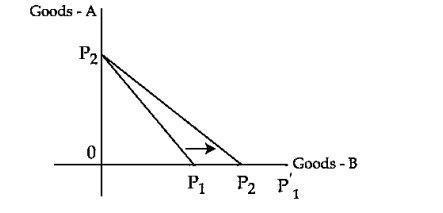
In this diagram, budget line goes flatter from P₁ to P₂ to P₁'. The reason for budget line being flatter is: (PYQ 2023)
QUESTION 15 OF 15
What is the General shape of Demand curve ? (PYQ 2023)
Test Complete!
Answer Review
1 Elasticity of demand is constant and equal to 1 at every point on the demand curve. The shape of such a demand curve would be : (PYQ 2022)
Unitary elastic demand means elasticity is equal to 1. When elasticity remains 1 at every point, total expenditure remains constant. Such a demand curve is not a straight line. It is represented by a rectangular hyperbola.
(Detailed) → When price elasticity of demand is equal to 1 at every point on the demand curve, it is called unitary elastic demand. → In this case, total expenditure remains constant because the percentage change in quantity demanded is equal to the percentage change in price. → The demand curve showing unitary elasticity throughout is a rectangular hyperbola. → Hence, Option D is the correct answer.
- A) Horizontal straight line → A horizontal demand curve represents perfectly elastic demand, where elasticity is infinite.
- B) Vertical straight line → A vertical demand curve represents perfectly inelastic demand, where elasticity is zero.
- C) Downward sloping curve → A normal demand curve slopes downward, but elasticity does not remain equal to 1 at every point.
Used
- Option A → Incorrect because horizontal demand curve means perfectly elastic demand.
- Option B → Incorrect because vertical demand curve means perfectly inelastic demand.
- Option C → Incorrect because it does not specifically show constant unitary elasticity.
- Option D → Correct because rectangular hyperbola shows elasticity equal to 1 throughout.
- Final Answer → Option D.
2 If tea and coffee can be used in place of one another, then which of the following statements hold true ? (PYQ 2022)
Statements:
(A) Increase in price of tea leads to decrease in demand for coffee.
(B) Increase in price of tea leads to increase in demand for coffee.
(C) Tea and coffee are substitute goods.
(D) Decrease in price of tea leads to increase in price of coffee.
(E) Tea and coffee are complementary goods.
Choose the correct answer from the options given below :
Tea and coffee can be used in place of one another, making them substitute goods. In substitute goods, an increase in the price of one leads to an increase in demand for the other. Therefore, if tea becomes more expensive, people will demand more coffee.
(Detailed) → Substitute goods are those that can be used in place of one another to satisfy a given want. → Therefore, Statement (C) is correct. → Because tea and coffee are substitutes, an increase in the price of tea will cause consumers to shift their consumption to coffee. → As a result, the demand for coffee will increase. → Therefore, Statement (B) is also correct. → Hence, Option D is the correct answer.
- A) (A) and (E) only → This is incorrect because an increase in the price of tea does not decrease the demand for coffee. Also, tea and coffee are not complementary goods.
- B) (B) and (E) only → This is incorrect because statement (E) is wrong. Tea and coffee are substitutes, not complements.
- C) (C) and (D) only → This is incorrect because statement (D) is not the correct relationship. A decrease in tea price affects demand for coffee, not necessarily the price of coffee directly.
Used
- Option A → Incorrect because substitute goods move demand in the other product's favour when one price rises.
- Option B → Incorrect because tea and coffee are not complementary goods.
- Option C → Incorrect because statement (D) gives an incorrect price-demand relation.
- Option D → Correct because tea and coffee are substitutes and a rise in tea price increases coffee demand.
- Final Answer → Option D.
3 Arrange the following of elasticities of demand in increasing order as per geometric method. (PYQ 2023)
Statements:
(A) Mid-Point of the demand curve
(B) Intercept on Y-axis
(C) Between Mid-Point and intercept on X-axis
(D) Between Mid-Point and intercept on Y-axis
(E) Intercept on X-axis
Choose the correct answer from the options given below:
At X-axis intercept, elasticity is zero. Between X-axis and midpoint, elasticity is less than one. At midpoint, elasticity is equal to one. At Y-axis intercept, elasticity is infinity.
(Detailed) → According to the geometric method of price elasticity of demand: → (E) At the X-axis intercept, elasticity = 0. → (C) Between X-axis and midpoint, elasticity < 1. → (A) At midpoint, elasticity = 1. → (D) Between midpoint and Y-axis, elasticity > 1. → (B) At Y-axis intercept, elasticity = infinity. → Therefore, increasing order is (E), (C), (A), (D), (B). → Hence, Option D is the correct answer.
- A) (A), (B), (C), (D), (E) → This does not follow the increasing order from zero to infinity.
- B) (D), (B), (A), (E), (C) → This starts with elasticity greater than one, so it is incorrect.
- C) (B), (D), (A), (C), (E) → This starts with the highest elasticity, not the lowest.
Used
- Option A → Incorrect order.
- Option B → Incorrect because high elasticity points come first.
- Option C → Incorrect because Y-axis intercept has highest elasticity.
- Option D → Correct increasing order from zero to infinity.
- Final Answer → Option D.
4 The goods which can be used in place of each other are called? (PYQ 2023)
Substitute goods can replace each other. Tea and coffee are common examples. If price of one rises, demand for the other may rise. They are different from complementary goods.
(Detailed) → Goods which can be used in place of each other to satisfy a particular want are called substitute goods. → For example, tea and coffee can be used as substitutes. → If the price of coffee rises, some consumers may shift to tea. → Hence, Option C is the correct answer.
- A) Normal goods → Normal goods are goods whose demand rises with income, not goods used in place of each other.
- B) Complementary goods → Complementary goods are used together, not in place of each other.
- D) Giffen goods → Giffen goods are inferior goods whose demand may rise when price rises.
Used
- Option A → Incorrect because it is an income-based concept.
- Option B → Incorrect because complementary goods are used together.
- Option C → Correct because substitute goods are used in place of each other.
- Option D → Incorrect because it is a special inferior good concept.
- Final Answer → Option C.
5 The demand for a good moves in opposite direction if change in the price of its ________: (PYQ 2023)
Complementary goods are used together. Price of one affects demand for the other oppositely. If petrol price rises, car demand may fall.
(Detailed) → The demand for a good moves in the opposite direction of the price of its complementary goods. → For example, if the price of sugar rises, demand for tea may fall because tea and sugar are consumed together. → Therefore, the blank should be filled with "complementary goods." → Hence, Option A is the correct answer.
- B) Substitute goods → For substitutes, demand usually moves in the same direction as the price of the related good.
- C) Inferior goods → Inferior goods are related to income, not the price of related goods.
- D) Consumption goods → This is a broad category and does not explain the opposite price-demand relation.
Used
- Option A → Correct because it directly fits the price-demand inverse relationship of jointly used goods.
- Option B → Incorrect because substitute relation is different.
- Option C → Incorrect because it is an income-related concept.
- Option D → Incorrect because it is too general.
- Final Answer → Option A.
6 If the price of coffee increases then consumption of tea also increases, it implies that tea and coffee are ________: (PYQ 2023)
Tea and coffee can replace each other. If coffee becomes costly, people may shift to tea. Demand for tea rises when coffee price rises. This is the relation of substitute goods.
(Detailed) → Substitute goods are goods that can be used in place of each other. → Tea and coffee are examples of substitute goods. → If the price of coffee increases, consumers may buy more tea instead. → Therefore, tea and coffee are substitute goods. → Hence, Option A is the correct answer.
- B) Giffen good → Giffen good is a special inferior good, not a related-good category like tea and coffee.
- C) Complementary good → Complementary goods are consumed together, like tea and sugar.
- D) Perishable good → Perishable goods are goods that spoil quickly; this is not the concept asked.
Used
- Option A → Correct because price of coffee rises and demand for tea rises.
- Option B → Incorrect because it is an unrelated concept.
- Option C → Incorrect because complements move oppositely.
- Option D → Incorrect because it is not related to demand relationship.
- Final Answer → Option A.
7 Car and petrol are the example of ________ goods. (PYQ 2023)
Car and petrol are used together. Petrol is needed to run a car. Such goods are complementary goods. Demand moves in opposite direction to related good's price.
(Detailed) → Complementary goods are goods used together to satisfy a particular want. → Car and petrol are consumed jointly because a car needs petrol to operate. → If petrol becomes very expensive, demand for petrol-using cars may fall. → Hence, car and petrol are complementary goods. → Hence, Option D is the correct answer.
- A) Normal goods → Normal goods are classified based on income-demand relation, not joint use.
- B) Inferior goods → Inferior goods are also income-based goods.
- C) Substitute goods → Substitute goods are used in place of each other, but car and petrol are used together.
Used
- Option A → Incorrect because it is an income-based category.
- Option B → Incorrect because it is an income-based category.
- Option C → Incorrect because car and petrol are not substitutes.
- Option D → Correct because they are used together.
- Final Answer → Option D.
8 Those goods which can be used together are called ________ goods. (PYQ 2023)
Goods used together are complementary goods. Examples: tea and sugar, car and petrol. Demand of one depends on the other.
(Detailed) → Complementary goods are those goods which are consumed or used together to satisfy a given want. → Common examples include tea and sugar, shoes and socks, pen and ink. → Therefore, the goods which can be used together are called complementary goods. → Hence, Option B is the correct answer.
- A) Substitute goods → Substitute goods are used in place of each other.
- C) Consumption goods → Consumption goods are used by consumers, but not necessarily together.
- D) Capital goods → Capital goods are used for production, not for joint consumption.
Used
- Option A → Incorrect because substitutes are used in place of each other.
- Option B → Correct because complements are used together.
- Option C → Incorrect because it is a broad category.
- Option D → Incorrect because it is production-related.
- Final Answer → Option B.
9 Arrange the elasticity (ed) as we move upwards along a linear demand curve. (PYQ 2023)
Statements:
(A) ed = 1
(B) ed = 0
(C) ed = ∞
(D) ed > 1
(E) ed < 1
Choose the correct answer from the options given below :
At the lower end of a straight-line demand curve, elasticity is zero. Below the midpoint, elasticity is less than 1. At the midpoint, elasticity is equal to 1. Above the midpoint, elasticity is greater than 1 and at the top it is infinity.
(Detailed) → On a linear demand curve, elasticity changes at different points. → Moving upward from the bottom of the demand curve: → At the quantity-axis intercept, elasticity is 0. → Below midpoint, elasticity is less than 1. → At midpoint, elasticity is equal to 1. → Above midpoint, elasticity is greater than 1. → At the price-axis intercept, elasticity is infinity. → Therefore, the correct sequence moving upwards is ed = 0, ed < 1, ed = 1, ed > 1, ed = ∞. → Hence, Option A is the correct answer.
- B) (A), (B), (C), (D), (E) → This is incorrect because elasticity does not start with ed = 1 when moving upward from the bottom.
- C) (D), (C), (B), (A), (E) → This is incorrect because elasticity greater than 1 and infinity occur near the upper part, not at the beginning from the bottom.
- D) (B), (C), (A), (D), (E) → This is incorrect because ed = ∞ is placed too early.
Used
- Option A → Correct because it follows the movement from bottom to top of a linear demand curve.
- Option B → Incorrect because the order is not based on curve position.
- Option C → Incorrect because upper-end elasticity values are placed first.
- Option D → Incorrect because infinity is wrongly placed near the beginning.
- Final Answer → Option A.
10 Which of the following are the examples of complementary goods ? (PYQ 2023)
Statements:
(A) pen and ink
(B) tea and sugar
(C) tea and coffee
(D) ball pen and gel pen
(E) shoes and socks
Choose the correct answer from the options given below :
Complementary goods are used together. Pen and ink are used together. Tea and sugar are commonly used together. Shoes and socks are also used together.
(Detailed) → Complementary goods are goods that are consumed or used together. → Pen and ink are complements because ink is used with a pen. → Tea and sugar are complements because sugar is commonly used with tea. → Shoes and socks are complements because they are generally used together. → Tea and coffee, and ball pen and gel pen are substitutes, not complements. → Hence, Option B is the correct answer.
- A) (A), (C) and (D) only → This is incorrect because tea and coffee, and ball pen and gel pen are substitute goods.
- C) (B), (C) and (D) only → This is incorrect because tea and coffee, and ball pen and gel pen are substitutes.
- D) (C) and (E) only → This is incorrect because tea and coffee are not complements; they are substitutes.
Used
- Option A → Incorrect because it includes substitute goods.
- Option B → Correct because all three pairs are complementary goods.
- Option C → Incorrect because it includes substitute goods.
- Option D → Incorrect because tea and coffee are substitutes.
- Final Answer → Option B.
11 Suppose the price elasticity of demand for a good is (-1). At a price of ₹ 4 per unit, demand for the good is 40 units. Suppose the price of the good increases to ₹ 6 per unit, and as a result, the demand for the good will be ______ : (PYQ 2023)
Price elasticity of demand = -1. Price rises from ₹ 4 to ₹ 6. Using elasticity formula, change in demand = -20 units. New demand = 40 - 20 = 20 units.
(Detailed) → Given: Elasticity of demand, Ed = -1 → Original price, P = ₹ 4 → Original quantity, Q = 40 units → New price = ₹ 6 → Change in price, ΔP = ₹ 2 → Formula: Ed = (ΔQ / ΔP) × (P / Q) → Substitute the values: → -1 = (ΔQ / 2) × (4 / 40) → -1 = (ΔQ / 2) × (1 / 10) → -1 = ΔQ / 20 → ΔQ = -20 units → New demand = Original demand + Change in demand → New demand = 40 + (-20) → New demand = 20 units → Therefore, the demand will be 20 units. → Hence, Option B is the correct answer.
- A) 10 units → This is incorrect because the calculated new demand is 20 units, not 10 units.
- C) 30 units → This is incorrect because a price rise with unit elasticity reduces demand by 20 units here.
- D) 40 units → This is incorrect because demand will not remain unchanged when price rises and elasticity is -1.
Used
- Option A → Incorrect because it overstates the fall in demand.
- Option B → Correct because elasticity calculation gives new demand of 20 units.
- Option C → Incorrect because it gives a smaller fall than required.
- Option D → Incorrect because demand must fall when price rises.
- Final Answer → Option B.
12 A consumer wants to consume two goods X and Y. The price of the goods are ₹ 2 per unit and ₹ 5 per unit respectively and his income is ₹ 30. What will be the slope of the budget line ? (PYQ 2023)
Slope of budget line = -Px / Py. Price of X = ₹ 2. Price of Y = ₹ 5. Slope = -2/5 = -0.4.
(Detailed) → Given: Price of good X, Px = ₹ 2 → Price of good Y, Py = ₹ 5 → Income = ₹ 30 → Formula: Slope of budget line = -Px / Py → Substitute the values: → Slope = -2 / 5 → Slope = -0.4 → Therefore, the slope of the budget line is -0.4. → Hence, Option B is the correct answer.
- A) -0.5 → This is incorrect because -2/5 equals -0.4, not -0.5.
- C) -5 → This is incorrect because it does not represent the ratio of prices.
- D) -2 → This is incorrect because it takes only the price of X, not the price ratio.
Used
- Option A → Incorrect because it is a calculation error.
- Option B → Correct because slope = -Px/Py = -2/5 = -0.4.
- Option C → Incorrect because -5 is not the price ratio.
- Option D → Incorrect because -2 is not the slope.
- Final Answer → Option B.
13 Match List-I with List-II. (PYQ 2023)
| List-I | List-II |
|---|---|
| A. Tea and Coffee | I. Complementary goods |
| B. Car and Fuel | II. Inferior goods |
| C. Low grade cereal food | III. Substitute goods |
| D. Good quality wheat | IV. Normal good |
Tea and coffee are substitute goods. Car and fuel are complementary goods. Low grade cereal food is an inferior good. Good quality wheat is a normal good.
(Detailed) → Tea and coffee can replace each other, so they are substitutes. Therefore, (A)-(III). → Car and fuel are used together, so they are complements. Therefore, (B)-(I). → Low grade cereal food is often an inferior good because its demand may fall as income rises. Therefore, (C)-(II). → Good quality wheat is a normal good because its demand generally rises with income. Therefore, (D)-(IV). → Hence, Option B is the correct answer.
- A) (A)-(I), (B)-(II), (C)-(III), (D)-(IV) → This is incorrect because tea and coffee are not complements, and car and fuel are not inferior goods.
- C) (A)-(II), (B)-(III), (C)-(IV), (D)-(I) → This is incorrect because tea and coffee are not inferior goods, and car and fuel are not substitutes.
- D) (A)-(IV), (B)-(III), (C)-(II), (D)-(I) → This is incorrect because tea-coffee and car-fuel are mismatched.
Used
- Option A → Incorrect because substitute and complement pairs are confused.
- Option B → Correct because all pairs are correctly matched.
- Option C → Incorrect because all major pairs are wrong.
- Option D → Incorrect because tea-coffee and car-fuel are mismatched.
- Final Answer → Option B.
14 In this diagram, budget line goes flatter from P₁ to P₂ to P₁'. The reason for budget line being flatter is: (PYQ 2023)
A flatter budget line means change in relative prices. If Good-A is on the X-axis, fall in its price increases its maximum affordable quantity. The X-axis intercept moves outward. This makes the budget line flatter.
(Detailed) → A budget line shows different combinations of two goods that a consumer can buy with given income and prices. → If the price of Good-A on the X-axis decreases, the consumer can buy more of Good-A with the same income. → This increases the intercept on the Good-A axis and causes the budget line to pivot outward. → As a result, the budget line becomes flatter. → Hence, Option D is the correct answer.
- A) No change Goods-B price → No change in Good-B price alone cannot explain the budget line becoming flatter.
- B) Goods-B price increases → Increase in Good-B price would change the intercept on the Good-B axis, but it does not match the standard reason here.
- C) Goods-B price decreases → Decrease in Good-B price would usually make the budget line steeper if Good-B is on the Y-axis.
Used
- Option A → Incorrect because a price change is needed to rotate the line.
- Option B → Incorrect because it does not match the flatter movement standardly.
- Option C → Incorrect because it would change the line differently.
- Option D → Correct because fall in Good-A price makes the budget line flatter.
- Final Answer → Option D.
15 What is the General shape of Demand curve ? (PYQ 2023)
Demand curve generally slopes downward. Price and quantity demanded are inversely related. For normal goods, lower price leads to higher demand. This follows the law of demand.
(Detailed) → The demand curve generally slopes downward from left to right. → This happens because there is an inverse relationship between the price of a good and its quantity demanded. → The law of diminishing marginal utility and substitution/income effects explain why demand generally rises when price falls. → Therefore, for normal goods, the demand curve is generally downward sloping. → Hence, Option C is the correct answer.
- A) Upward sloping straight line → This represents the supply curve, not the demand curve.
- B) A line parallel to x-axis → This represents perfectly elastic demand, which is a special case, not the general shape.
- D) A line parallel to y-axis → This represents perfectly inelastic demand, not the general case.
Used
- Option A → Incorrect because demand usually slopes downward.
- Option B → Incorrect because it is a special case.
- Option C → Correct because it gives the general shape of the demand curve.
- Option D → Incorrect because it is another special case.
- Final Answer → Option C.