
CUET UG Biology Booster Test 2-Recombinant DNA Processes
📌 Answers are locked once submitted — results and explanations appear at the end.
QUESTION 1 OF 20
Arrange the enzymatic treatments in the logical order required to isolate pure DNA from a bacterial cell:
1. Addition of chilled ethanol
2. Treatment with lysozyme
3. Treatment with ribonuclease and protease
QUESTION 2 OF 20
Match the extraction events with their corresponding visual or physical outcome:
| Event | Outcome |
|---|---|
| I. Addition of chilled ethanol | P. Breaks down bacterial cell wall |
| II. Treatment with lysozyme | Q. Removes RNA |
| III. Treatment with protease | R. Precipitates pure DNA as fine threads |
| IV. Treatment with ribonuclease | S. Removes histone proteins |
QUESTION 3 OF 20
Why would a researcher choose to use cellulase rather than lysozyme when attempting to extract genetic material from a leaf sample?
QUESTION 4 OF 20
Which of the following enzymes should NOT be added to the cellular extract if the goal is to purify and maintain intact DNA?
QUESTION 5 OF 20
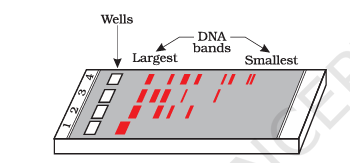
Based on the provided gel image, how does the visual migration pattern in lanes 2 to 4 prove that the restriction enzyme digestion was successful?
QUESTION 6 OF 20
What fundamental property of DNA forces it to migrate towards the anode during the progression check shown in the gel?
QUESTION 7 OF 20
Which of the following components is NOT required in the reaction mixture for the in vitro synthesis of a gene using PCR?
QUESTION 8 OF 20
Arrange the events involving primers during a single PCR cycle:
1. The enzyme extends the primers using provided nucleotides.
2. The double-stranded DNA template is denatured into single strands.
3. Primers anneal to complementary regions on the single-stranded DNA.
QUESTION 9 OF 20
Match the PCR steps/tools to their underlying mechanisms:
| PCR Step/Tool | Mechanism |
|---|---|
| I. Denaturation | P. Extends primers along the template |
| II. Thermostable Polymerase | Q. Separates double-stranded DNA via high temperature |
| III. Annealing | R. Binds chemically synthesized oligonucleotides |
| IV. Extension | S. Withstands heat-induced degradation |
QUESTION 10 OF 20
During the extension phase of PCR, what serves as the template for the thermostable DNA polymerase to add nucleotides?
QUESTION 11 OF 20
Why is the origin of Taq polymerase from Thermus aquaticus biologically significant for the PCR process?
QUESTION 12 OF 20
Evaluate the following statements concerning Taq polymerase activity:
Statement I: It actively synthesises new DNA strands during the high-temperature denaturation phase.
Statement II: It requires oligonucleotide primers to initiate the extension process.
QUESTION 13 OF 20
QUESTION 14 OF 20
QUESTION 15 OF 20
Why is it crucial that both the source DNA and the vector DNA are cut with the exact same specific restriction enzyme before mixing them?
QUESTION 16 OF 20
Which of the following events is NOT a part of creating new DNA combinations in vitro during recombinant DNA technology?
QUESTION 17 OF 20
When selecting for transformants, the ampicillin resistance gene introduced via the recombinant vector acts as a selectable marker because it:
QUESTION 18 OF 20
If a population of E. coli cells is subjected to the transformation process but fails to take up the recombinant DNA, which of the following statements will NOT be true?
QUESTION 19 OF 20
If a protein-encoding gene is successfully expressed in a heterologous host, the resulting product is technically referred to as a:
QUESTION 20 OF 20
Consider the following statements about producing desirable proteins:
Statement I: Small volume cultures in the laboratory are sufficient to yield large, commercial quantities of products.
Statement II: To produce in large quantities, bioreactors processing 100-1000 litres of culture are required.
Test Complete!
Answer Review
1 Arrange the enzymatic treatments in the logical order required to isolate pure DNA from a bacterial cell:
1. Addition of chilled ethanol
2. Treatment with lysozyme
3. Treatment with ribonuclease and protease
First, the cell wall must be broken by enzymes (Lysozyme). Second, the macromolecules (RNA/proteins) are removed by their respective enzymes. Finally, the pure DNA is precipitated by chilled ethanol.
Isolation of DNA follows a strict sequence: (2) Cell lysis using lysozyme (for bacteria) to release the cellular content, (3) Purification by adding ribonuclease (removes RNA) and protease (removes proteins), and finally (1) Precipitation using chilled ethanol to make the DNA visible/isolatable as fine threads.
- Option B → Ethanol precipitation cannot occur before cell lysis or purification.
- Option C → Purification enzymes cannot be added before the cell wall is broken.
- Option D → Ethanol cannot be added between enzyme treatments.
Used Contextual/Tonal Matching
Application: Defining the logic: Lysis -> Purification -> Precipitation.
Final Logic: The biological order of operations requires breaking the cell, cleaning the sample, then precipitating.
"Break (Lysozyme), Clean (RNase/Protease), Precipitate (Ethanol)."
2 Match the extraction events with their corresponding visual or physical outcome:
| Event | Outcome |
|---|---|
| I. Addition of chilled ethanol | P. Breaks down bacterial cell wall |
| II. Treatment with lysozyme | Q. Removes RNA |
| III. Treatment with protease | R. Precipitates pure DNA as fine threads |
| IV. Treatment with ribonuclease | S. Removes histone proteins |
I-R: Ethanol precipitates DNA. II-P: Lysozyme digests cell walls. III-S: Protease removes histones/proteins. IV-Q: Ribonuclease removes RNA.
Chilled ethanol is strictly used for the precipitation of DNA (I-R). Lysozyme is a specific enzyme used to break bacterial cell walls (II-P). Proteases are used to degrade proteins, including histones associated with DNA (III-S). Ribonucleases specifically degrade RNA (IV-Q).
- Option B → Incorrectly pairs ethanol with wall breaking (P).
- Option C → Incorrectly pairs ribonuclease with wall breaking (P).
- Option D → Incorrectly pairs ethanol with RNA removal (Q).
Used Option Grouping
Application: Aligning the specific tool/reagent with its biochemical function.
Final Logic: A is the only choice where all pairs are scientifically accurate.
"Ethanol-Precipitate; Lysozyme-Lysis."
3 Why would a researcher choose to use cellulase rather than lysozyme when attempting to extract genetic material from a leaf sample?
Plant cell walls are made of cellulose. Cellulase is the enzyme that breaks down cellulose. Lysozyme is for bacterial cell walls (peptidoglycan).
Different organisms have different cell wall compositions. Plants have cell walls made of cellulose. Therefore, to effectively break the plant cell wall and release the DNA, one must use cellulase. Lysozyme is specific to bacterial peptidoglycan walls.
- Option A → Fungi, not plants, contain chitin.
- Option C → Lysozyme does not destroy DNA.
- Option D → Protease is the enzyme that breaks down proteins.
Used Elimination
Application: Eliminate based on cell wall composition: Plants = Cellulose = Cellulase.
Final Logic: Substrate specificity matches Enzyme specificity.
"Cellulose = Cellulase."
4 Which of the following enzymes should NOT be added to the cellular extract if the goal is to purify and maintain intact DNA?
DNA is the target molecule. Deoxyribonuclease (DNase) breaks down DNA. The goal is to keep DNA intact.
Deoxyribonuclease is an enzyme that degrades DNA. Adding it to an extract would destroy the very molecule one is trying to isolate. The other enzymes (Ribonuclease, Protease, Lysozyme) are helpful for purification by removing unwanted contaminants (RNA, proteins, or breaking cell walls).
- Option A → Ribonuclease removes RNA, aiding purity.
- Option B → Protease removes proteins, aiding purity.
- Option D → Lysozyme helps release DNA from bacterial cells.
Used Odd One Out
Application: All other enzymes help purify/isolate DNA; DNase destroys the target.
Final Logic: You never add an enzyme that destroys your target product.
"DNase destroys DNA."
5 Based on the provided gel image, how does the visual migration pattern in lanes 2 to 4 prove that the restriction enzyme digestion was successful?
Undigested DNA is one large band. Digested DNA is many small fragments. Small fragments move faster through the gel.
In agarose gel electrophoresis, larger molecules move slowly and stay near the top, while smaller fragments resulting from successful restriction digestion move faster and further through the gel. Multiple distinct bands indicate that the enzyme cut the DNA at specific sites.
- Option A → This indicates the DNA was not cut (or the gel failed).
- Option C → DNA should not disappear; it should be visible as bands.
- Option D → DNA always moves towards the anode (positive electrode) because it is negatively charged.
Used Contextual/Tonal Matching
Application: Matching the visual "success" with the principle of gel migration.
Final Logic: Digestion = Fragmentation = Faster migration/multiple bands.
"Small bands = Successful cutting."
6 What fundamental property of DNA forces it to migrate towards the anode during the progression check shown in the gel?
DNA backbone contains phosphates. Phosphates are negatively charged. Opposite charges attract; DNA moves to positive (Anode).
The phosphate groups in the sugar-phosphate backbone of DNA give the molecule an overall negative charge at neutral pH. In an electric field, negatively charged molecules are attracted to the positive electrode (anode).
- Option A → DNA is negative, not positive.
- Option B → DNA is not neutral; it is strongly charged.
- Option D → Agarose is a porous matrix, not a repulsive agent.
Used Elimination
Application: Recall the chemical nature of DNA.
Final Logic: DNA = Negatively charged backbone = moves to Anode.
"DNA is negative; Anode is positive."
7 Which of the following components is NOT required in the reaction mixture for the in vitro synthesis of a gene using PCR?
PCR is for synthesis/amplification. Restriction enzymes are for cutting. You do not cut the DNA during PCR.
PCR is a replication technique. It requires a template (genomic DNA), building blocks (nucleotides), primers to start synthesis, and a polymerase enzyme to build the strands. Restriction endonucleases are used in the cloning or isolation phases, not in the PCR amplification phase itself.
- Option A → Template is essential for replication.
- Option B → Primers are essential to initiate replication.
- Option D → Thermostable polymerase is essential to build the new strands.
Used Elimination
Application: Eliminate the tools needed for other phases of rDNA technology.
Final Logic: PCR = Synthesis; Restriction Enzymes = Cutting.
"PCR doesn't need scissors (Restriction Enzymes)."
8 Arrange the events involving primers during a single PCR cycle:
1. The enzyme extends the primers using provided nucleotides.
2. The double-stranded DNA template is denatured into single strands.
3. Primers anneal to complementary regions on the single-stranded DNA.
First: Denature DNA. Second: Anneal Primers. Third: Extend chain.
PCR cycling occurs in a set sequence: (2) High heat denatures the template, (3) lowering temperature allows primers to anneal to the template, and (1) then the temperature is optimized for the polymerase to extend the chain using nucleotides.
- Option B, C, D → Incorrect order of physical events needed for synthesis.
Used Contextual/Tonal Matching
Application: DAE (Denature-Anneal-Extend) protocol.
Final Logic: Template must be single-stranded (2) before primers can bind (3), before extension (1) can occur.
"DAE."
9 Match the PCR steps/tools to their underlying mechanisms:
| PCR Step/Tool | Mechanism |
|---|---|
| I. Denaturation | P. Extends primers along the template |
| II. Thermostable Polymerase | Q. Separates double-stranded DNA via high temperature |
| III. Annealing | R. Binds chemically synthesized oligonucleotides |
| IV. Extension | S. Withstands heat-induced degradation |
I (Denaturation) = Q (Heat separation). II (Polymerase) = S (Heat stability). III (Annealing) = R (Primer binding). IV (Extension) = P (Primer extension).
Denaturation (I) involves separating strands via high heat (Q). Thermostable polymerase (II) is unique because it withstands this heat (S). Annealing (III) is where primers bind (R). Extension (IV) is where the polymerase builds the strand (P).
- Option B → Misaligns Polymerase mechanism with P.
- Option C → Misaligns Denaturation with S.
- Option D → Misaligns Denaturation with R.
Used Option Grouping
Application: Direct mapping of steps to biological mechanisms.
Final Logic: Option A provides the only set of perfectly aligned definitions.
"I-Q, II-S, III-R, IV-P."
10 During the extension phase of PCR, what serves as the template for the thermostable DNA polymerase to add nucleotides?
PCR amplifies a target DNA segment. The original target (genomic) is the template for the new copy.
The polymerase uses the single-stranded template DNA—which originates from the genomic DNA—to determine the order of nucleotides added to the growing strand. The primer binds to this template, and the enzyme extends it based on the template's sequence.
- Option A → PCR uses DNA templates, not RNA.
- Option C → Enzymes are not templates.
- Option D → An ampicillin gene is a marker, not the template for PCR replication.
Used Substitution
Application: Substituting "Template" with "DNA strand to be copied."
Final Logic: Extension phase follows the sequence of the DNA template (genomic DNA).
"Template = The original document."
11 Why is the origin of Taq polymerase from Thermus aquaticus biologically significant for the PCR process?
PCR cycles involve high heat (94-95°C). Normal enzymes would denature and fail. Taq polymerase is evolutionarily adapted to heat, maintaining activity.
The PCR process requires repeated cycles of high-temperature denaturation to separate DNA strands. The significance of using Taq polymerase from Thermus aquaticus is its inherent thermostability, allowing it to function at high temperatures without being denatured, which is essential for repeating the amplification process automatically.
- Option B → Taq polymerase is a DNA synthesizer, not a cutter.
- Option C → The negative charge of DNA is a chemical property of the phosphate backbone, not enzyme-related.
- Option D → Cell wall breakdown is handled by lysozyme, not Taq.
Used Substitution
Application: Substitute the biological necessity ("heat survival") with the enzyme's property ("Thermostability").
Final Logic: High-temperature PCR needs a heat-stable enzyme.
"Thermus = Thermostable."
12 Evaluate the following statements concerning Taq polymerase activity:
Statement I: It actively synthesises new DNA strands during the high-temperature denaturation phase.
Statement II: It requires oligonucleotide primers to initiate the extension process.
Synthesis occurs during the extension phase, not denaturation. DNA polymerase always requires a primer 3'-OH end.
Statement I is false because denaturation is the phase for separating strands, not synthesis; synthesis occurs during the extension phase at a lower temperature (approx. 72°C). Statement II is true because DNA polymerases cannot start synthesis de novo; they must have a primer to provide a starting point.
- Option A → Statement I is incorrect.
- Option B → Statement II is correct.
- Option D → Statement I is incorrect.
Used Elimination
Application: Validate both statements independently against PCR mechanics.
Final Logic: Denaturation = separation; Extension = synthesis; Polymerase = needs primer.
"Denature = Separate; Extend = Synthesis."
13
Repeating the cycle requires high heat. Only a heat-stable enzyme survives this. Thus, the enzyme enables the repetition.
As mentioned in the passage, the repeated amplification is achieved specifically by using a thermostable DNA polymerase. This enzyme does not degrade at the high temperatures used in the denaturation step, allowing it to survive multiple cycles.
- Option A → Used for final DNA precipitation, not for cycling.
- Option C → Primers are DNA, not RNA in PCR, and not the factor for cycling.
- Option D → Used for initial bacterial cell wall breakdown.
Used Contextual/Tonal Matching
Application: Extracting information directly from the provided passage.
Final Logic: The passage explicitly attributes repeated amplification to "thermostable DNA polymerase."
"Repeated Cycles = Heat Stable Enzyme."
14
PCR is an exponential amplification method. The passage explicitly mentions "1 billion copies."
The passage clearly states that repeating the DNA replication process many times results in the segment being amplified to approximately 1 billion copies.
- Option A → Degradation is not the goal.
- Option C → DNA is not converted into RNA in PCR.
- Option D → The number mentioned is 1 billion, not 1 million, and it produces DNA, not protein.
Used Contextual/Tonal Matching
Application: Direct retrieval of the numerical fact from the passage.
Final Logic: Passage text: "1 billion copies are made."
"PCR = Billion-fold."
15 Why is it crucial that both the source DNA and the vector DNA are cut with the exact same specific restriction enzyme before mixing them?
Same enzyme = same recognition sequence. This results in identical "sticky" overhangs. Complementary overhangs allow them to join together.
Restriction enzymes cut DNA at specific recognition sequences, leaving "sticky ends" (overhangs). By using the same enzyme for both the gene of interest and the vector, they are left with complementary sticky ends. This allows them to base-pair together, enabling ligase to seal them into a single recombinant molecule.
- Option A → Antibiotic resistance is a marker property, not dependent on the cutting enzyme.
- Option C → Digestion into nucleotides is not the goal of cloning.
- Option D → Ligase works on cut (nicked) DNA, not uncut.
Used Substitution
Application: Substituting "Compatible cut" with "Complementary sticky ends."
Final Logic: Same enzyme = Same cut ends = Compatible base pairing.
"Same Cut = Same Sticky Ends."
16 Which of the following events is NOT a part of creating new DNA combinations in vitro during recombinant DNA technology?
rDNA technology builds the DNA construct. Translation is a cellular process requiring ribosomes, tRNA, etc. It does not happen "in the tube" with just ligation reagents.
Recombinant DNA technology focuses on joining DNA segments. Translating DNA into protein is a complex cellular process (Protein Synthesis) that requires living cells, not just reagents in a tube.
- Option A → Cutting is the first essential step.
- Option B → Mixing is required to bring fragments together.
- Option C → Ligation is required to join fragments.
Used Elimination
Application: Eliminate the standard cloning steps to find the process that occurs only in vivo.
Final Logic: Protein synthesis requires ribosomes and cells, not just the tube containing DNA ligation reagents.
"Recombinant DNA = Building the Molecule, not the Protein."
17 When selecting for transformants, the ampicillin resistance gene introduced via the recombinant vector acts as a selectable marker because it:
Marker = Resistance. Resistance = Growth in presence of antibiotic. Ampicillin-sensitive cells die; resistant ones survive.
A selectable marker is a gene used to identify which cells have successfully taken up the foreign DNA (transformants). By growing the cells on media containing ampicillin, only those that express the ampicillin resistance gene (i.e., the transformants) will survive and grow, allowing for selection.
- Option A → It gives resistance to the antibiotic, it does not produce it.
- Option B → It allows transformed cells to grow, it does not kill them.
- Option D → This is irrelevant to the function of a selectable marker.
Used Substitution
Application: Substituting "Selectable Marker" with its functional role in cell culture.
Final Logic: Marker = Antibiotic resistance = Growth survival.
"Selectable Marker = Survival Tag."
18 If a population of E. coli cells is subjected to the transformation process but fails to take up the recombinant DNA, which of the following statements will NOT be true?
Untransformed cells are sensitive to ampicillin. They die; they do not grow. They are not markers; they are the failed product.
If cells fail to take up the recombinant DNA, they remain "untransformed." Because they do not have the resistance gene, they remain sensitive to ampicillin and will die when plated on antibiotic media. They cannot grow profusely, nor do they function as a marker.
- Option A → Correct; they are indeed untransformed.
- Option B → Correct; they did not get the DNA.
- Option C → Correct; they are sensitive to ampicillin.
Used Extreme Word Filter
Application: The statement "grow profusely" is impossible for antibiotic-sensitive cells on an antibiotic plate.
Final Logic: Untransformed = Sensitive = Death.
"Fail to take up DNA = Fail to survive."
19 If a protein-encoding gene is successfully expressed in a heterologous host, the resulting product is technically referred to as a:
Protein encoded by a foreign (recombinant) DNA is called "recombinant protein." Restriction enzymes cut DNA. Markers indicate success.
When a foreign gene is placed into a host (the heterologous host) and expressed, the protein product is created using the rDNA construct. Therefore, the product itself is called a "recombinant protein."
- Option B → This is a tool, not a product.
- Option C → This is a marker gene, not the protein product.
- Option D → This is a DNA molecule, not a protein.
Used Substitution
Application: Substituting "Expressed recombinant gene product" with the industry standard term.
Final Logic: rDNA-produced protein = Recombinant protein.
"Recombinant gene = Recombinant protein."
20 Consider the following statements about producing desirable proteins:
Statement I: Small volume cultures in the laboratory are sufficient to yield large, commercial quantities of products.
Statement II: To produce in large quantities, bioreactors processing 100-1000 litres of culture are required.
Lab scales are too small for commercial quantities. Commercial quantities require large bioreactors (100-1000L).
Statement I is incorrect because lab-scale experiments are insufficient for mass-producing products like insulin or vaccines; they are for research and development. Statement II is true because commercial quantities require industrial-sized bioreactors (vessels) to control environmental parameters over 100–1000 liters.
- Option A → Statement I is incorrect.
- Option B → Statement II is correct.
- Option C → Statement II is correct.
Used Substitution
Application: Contrast "Laboratory scale" vs. "Commercial scale."
Final Logic: Lab volume (small) $\neq$ Commercial demand (large volume requires large bioreactors).
"Lab = Test; Bioreactor = Production."