
CUET UG Biology Booster Test 2-Large Scale Production and Refining
📌 Answers are locked once submitted — results and explanations appear at the end.
QUESTION 1 OF 20
If an Indian scientist successfully isolates an insulin-producing gene from a human cell and expresses it in an E. coli cell, the resulting insulin is termed a 'recombinant protein'. This is primarily because:
QUESTION 2 OF 20
Consider the following statements regarding the multiplication of cloned genes:
I. Small scale laboratory cultures are sufficient for extracting and purifying small yields of recombinant proteins.
II. Extracting desired proteins from small cultures requires continuous medium drainage.
III. Large scale production requires switching from shake flasks to bioreactors.
Which statement(s) is/are correct?
QUESTION 3 OF 20
QUESTION 4 OF 20
I. It produces a larger biomass.
II. It leads to higher yields of the desired protein.
III. It completes downstream processing automatically.
QUESTION 5 OF 20
Which of the following is NOT a reason that necessitates the transition from small volume cultures to bioreactors?
QUESTION 6 OF 20
Arrange the following systems in order of increasing culture volume processing capacity:
I. Micro-injection tube
II. 100-1000L Stirred-tank bioreactor
III. Small laboratory scale shake flask
QUESTION 7 OF 20
Match the bioreactor control component to its physiological impact on the culture:
| Column I | Column II |
|---|---|
| 1. Temperature control system | P. Prevents bubble overflow from ruining the batch |
| 2. pH control system | Q. Ensures optimal enzyme activity and protein folding |
| 3. Agitator system | R. Maintains neutral or optimal acidity/alkalinity for the microbe |
| 4. Foam control system | S. Distributes contents evenly avoiding stagnation |
QUESTION 8 OF 20
A researcher notices poor recombinant protein yield despite optimal temperature and pH in the bioreactor. Which of the following missing components would NOT be considered a primary "optimum growth condition" provided by the bioreactor?
QUESTION 9 OF 20
A stirred-tank reactor is specifically designed as cylindrical or with a curved base rather than a flat, square base. What reasoning best justifies this engineering choice?
QUESTION 10 OF 20
Which of the following is NOT a method used to facilitate oxygen availability throughout a stirred-tank bioreactor?
QUESTION 11 OF 20
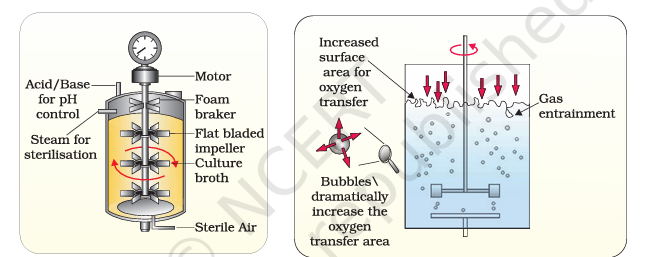
Based on the bioreactor image, a technician needs to test the pH and check the cell concentration without halting the entire 1000L process. Which component allows this?
QUESTION 12 OF 20
Based on the bioreactor image and structural knowledge, which of the following is NOT visually represented as a mechanical part of the simple stirred-tank bioreactor?
QUESTION 13 OF 20
Consider the following statements about sparged stirred-tank bioreactors:
I. Sterile air bubbles are actively sparged into the medium.
II. The air bubbling replaces the need for an agitator system entirely.
III. Sterile air bubbling drastically increases the surface area for oxygen transfer.
Which statement(s) is/are correct?
QUESTION 14 OF 20
Which of the following statements is NOT a biological advantage of the increased surface area created by sparging sterile air?
QUESTION 15 OF 20
Arrange the following biotechnological phases in chronological order:
I. Downstream processing (Separation and purification)
II. Culturing in a bioreactor (Biosynthetic stage)
III. Product formulation with preservatives
IV. Isolation of the genetic material
QUESTION 16 OF 20
Match the process to its respective stage in recombinant DNA technology:
| Column I | Column II |
|---|---|
| 1. Cutting DNA with restriction enzymes | P. Upstream / Tools stage |
| 2. Large scale multiplication | Q. Biosynthetic stage |
| 3. Separation and purification | R. Downstream processing |
| 4. Strict quality testing | S. Product Formulating / Marketing stage |
QUESTION 17 OF 20
Formulation with suitable preservatives is a necessary step before marketing because:
QUESTION 18 OF 20
Which of the following is NOT required to turn a successfully separated product into a finished marketing material?
QUESTION 19 OF 20
Why do biotechnologically produced drugs require thorough clinical trials similar to conventional pharmaceutical drugs?
QUESTION 20 OF 20
"The downstream processing and quality control testing vary from product to product." This statement implies that:
Test Complete!
Answer Review
1 If an Indian scientist successfully isolates an insulin-producing gene from a human cell and expresses it in an E. coli cell, the resulting insulin is termed a 'recombinant protein'. This is primarily because:
A recombinant protein is the product of a gene inserted into a foreign (heterologous) host organism. E. coli is a prokaryotic host, while the human insulin gene is eukaryotic. The "recombinant" nature refers to the genetic modification of the host, not the scale of production.
In biotechnology, when a gene of interest (e.g., human insulin gene) is cloned and expressed in an organism other than its source (e.g., E. coli), that organism is a "heterologous host." The protein produced is called a recombinant protein. Option A describes the production method, not the reason for the nomenclature. Option C is incorrect as the goal is to produce the correct functional protein, not a mutation. Option D is factually wrong; E. coli does not naturally produce human insulin.
- Option A → Scale (bioreactor) is for yield, not definition of the molecule.
- Option C → Mutation is not the goal of cloning.
- Option D → Insulin is not a natural product of E. coli.
Used Substitution
Application: Replace "recombinant" with "the product of a transgene in a different host."
Final Logic: Transgene expression in a foreign host = Recombinant protein.
"Recombinant = Re-combining DNA in a foreign home."
2 Consider the following statements regarding the multiplication of cloned genes:
I. Small scale laboratory cultures are sufficient for extracting and purifying small yields of recombinant proteins.
II. Extracting desired proteins from small cultures requires continuous medium drainage.
III. Large scale production requires switching from shake flasks to bioreactors.
Which statement(s) is/are correct?
Statement I is true; labs use small batches to verify production. Statement II is false; continuous drainage is for large-scale continuous culture systems, not small lab flasks. Statement III is true; bioreactors scale up production.
Small-scale cultures (shake flasks) are standard for laboratory-level protein extraction and validation (Statement I). Continuous medium drainage/addition is a feature of large-scale industrial continuous culture systems to maintain log phase, not typically used in small-scale benchtop setups (Statement II is false). Moving to commercial scale requires the controlled, high-volume environment of a bioreactor (Statement III).
- Option A → Misses statement III.
- Option C → Includes incorrect statement II.
- Option D → Includes incorrect statement II.
Used Elimination
Application: Eliminate statement II by identifying the scale mismatch between "small cultures" and "continuous culture systems."
Final Logic: Small scale = Batch/Shake flask; Continuous = Large-scale/Bioreactor.
"Continuous = Large scale; Batch = Small scale."
3
The passage states the purpose is to "maintain the cells in their physiologically most active log/exponential phase." Entering stationary/decline is the opposite of that goal. Drainage/Addition removes toxins and keeps nutrients high, which prevents decline.
The passage clearly describes the continuous culture system's intent: to keep cells in the log phase. Stationary or decline phases occur when nutrients are exhausted and toxins build up. By continuously draining used medium (toxins) and adding fresh medium (nutrients), the culture avoids entering those decline phases. Therefore, B is logically incorrect in the context of the system's purpose.
- Option A → Removal of used medium physically removes waste/toxins.
- Option C → Addition of fresh medium provides new nutrients.
- Option D → Maintaining nutrients and removing waste keeps cells in the active log phase.
Used Extreme Word Filter
Application: The phrase "stationary or decline phase" contradicts the "active log/exponential phase" described in the passage.
Final Logic: Passage goal = Log phase; Option B = Decline phase.
"Continuous = Log Phase, not decline."
4
I. It produces a larger biomass.
II. It leads to higher yields of the desired protein.
III. It completes downstream processing automatically.
The passage concludes: "produces a larger biomass leading to higher yields." Downstream processing (DSP) is a separate, post-production stage; it is never automatic.
According to the provided passage text: "This type of culturing method produces a larger biomass leading to higher yields of desired protein." Statements I and II are explicitly supported. Statement III is incorrect because downstream processing (separation/purification) occurs after the biosynthetic stage in the bioreactor, it is a human/machine-mediated recovery process, not an automated part of the growth phase.
- Option A → Misses statement II.
- Option B → Misses statement I.
- Option D → Includes the false Statement III.
Used Contextual/Tonal Matching
Application: Compare the list of advantages with the specific sentence in the passage.
Final Logic: Passage claims biomass and yield advantages; DSP is not an advantage of log phase.
"Log = Biomass + Yield, never DSP."
5 Which of the following is NOT a reason that necessitates the transition from small volume cultures to bioreactors?
Small cultures can express heterologous genes (used in labs to check clones). The problem with small cultures is yield quantity, not the ability to express the gene. Bioreactors are for scale, not for enabling basic expression.
Small volume cultures are entirely capable of expressing heterologous host genes (this is standard lab procedure for gene characterization). The limitation of small cultures is their capacity for high-yield production. Bioreactors exist to manage scale (100–1000L) and optimize environmental conditions, not because small volumes cannot express genes at all.
- Option A → True, yield is a major reason for scale-up.
- Option B → True, precise control is a major bioreactor feature.
- Option D → True, volume capacity is a defining bioreactor feature.
Used Elimination
Application: Eliminate true statements about why bioreactors are used, identifying the statement that claims an inherent failure of small cultures that doesn't exist.
Final Logic: Small scale works for expression; it fails at quantity.
"Small scale = Quality/Gene check; Large scale = Quantity."
6 Arrange the following systems in order of increasing culture volume processing capacity:
I. Micro-injection tube
II. 100-1000L Stirred-tank bioreactor
III. Small laboratory scale shake flask
Micro-injection: A single cell/tiny droplet. Shake flask: 100mL to 5L. Bioreactor: 100L to 1000L.
The volume capacity follows the order: (I) Micro-injection involves sub-microliter volumes at the single-cell level, (III) small lab shake flasks hold up to a few liters, and (II) stirred-tank bioreactors hold 100 to 1000 liters.
- Option B, C, D → Incorrect sequences that violate the physical scales of these tools.
Used Dimensional/Unit Analysis
Application: Rank the equipment based on their known operational volumes.
Final Logic: Smallest (cell level) < Intermediate (lab scale) < Largest (industrial scale).
"Micro < Flask < Bioreactor."
7 Match the bioreactor control component to its physiological impact on the culture:
| Column I | Column II |
|---|---|
| 1. Temperature control system | P. Prevents bubble overflow from ruining the batch |
| 2. pH control system | Q. Ensures optimal enzyme activity and protein folding |
| 3. Agitator system | R. Maintains neutral or optimal acidity/alkalinity for the microbe |
| 4. Foam control system | S. Distributes contents evenly avoiding stagnation |
Temp affects proteins (Q). pH affects acidity (R). Agitator distributes/mixes (S). Foam prevention stops overflow (P).
Temperature control (1) is vital for protein folding and enzymatic reactions (Q). pH control (2) maintains the chemical balance needed for the microbes (R). The agitator (3) keeps the medium uniform/homogenous (S). Foam control (4) prevents the build-up of excess foam that leads to overflow (P).
- Option B, C, D → Misalign the physical control with its specific biological/process function.
Used Option Grouping
Application: Direct mapping of control parameters to their specific biological/physical function.
Final Logic: A is the only logically correct pairing set.
"Temp = Folding/Enzyme; pH = Acidity; Agitator = Distribution; Foam = Overflow."
8 A researcher notices poor recombinant protein yield despite optimal temperature and pH in the bioreactor. Which of the following missing components would NOT be considered a primary "optimum growth condition" provided by the bioreactor?
Substrates, vitamins, and salts are essential medium components for cell metabolism. Restriction enzymes are laboratory tools used for cutting DNA; they have no function in the growth medium of a cell.
A bioreactor is an environment that provides the raw ingredients necessary for life (food/substrates, vitamins for metabolic cofactors, salts for osmotic balance). Restriction endonucleases are enzymes used only in the "tools" stage of Recombinant DNA technology to prepare DNA fragments. They would perform no useful function in a growing cell culture and are definitely not an "optimal growth condition."
- Options A, C, D → All are essential nutrient components for cell proliferation.
Used Odd One Out
Application: Categorize options as "Nutrients" vs. "Genetic Engineering Tool."
Final Logic: Growth media = Nutrients; Restriction Enzyme = DNA Cutting Tool.
"Bioreactor = Feeding; Restriction Enzyme = Cutting."
9 A stirred-tank reactor is specifically designed as cylindrical or with a curved base rather than a flat, square base. What reasoning best justifies this engineering choice?
Corners in square tanks are "dead zones." Mixing in dead zones is poor, leading to nutrient gradients. Curved bases provide laminar/uniform flow.
Even mixing is critical in bioreactors to ensure every cell has uniform access to oxygen and nutrients. A flat, square base creates corners (dead zones) where mixing is ineffective. A curved base eliminates these corners, ensuring the entire volume is homogenous.
- Option A → Breakage is an engineering design flaw, not a result of base shape.
- Option C → Extraction is a downstream process, not performed in the base.
- Option D → Square systems can (but rarely) have cooling; shape is about mixing, not temperature.
Used Contextual/Tonal Matching
Application: Connect "Bioreactor Geometry" with "Fluid dynamics/Mixing."
Final Logic: Curves = No corners = Homogeneous mixing.
"Curved = Continuous flow."
10 Which of the following is NOT a method used to facilitate oxygen availability throughout a stirred-tank bioreactor?
Cells in culture require oxygen. Sealing the tank would stop oxygen input and lead to anaerobic/death conditions. Stirring and sparging (A, B, C) are exactly how oxygen is provided.
Bioreactors must be aerated (unless the culture is anaerobic). Sealing the system completely (D) prevents gas exchange (oxygen entry and $CO_2$ exit), which is detrimental to most recombinant protein productions. Stirring and sparging (A, B, C) are the primary methods for ensuring oxygen reaches the cells.
- Options A, B, C → All are methods used to increase oxygen transfer in bioreactors.
Used Elimination
Application: Eliminate active methods of aeration.
Final Logic: Sealing = Blocking O2 = Cell death.
"Aerobic culture = Open/Sparged system, not sealed."
11 Based on the bioreactor image, a technician needs to test the pH and check the cell concentration without halting the entire 1000L process. Which component allows this?
Sampling ports are designed for periodic extraction. They allow monitoring without stopping production. Essential for quality control in large volumes.
In industrial-scale bioreactors, monitoring parameters like pH and cell density while the process is running is crucial. The sampling port is the specific, small-diameter valve designed to withdraw minimal amounts of culture for these analytical tests without compromising the sterility or continuity of the 1000L process.
- Option A → The foam breaker removes excess foam; it is not for testing.
- Option B → The air inlet delivers air; it is not for testing.
- Option D → The impeller provides mixing; it is not for testing.
Used Substitution
Application: Replace "testing process parameters" with "sampling port function."
Final Logic: Port = Periodic withdrawal = Testing.
"Sampling port = Snapshot of the culture."
12 Based on the bioreactor image and structural knowledge, which of the following is NOT visually represented as a mechanical part of the simple stirred-tank bioreactor?
Standard simple stirred-tank (Fig 9.7a in NCERT) shows the impeller, motor, and pH/temp controls. Sparged bubbles (Fig 9.7b) are a distinct feature of sparged tanks, not the "simple" stirred-tank diagram. Bubbles are a result of the sparger, not a "mechanical part" of the tank structure itself.
In the standard diagram of a simple stirred-tank bioreactor (NCERT Figure 9.7a), mechanical components like the impeller, the agitator motor, and pH/temp control systems are clearly shown. Sparged air bubbles (Figure 9.7b) are a feature of a specifically sparged design to increase oxygen, and air bubbles themselves are not "mechanical parts" of the vessel structure.
- Option A, B, D → These are standard mechanical/control parts clearly shown in the bioreactor diagram.
Used Elimination
Application: Cross-referencing components against the standard NCERT diagram.
Final Logic: Bubbles are an event/result, not a mechanical structure.
"Diagram 9.7a = Simple tank (No bubbles)."
13 Consider the following statements about sparged stirred-tank bioreactors:
I. Sterile air bubbles are actively sparged into the medium.
II. The air bubbling replaces the need for an agitator system entirely.
III. Sterile air bubbling drastically increases the surface area for oxygen transfer.
Which statement(s) is/are correct?
Statement I: Correct, this defines sparging. Statement II: Incorrect, the agitator is still needed to disperse the bubbles. Statement III: Correct, this is the main benefit of bubbling.
Sparging involves injecting sterile air bubbles (Statement I). These bubbles provide a large surface area for gas exchange (Statement III). However, bubbling does not replace the agitator; the agitator is essential to disperse those bubbles throughout the liquid to prevent oxygen depletion zones (Statement II is false).
- Options A, C, D → All either omit the correct Statement III or include the false Statement II.
Used Contextual/Tonal Matching
Application: Analyze the interaction between air injection and mechanical mixing.
Final Logic: Agitator + Sparger = Combined aeration system.
"Sparger = Bubbles; Agitator = Disperser."
14 Which of the following statements is NOT a biological advantage of the increased surface area created by sparging sterile air?
Sparging is for gas exchange ($O_2$). DNA ligase reaction occurs in a test tube during in vitro cloning, not inside a bioreactor. The bioreactor is for biomass growth, not DNA ligation.
Sparging facilitates oxygen transfer (A), which sustains aerobic growth (B) and prevents anaerobic conditions (D). DNA ligation is an in vitro (test tube) process performed with enzymes during the "tools" phase of biotechnology; it has absolutely no relationship to the aeration of a bioreactor.
- Options A, B, D → These are all direct biological benefits of oxygenation in a bioreactor.
Used Elimination
Application: Categorize processes into "Large-scale Culture (Bioreactor)" vs. "In vitro Cloning (Lab)."
Final Logic: Bioreactor = Aeration; DNA Ligation = Lab bench.
"Oxygen for cells, not for ligase."
15 Arrange the following biotechnological phases in chronological order:
I. Downstream processing (Separation and purification)
II. Culturing in a bioreactor (Biosynthetic stage)
III. Product formulation with preservatives
IV. Isolation of the genetic material
Isolation of genetic material (IV) is the first step (rDNA prep). Biosynthetic stage (II) is the growth step. Downstream processing (I) is the cleanup. Formulation (III) is the final touch.
The standard workflow is: (IV) Isolation of DNA/Cloning, (II) Culturing in a bioreactor for product synthesis, (I) Downstream processing to extract the product, and (III) Formulation for final stability and marketing.
- Options B, C, D → Misorder the fundamental biotech pipeline.
Used Substitution
Application: Sequential mapping of the Biotech process flow.
Final Logic: Genetic Prep -> Growth -> Cleanup -> Formulation.
"Isolation -> Biosynthesis -> DSP -> Formulation."
16 Match the process to its respective stage in recombinant DNA technology:
| Column I | Column II |
|---|---|
| 1. Cutting DNA with restriction enzymes | P. Upstream / Tools stage |
| 2. Large scale multiplication | Q. Biosynthetic stage |
| 3. Separation and purification | R. Downstream processing |
| 4. Strict quality testing | S. Product Formulating / Marketing stage |
1-P: Cutting = Tools (Upstream). 2-Q: Multiplication = Biosynthesis. 3-R: DSP = Separation. 4-S: Quality testing = Formulation/Marketing stage.
Cutting DNA is a fundamental step in the tools/upstream stage (P). Large-scale multiplication occurs in the bioreactor during the biosynthetic stage (Q). Separation and purification define the downstream processing (R). Quality testing is the final step before the product hits the market (S).
- Options B, C, D → All misalign the stages with the biotech workflow.
Used Option Grouping
Application: Mapping tasks to the chronological workflow stages.
Final Logic: A is the only chronologically and functionally correct mapping.
"Tools (P) -> Biosynthesis (Q) -> Downstream (R) -> Marketing (S)."
17 Formulation with suitable preservatives is a necessary step before marketing because:
Preservatives ensure shelf-life. Purified proteins are fragile and prone to degradation. Formulation prepares them for clinical/market use.
A purified protein is often unstable. Formulation with preservatives and stabilizers is necessary to prevent microbial degradation and chemical breakdown, thereby increasing the drug's shelf-life (half-life) so it remains effective for patients.
- Option A → Separation happens in downstream processing, not formulation.
- Option C → Formulation happens after DSP.
- Option D → This is irrelevant to marketing.
Used Substitution
Application: Define "Formulation" as "stabilizing the final product."
Final Logic: Preservatives = Stability/Shelf-life.
"Formulation = Stabilizing the medicine."
18 Which of the following is NOT required to turn a successfully separated product into a finished marketing material?
The protein is the product; the host cells are contaminants. You must remove the host cells during DSP. Keeping them in the final liquid would be unsafe.
Downstream processing (DSP) is designed to remove host cell debris and impurities to isolate the functional protein. Retaining the host cells (C) would render the product impure and potentially toxic or allergenic; they must be removed, not retained.
- Options A, B, D → These are mandatory steps in the post-biosynthetic workflow.
Used Elimination
Application: Identify that host cells are "waste" to be removed, not part of the final drug.
Final Logic: Final product = Pure protein; Host cells = Contaminant.
"Product = Pure; Host = Trash."
19 Why do biotechnologically produced drugs require thorough clinical trials similar to conventional pharmaceutical drugs?
Clinical trials verify safety and efficacy. Impurities from host cells (like endotoxins) can cause allergic reactions. All drugs must meet the same regulatory standard.
Biotechnological drugs are drugs. Any drug, regardless of origin, must undergo rigorous clinical trials to ensure it is safe, effective, and free from impurities (like residual host DNA or proteins) that could trigger immune responses in patients.
- Option A → Recombinant proteins aren't "toxic by default."
- Option C → Curd and wine are not pharmaceutical drugs.
- Option D → Restriction enzymes are removed in DSP; they are not in the drug.
Used Contextual/Tonal Matching
Application: Align the concept of "Clinical Trials" with "Safety/Efficacy/Impurity testing."
Final Logic: Drugs = Safety = Clinical trials.
"Trial = Safety + Efficacy."
20 "The downstream processing and quality control testing vary from product to product." This statement implies that:
Every protein has a different size, charge, and stability. You cannot purify insulin the same way you purify an antibody. Customization is the hallmark of the DSP stage.
Because proteins differ in structure and function, the methods for their separation, stabilization (formulation), and the subsequent analytical checks (quality control) must be customized for each specific product to maintain integrity and efficacy.
- Option A → Proteins are too diverse for a "universal" protocol.
- Option C → QC is never optional.
- Option D → Bioreactors are general-purpose vessels; they don't need rebuilding.
Used Substitution
Application: Define the diversity of protein biochemistry as the reason for process variation.
Final Logic: Protein uniqueness = Process uniqueness.
"Unique Protein = Unique Process."