
CUET UG Biology Booster Test 3- Cloning Vectors and Host Systems
📌 Answers are locked once submitted — results and explanations appear at the end.
QUESTION 1 OF 20
Arrange the following conceptual events to illustrate the mechanism of autonomous plasmid-based cloning:
1. The alien piece of DNA replicates and multiplies itself, mimicking the plasmid's copy number.
2. An alien DNA fragment is artificially linked to a native plasmid possessing an independent 'ori'.
3. The recombinant plasmid is transferred into a bacterial host where it utilizes the host's DNA polymerase.
QUESTION 2 OF 20
Why might a researcher specifically choose a bacteriophage vector over a low-copy plasmid vector when cloning a gene for industrial-scale protein production?
QUESTION 3 OF 20
The origin of replication (ori) is the cornerstone of plasmid propagation. Which of the following statements is NOT a valid biological role or property of the ori sequence?
QUESTION 4 OF 20
If a specific origin of replication (ori) sequence mutated such that its binding affinity for replication initiation factors was drastically reduced, what would be the most immediate measurable impact on the cloning system?
QUESTION 5 OF 20
QUESTION 6 OF 20
QUESTION 7 OF 20
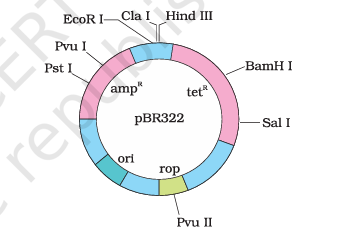
Analyzing the structural layout of the pBR322 vector shown, if a foreign DNA is successfully ligated exclusively at the Pst I recognition site, what will be the exact genetic consequence for the recombinant plasmid?
QUESTION 8 OF 20
Looking at the provided vector diagram, notice the positions of the EcoR I, Cla I, and Hind III sites. If a researcher mistakenly assumes these three sites act identically to the single BamH I site inside a resistance gene and ligates DNA there, what critical selection advantage is lost?
QUESTION 9 OF 20
Match the underlying mechanism of insertional inactivation with its respective component in the chromogenic selection method:
| Column I | Column II |
|---|---|
| 1. Recombinant DNA insertion | P. The chemical compound that yields a color change upon enzymatic cleavage |
| 2. Beta-galactosidase gene | Q. The biological event that halts enzyme synthesis |
| 3. Chromogenic substrate | R. The coding sequence that gets physically disrupted |
| 4. Insertional inactivation | S. The physical trigger placed inside the coding sequence |
QUESTION 10 OF 20
Analyze the comparative advantages of chromogenic selection over traditional antibiotic selection:
Statement I: Selection of recombinants via antibiotic inactivation is often considered cumbersome because it requires simultaneous/sequential plating on multiple plates with different antibiotics.
Statement II: Chromogenic selection simplifies this process by allowing the direct visual differentiation of recombinants (colorless) from non-recombinants (blue) on a single substrate plate.
QUESTION 11 OF 20
The biological ingenuity of Agrobacterium tumifaciens lies in its T-DNA mechanism. From an analytical perspective, what is the ultimate evolutionary purpose of the plant tumor created by this pathogen?
QUESTION 12 OF 20
A successfully 'disarmed' Ti plasmid has undergone crucial genetic modifications. Which of the following capabilities is NOT retained by a properly disarmed Ti vector?
QUESTION 13 OF 20
The core danger of a natural retrovirus in animals is its ability to transform normal cells into cancerous cells. How is this exact destructive pathway repurposed constructively in biotechnology?
QUESTION 14 OF 20
Arrange the sequence of technological steps required to safely use an animal pathogen as a vector:
1. Delivery of the desirable gene into the host animal cell.
2. Disarming the natural pathogen by modifying or removing its disease-causing genes.
3. Ligating a DNA fragment (gene of interest) into the disarmed vector.
QUESTION 15 OF 20
Evaluate the following statements regarding the physical constraints of gene transfer:
Statement I: The highly hydrophilic nature of DNA molecules allows them to effortlessly diffuse through the hydrophobic lipid bilayer of bacterial cell membranes.
Statement II: Because of its chemical inability to cross the membrane naturally, host cells must undergo forced competency procedures to internalize plasmid DNA.
QUESTION 16 OF 20
Match the cellular barrier or transformation step with its corresponding physical/chemical solution:
| Column I | Column II |
|---|---|
| 1. Hydrophilic DNA repulsion by lipid membrane | P. Extraction from agarose gel piece |
| 2. Forcing DNA into competent cells | Q. Divalent cation (calcium) treatment |
| 3. Increasing wall pore efficiency for entry | R. Host competency procedures |
| 4. Elution step during fragment isolation | S. Heat shock (Ice → 42°C → Ice) |
QUESTION 17 OF 20
Micro-injection is a highly precise physical method for introducing foreign DNA. Which of the following is NOT a characteristic of this specific technique?
QUESTION 18 OF 20
The biolistics technique represents an intersection of physics and biotechnology. Why are gold or tungsten specifically chosen as the micro-particles to be coated with DNA in this method?
QUESTION 19 OF 20
The thermal shock procedure is a delicate balance of physical states. Which of the following conditions or actions is NOT utilized during this specific transformation method?
QUESTION 20 OF 20
From a biophysical standpoint, what is the widely accepted functional consequence of the sudden, brief temperature shift to 42°C followed by an immediate return to ice during the heat shock method?
Test Complete!
Answer Review
1 Arrange the following conceptual events to illustrate the mechanism of autonomous plasmid-based cloning:
1. The alien piece of DNA replicates and multiplies itself, mimicking the plasmid's copy number.
2. An alien DNA fragment is artificially linked to a native plasmid possessing an independent 'ori'.
3. The recombinant plasmid is transferred into a bacterial host where it utilizes the host's DNA polymerase.
First, link the DNA to the vector. Second, transform (transfer) the plasmid into the host. Third, replication occurs using host machinery.
The correct logical sequence for cloning is: (2) construct the recombinant plasmid by linking foreign DNA to a vector with an 'ori', (3) introduce this plasmid into a host cell, where (1) it uses the host's replication machinery (DNA polymerase) to multiply the DNA.
- Option B → Impossible to replicate before linking or transferring.
- Option C → Cannot use host machinery before the plasmid is inside the host.
- Option D → Replication (1) cannot happen before the plasmid is transferred into the host (3).
Used Contextual/Tonal Matching
Application: Sequencing the process as Construct -> Transform -> Replicate.
Final Logic: Linkage must precede entry, and entry must precede utilization of host polymerase.
"Link -> Transfer -> Replicate."
2 Why might a researcher specifically choose a bacteriophage vector over a low-copy plasmid vector when cloning a gene for industrial-scale protein production?
Industrial production requires high protein yields. High gene dosage (copy number) leads to more protein. Bacteriophages provide high genome copies per cell.
High protein production requires a high gene dosage. Bacteriophage vectors are known for having very high copy numbers compared to low-copy plasmids, meaning more templates are available for transcription and translation, thus maximizing protein production.
- Option A → Phages are often lytic, but the copy number is the reason for selection, not a desire to "prevent host death."
- Option C → All vectors require an origin of replication to multiply.
- Option D → Bacteriophages infect bacteria, not eukaryotes.
Used Elimination
Application: Eliminate factual errors (C and D) and focus on the link between "high copy number" and "protein production."
Final Logic: High copies = More protein.
"Phage = High Copy = High Yield."
3 The origin of replication (ori) is the cornerstone of plasmid propagation. Which of the following statements is NOT a valid biological role or property of the ori sequence?
Ori controls replication, not restriction sites. Restriction enzyme sites are determined by the DNA sequence, not the 'ori'. Restriction sites are separate features.
The 'ori' sequence is strictly for replication initiation and copy number control. The choice of restriction enzymes is dictated by the presence of specific palindromic sequences elsewhere in the vector (or in the MCS), not by the 'ori' itself.
- Option A → Valid role of ori.
- Option B → Valid property of ori.
- Option D → Valid role of ori.
Used Extreme Word Filter
Application: The statement about "determining restriction enzymes" is logically distinct from "DNA replication."
Final Logic: Ori = Replication; Restriction sites = Cutting.
"Ori = Copying, not Cutting."
4 If a specific origin of replication (ori) sequence mutated such that its binding affinity for replication initiation factors was drastically reduced, what would be the most immediate measurable impact on the cloning system?
Ori controls initiation of replication. Reduced binding = reduced initiation frequency. Reduced initiation = fewer copies.
Replication initiation factors binding to the 'ori' are required to start the replication process. If this binding is reduced, the plasmid will replicate less frequently, leading to a significant decrease in the number of plasmid copies (copy number) within each host cell.
- Option A → Integration is not determined by 'ori' initiation affinity.
- Option C → Marker genes are regulated by promoters, not the 'ori' replication affinity.
- Option D → Infectivity depends on the vector's viral proteins or surface markers, not the 'ori' affinity.
Used Substitution
Application: Replace "reduced initiation" with "less replication," leading directly to "lower copy number."
Final Logic: Less initiation = Fewer copies.
"Low Affinity = Low Copy."
5
Vector has $amp^R$. $Amp^R$ allows growth on ampicillin. Cells without the vector ($amp^S$) die on ampicillin.
The plasmid carries the ampicillin resistance gene ($amp^R$). When plated on ampicillin, any cell that did not take up a plasmid (non-transformant) remains sensitive and will be killed. All cells that took up the plasmid (transformants, whether recombinant or not) will survive because they possess the $amp^R$ gene.
- Option A → Recombinants contain the plasmid and survive.
- Option B → Non-recombinants contain the plasmid and survive.
- Option D → The ampicillin plate selects for the plasmid, not specifically the status of the $tet^R$ gene.
Used Elimination
Application: Eliminate the two groups (recombinants/non-recombinants) that actually have the plasmid and thus survive.
Final Logic: $Amp^R$ presence = survival; No plasmid = death.
"Amp = Filter for Plasmid uptake."
6
Recombinant = Insert in $tet^R$ gene. $tet^R$ is inactivated. $amp^R$ remains functional.
Successful insertion at the $BamH I$ site within the tetracycline resistance gene inactivates that gene. Consequently, the recombinant bacteria remain resistant to ampicillin (so they grow) but become sensitive to tetracycline (so they die on that medium).
- Option A → Recombinants are resistant to ampicillin.
- Option C → Recombinants are sensitive to tetracycline.
- Option D → This describes a non-recombinant (plasmid intact).
Used Contextual/Tonal Matching
Application: Identifying "recombinant" as having "inactivated tetracycline resistance."
Final Logic: Recombinant = Resistant ($Amp$) + Sensitive ($Tet$).
"Recombinant = Amp Yes, Tet No."
7 Analyzing the structural layout of the pBR322 vector shown, if a foreign DNA is successfully ligated exclusively at the Pst I recognition site, what will be the exact genetic consequence for the recombinant plasmid?
Pst I is located within the $amp^R$ gene. Insertion at Pst I disrupts the $amp^R$ gene. This results in insertional inactivation of $amp^R$.
In the standard map of pBR322, the Pst I site is located within the ampicillin resistance gene. Therefore, ligating foreign DNA at this specific site interrupts the coding sequence of the $amp^R$ gene, leading to insertional inactivation.
- Option A → The BamH I or Sal I sites are in the tetracycline gene, not Pst I.
- Option C → The 'ori' site is distinct from these resistance genes.
- Option D → The rop gene is located elsewhere on the plasmid.
Used Substitution
Application: Using the known map locations of restriction sites in pBR322.
Final Logic: Pst I = $Amp^R$ gene.
"Pst = Amp."
8 Looking at the provided vector diagram, notice the positions of the EcoR I, Cla I, and Hind III sites. If a researcher mistakenly assumes these three sites act identically to the single BamH I site inside a resistance gene and ligates DNA there, what critical selection advantage is lost?
Successful selection requires the site to be inside a marker gene. EcoR I/Cla I/Hind III are outside the markers in pBR322. No inactivation occurs, so you cannot distinguish transformants from recombinants.
The core of insertional inactivation is the physical disruption of a marker gene. If the site is outside the gene, the marker remains functional even if DNA is inserted. Thus, you cannot visually or physiologically differentiate recombinants from non-recombinants, as both will remain antibiotic-resistant.
- Option A → 'ori' is not affected.
- Option C → Transformation is independent of marker inactivation.
- Option D → rop protein production is independent of marker inactivation.
Used Elimination
Application: If the gene is not inactivated, selection fails. Option B describes exactly this failure.
Final Logic: Inactive gene = Selection. No inactivation = No selection.
"Inactivation = Identification."
9 Match the underlying mechanism of insertional inactivation with its respective component in the chromogenic selection method:
| Column I | Column II |
|---|---|
| 1. Recombinant DNA insertion | P. The chemical compound that yields a color change upon enzymatic cleavage |
| 2. Beta-galactosidase gene | Q. The biological event that halts enzyme synthesis |
| 3. Chromogenic substrate | R. The coding sequence that gets physically disrupted |
| 4. Insertional inactivation | S. The physical trigger placed inside the coding sequence |
Insertion is the trigger (S). Gene is the sequence disrupted (R). Substrate is the chemical (P). Inactivation is the event (Q).
Recombinant DNA insertion (1) acts as the trigger (S) placed in the gene. The Beta-galactosidase gene (2) is the coding sequence that gets disrupted (R). The chromogenic substrate (3) is the chemical compound cleaved (P). Insertional inactivation (4) is the resulting biological event (Q).
- Option B, C, D → Misalign the mechanism, components, and chemical roles.
Used Option Grouping
Application: Matching the chemical (Substrate) to the definition (Cleavage/Color) (3-P) and the Gene to the disruption (2-R). Option A is the only choice with these pairings.
Final Logic: S-R-P-Q matching.
"Insert = Trigger (S); Gene = Target (R)."
10 Analyze the comparative advantages of chromogenic selection over traditional antibiotic selection:
Statement I: Selection of recombinants via antibiotic inactivation is often considered cumbersome because it requires simultaneous/sequential plating on multiple plates with different antibiotics.
Statement II: Chromogenic selection simplifies this process by allowing the direct visual differentiation of recombinants (colorless) from non-recombinants (blue) on a single substrate plate.
Antibiotic method requires duplicate plates (two-step). Chromogenic method is one-step (visual). Both statements describe the standard biotechnology comparison.
Statement I is correct; using two antibiotics requires replica plating or sequential testing, which is time-consuming. Statement II is correct; blue-white screening allows for simple visual detection on a single plate.
- Option A, B, D → These contradict established laboratory methodology.
Used Contextual/Tonal Matching
Application: Confirming both standard laboratory advantages/disadvantages.
Final Logic: Antibiotic = Cumbersome; Chromogenic = Visual/Efficient.
"Antibiotic = Two plates; Chromogenic = One view."
11 The biological ingenuity of Agrobacterium tumifaciens lies in its T-DNA mechanism. From an analytical perspective, what is the ultimate evolutionary purpose of the plant tumor created by this pathogen?
Agrobacterium transforms plant cells to become "factories." The plant produces opines (unique chemicals). The pathogen consumes these chemicals for growth.
Agrobacterium tumifaciens acts as a natural genetic engineer. The T-DNA integrates into the plant genome, forcing the plant cells to synthesize opines—specialized amino acid derivatives that the bacteria use as a carbon and nitrogen source. Option B accurately describes this resource-harvesting strategy. Options A, C, and D are incorrect as they do not reflect the parasitic nature of the infection.
- Option A → Killing the host prematurely is not the goal; the pathogen needs the host to continuously produce food.
- Option C → The tumor is a disease state, not a defensive structure.
- Option D → The plant gains no benefit from the tumor; it is entirely to the pathogen's advantage.
Used Contextual/Tonal Matching Application: Identifying the core parasitic relationship (the bacterium forces the host to feed it). Final Logic: Tumor = Resource factory for the bacteria.
"T-DNA = Factory for Opines."
12 A successfully 'disarmed' Ti plasmid has undergone crucial genetic modifications. Which of the following capabilities is NOT retained by a properly disarmed Ti vector?
'Disarmed' means removing the tumor-inducing genes. It retains gene delivery (transfer). It still replicates and can hold new genes.
The goal of disarming a Ti plasmid is to remove the genes responsible for tumor formation (pathogenicity) while keeping the transfer mechanism intact. Therefore, it is no longer capable of inducing tumors (Option A). It retains its ability to replicate, carry "genes of interest," and deliver them into plant cells.
- Option A → Retained; this is the primary purpose of the vector.
- Option B → Retained; it must replicate to be useful as a vector.
- Option D → Retained; this is the biotech function of the vector.
Used Extreme Word Filter Application: Looking for the definition of "disarmed" (non-pathogeni
- A). Final Logic: Disarmed = No Tumor.
"Disarmed = Safe delivery, no disease."
13 The core danger of a natural retrovirus in animals is its ability to transform normal cells into cancerous cells. How is this exact destructive pathway repurposed constructively in biotechnology?
Viruses are great at entering cells. Biotechnology removes the "bad" parts (pathogenic genes). It replaces them with "good" parts (therapeutic genes).
Retroviruses are experts at inserting their genetic material into host cells. By removing (disarming) the genes that cause cancer and inserting a therapeutic gene in their place, scientists can safely use the virus as a "delivery truck" to transport healthy genes into animal cells.
- Option A → Cancer cells are not the objective; gene delivery is.
- Option C → Retroviruses and Agrobacterium are distinct systems for animals and plants, respectively.
- Option D → Viruses do not synthesize chemical substrates; that is a biochemical reaction.
Used Substitution Application: Substituting "disarmed" for "removing pathogenic genes." Final Logic: Efficient entry + No harm = Perfect vector.
"Disarm and Replace."
14 Arrange the sequence of technological steps required to safely use an animal pathogen as a vector:
1. Delivery of the desirable gene into the host animal cell.
2. Disarming the natural pathogen by modifying or removing its disease-causing genes.
3. Ligating a DNA fragment (gene of interest) into the disarmed vector.
Modify the vector first (2). Ligate the gene (3). Deliver to host (1).
The correct logical engineering sequence is: first, make the pathogen safe (2); second, insert the gene you want to study or use (3); third, use the modified virus to infect the host and deliver the gene (1).
- Option B → You cannot deliver the gene before preparing the vector.
- Option C → You cannot ligate a gene into a dangerous, unmodified pathogen.
- Option D → Delivery cannot happen before ligation.
Used Contextual/Tonal Matching Application: Ordering the engineering process: Design/Safety -> Preparation -> Execution. Final Logic: Disarm -> Load -> Deliver.
"Modify, Load, Fire."
15 Evaluate the following statements regarding the physical constraints of gene transfer:
Statement I: The highly hydrophilic nature of DNA molecules allows them to effortlessly diffuse through the hydrophobic lipid bilayer of bacterial cell membranes.
Statement II: Because of its chemical inability to cross the membrane naturally, host cells must undergo forced competency procedures to internalize plasmid DNA.
Statement I: Hydrophilic DNA cannot cross hydrophobic lipids (False). Statement II: Forcing entry is necessary (True).
DNA is hydrophilic (negatively charge D) and the cell membrane interior is hydrophobic. This creates a repulsion, making Statement I false. Because DNA cannot cross the membrane naturally, scientists use methods like calcium treatment and heat shock, making Statement II correct.
- Option A → Contradicts the scientific principle of lipid bilayers.
- Option C → Statement I is definitely false.
- Option D → Statement II is definitely true.
Used Elimination Application: Use basic chemical principles (Hydrophobic vs. Hydrophili
- A) to reject Statement I. Final Logic: Hydrophilic = Repelled by Hydrophobic.
"Hydrophilic + Hydrophobic = No entry."
16 Match the cellular barrier or transformation step with its corresponding physical/chemical solution:
| Column I | Column II |
|---|---|
| 1. Hydrophilic DNA repulsion by lipid membrane | P. Extraction from agarose gel piece |
| 2. Forcing DNA into competent cells | Q. Divalent cation (calcium) treatment |
| 3. Increasing wall pore efficiency for entry | R. Host competency procedures |
| 4. Elution step during fragment isolation | S. Heat shock (Ice → 42°C → Ice) |
Repulsion requires general competency (R). Force entry via heat shock (S). Calcium improves pore efficiency (Q). Elution comes from agarose (P).
To overcome repulsion, you create a "competent" cell (R). Forcing entry uses heat shock (S). Calcium makes the membrane more permeable/efficient (Q). Extraction of DNA from an agarose slice is elution (P).
- Options B, C, D misattribute the physical techniques to the biological steps.
Used Option Grouping Application: Aligning the most well-known association (Heat Shock = Forcing entry; Calcium = Pores). Final Logic: A provides the correct biological-to-technique mapping.
"Competency (R) -> Pores (Q) -> Shock (S)."
17 Micro-injection is a highly precise physical method for introducing foreign DNA. Which of the following is NOT a characteristic of this specific technique?
Tungsten/Gold particles are for "Biolistics" (Gene Gun), not micro-injection. Micro-injection uses a fine needle/pipette. Micro-injection is for animal cells.
Micro-injection uses a microscopic needle, not particles. High-velocity tungsten or gold particles are used exclusively in the "Biolistics" (or Gene Gun) method. Therefore, Option C is incorrect.
- Option A → Correct; it is a physical method that avoids vectors.
- Option B → Correct; it targets the nucleus directly.
- Option D → Correct; it is the preferred method for animal oocytes/cells.
Used Elimination Application: Identifying that "tungsten particles" belong to a different technique (Biolistics). Final Logic: Micro-injection = Needle; Biolistics = Gun/Particles.
"Injection = Needle; Biolistics = Gun."
18 The biolistics technique represents an intersection of physics and biotechnology. Why are gold or tungsten specifically chosen as the micro-particles to be coated with DNA in this method?
They must be dense to carry momentum. They must be inert (non-toxi A) to the cell. They physically punch through walls.
To pass through the tough, thick plant cell wall, particles need high momentum (mass x velocity). Gold and tungsten are dense and inert, meaning they provide the necessary force without poisoning the plant cell.
- Option A → They are chosen because they are inert, not reactive.
- Option C → They do not act as catalysts; they are physical carriers.
- Option D → They do not emit radiation.
Used Substitution Application: Defining the requirements for a "projectile" (Massive, Inert). Final Logic: High density + Non-toxic = Successful projectile.
"Gold = Dense + Inert."
19 The thermal shock procedure is a delicate balance of physical states. Which of the following conditions or actions is NOT utilized during this specific transformation method?
Bombardment is "Biolistics," not "Thermal Shock." Thermal shock involves temp changes (Ice-42-Ice).
Thermal shock is a chemical-based transformation protocol (using Calcium Chloride). Bombardment with gold particles is a completely different physical method called "Biolistics." Therefore, Option D is not part of the thermal shock protocol.
- Option A, B, C are the standard, correct steps of the thermal shock protocol.
Used Elimination Application: Clearly distinguishing between two separate methods: Thermal Shock (Chemical) vs. Biolistics (Physical). Final Logic: Thermal Shock ≠ Biolistics.
"Shock = Heat; Bombardment = Gun."
20 From a biophysical standpoint, what is the widely accepted functional consequence of the sudden, brief temperature shift to 42°C followed by an immediate return to ice during the heat shock method?
Heat shock is a physical force. It increases membrane permeability. DNA is driven inside (uptake).
The shift to 42°C creates a brief window of high permeability in the bacterial membrane. Moving back to ice "locks" the membrane, effectively trapping the DNA that was driven inside by the thermal gradient.
- Option A → Denaturation is not the goal; it would kill the host.
- Option C → Ligation happens via enzymes (ligase) inside the cell, not by temperature shock.
- Option D → The cell does not divide during the short shock; it is just a step to get DNA inside.
Used Substitution Application: Substituting "Heat Shock" for "Transient Membrane Change." Final Logic: Shock = Permeability = Entry.
"Heat = Pores open; Ice = Pores shut."