
CUET UG Biology Booster Test 2- Tools of Recombinant DNA Technology
📌 Answers are locked once submitted — results and explanations appear at the end.
QUESTION 1 OF 20
QUESTION 2 OF 20
QUESTION 3 OF 20
Match the enzyme to its source organism format logic based on the naming convention:
| List I | List II |
|---|---|
| 1. First letter | P. Order in which enzymes were isolated |
| 2. Second and third letters | Q. Genus of prokaryotic cell |
| 3. Fourth letter | R. Species of prokaryotic cell |
| 4. Roman numeral | S. Name of the strain |
QUESTION 4 OF 20
Consider the following regarding the Roman numeral in an enzyme's name:
I. It indicates the optimal pH at which the enzyme functions.
II. It denotes the order in which the enzyme was isolated from a strain.
III. It signifies the number of cuts the enzyme makes on the DNA.
QUESTION 5 OF 20
If a scientist wishes to create sticky ends in the middle of a long linear DNA fragment, which of the following is NOT an appropriate tool, and why?
QUESTION 6 OF 20
The action of an endonuclease is heavily dependent on "inspecting" the DNA. What specifically is it inspecting to make an internal cut?
QUESTION 7 OF 20
Sequence the steps an endonuclease takes to utilize DNA sequence symmetry:
1. It cuts each of the two strands at specific points.
2. It inspects the length of a DNA sequence.
3. It binds to the DNA.
4. It finds its specific palindromic recognition sequence.
QUESTION 8 OF 20
To confirm a DNA palindrome, the sequence must read the same on both strands. What critical condition must be maintained while reading?
QUESTION 9 OF 20
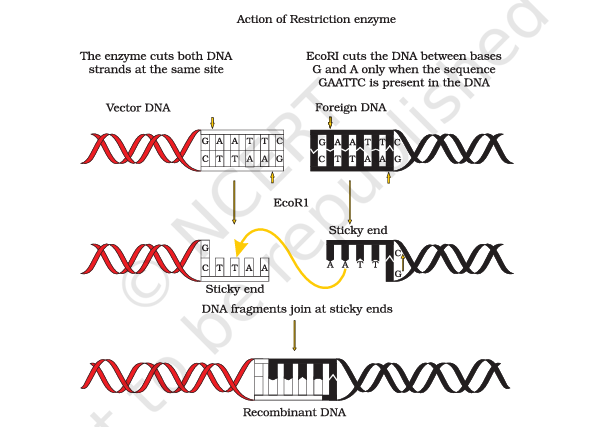
In the provided figure showing the action of EcoRI, where does the restriction enzyme cut relative to the center of the palindrome site to create overhanging stretches?
QUESTION 10 OF 20
According to the visual sequence of forming recombinant DNA, what specifically allows the sticky ends of the vector DNA and foreign DNA to unite before ligase acts?
QUESTION 11 OF 20
Match the process to the enzyme responsible:
| List I | List II |
|---|---|
| 1. Cutting DNA at a specific site | P. DNA Ligase |
| 2. Connecting sticky ends end-to-end | Q. DNA Polymerase |
| 3. Adding methyl groups to DNA | R. Restriction Endonuclease |
| 4. Synthesizing multiple copies in PCR | S. Methylase (Methyl-adding enzyme) |
QUESTION 12 OF 20
Which of the following conditions is NOT required for DNA ligase to successfully create a recombinant DNA molecule from two sources?
QUESTION 13 OF 20
Regarding gel electrophoresis, evaluate these statements:
I. DNA moves towards the anode because it is negatively charged.
II. The electric field is the driving force for the movement of fragments.
III. DNA moves towards the cathode because it is positively charged.
QUESTION 14 OF 20
Arrange the following DNA fragments in the order they would appear from the loading well to the farthest end of the gel due to the sieving effect:
1. 500 base pairs
2. 2500 base pairs
3. 100 base pairs
4. 1500 base pairs
QUESTION 15 OF 20
Why is ethidium bromide highly essential in the downstream process of gel electrophoresis?
QUESTION 16 OF 20
Which of the following combinations will NOT result in visible bright orange coloured bands of DNA?
QUESTION 17 OF 20
When visually identifying bands to extract, a researcher looks for:
QUESTION 18 OF 20
Which of the following actions is NOT a part of the elution process?
QUESTION 19 OF 20
What critical role does the host's DNA polymerase enzyme play once the recombinant DNA (like a modified plasmid) is transferred into an E. coli cell?
QUESTION 20 OF 20
Why are vectors like plasmids absolutely necessary for cloning an alien piece of DNA in a host organism?
Test Complete!
Answer Review
1
The enzymes were part of the bacterial defense mechanism. They protected the bacteria by destroying invading viral (bacteriophage) DNA. This "restriction" ability is the foundation of restriction endonucleases.
The correct answer is ( A). The passage explicitly states that the two enzymes isolated in 1963 from Escherichia coli were responsible for "restricting the growth of bacteriophage." One enzyme methylated the DNA (protecting host DN A), and the other (restriction endonuclease) cut the foreign viral DNA.
- Option A → DNA replication is performed by DNA polymerases, not restriction enzymes.
- Option C → RNA synthesis is performed by RNA polymerase.
- Option D → Joining DNA fragments is the role of DNA ligase.
Used Contextual Matching.
Application: The answer is directly derived from the opening sentence of the provided passage.
Final Logic: Restriction enzymes = Bacteriophage defense = Growth restriction.
"Restrict = Stop Virus."
2
Hind II was the first restriction endonuclease. Its key breakthrough was sequence-specific cutting. This precision allowed it to become a tool for biotechnology.
The correct answer is ( A). While the methyl-adding enzyme modified DNA to protect it, Hind II was revolutionary because it recognized a specific nucleotide sequence and cut the DNA at that location. This sequence specificity is the basis for its utility in recombinant DNA technology.
- Option A → Hind II was found in bacteria (Haemophilus influenzae), not animals.
- Option C → Hind II is an endonuclease (a cutter), not a ligase (a joiner).
- Option D → Endonucleases cut internally, whereas exonucleases cut from the ends.
Used Contextual Matching.
Application: The passage directly states: "Hind II, whose functioning depended on a specific DNA nucleotide sequence."
Final Logic: Hind II = Sequence-specific endonuclease.
"Hind II = First Sequence Cutter."
3 Match the enzyme to its source organism format logic based on the naming convention:
| List I | List II |
|---|---|
| 1. First letter | P. Order in which enzymes were isolated |
| 2. Second and third letters | Q. Genus of prokaryotic cell |
| 3. Fourth letter | R. Species of prokaryotic cell |
| 4. Roman numeral | S. Name of the strain |
1st Letter = Genus (Q). 2nd/3rd Letters = Species (R). 4th Letter = Strain (S). Roman Numeral = Order (P).
The correct answer is ( A). The nomenclature of restriction enzymes follows a strict protocol: (1) First letter from the genus (Q), (2) Next two letters from the species (R), (3) Fourth letter from the strain (S), and (4) Roman numeral indicating the order of isolation (P).
- Options B, C, and D incorrectly map the components of the naming convention.
Used Option Grouping.
Application: Map the known definitions to their placeholders (1-Q, 4-P) to eliminate incorrect sequences.
Final Logic: Genus-Species-Strain-Order = Q-R-S-P.
"G-S-S-O (Genus-Species-Strain-Order)."
4 Consider the following regarding the Roman numeral in an enzyme's name:
I. It indicates the optimal pH at which the enzyme functions.
II. It denotes the order in which the enzyme was isolated from a strain.
III. It signifies the number of cuts the enzyme makes on the DNA.
Roman numerals in enzyme names (e.g., EcoRI) indicate isolation order. "I" means it was the first enzyme discovered in that specific strain. It has nothing to do with pH or the number of cuts.
The correct answer is ( A). The Roman numeral in a restriction enzyme's name, such as the "I" in EcoRI, denotes the order in which the enzyme was isolated from that particular bacterial strain. Statements I and III are scientifically incorrect.
- Options A, C, and D are incorrect because they include false statements about pH or cutting frequency.
Used Elimination.
Application: The order of isolation is the standard definition found in NCERT for the Roman numeral suffix. Eliminate all other claims.
Final Logic: Roman numeral = Order of isolation.
"Roman = Rank (Order)."
5 If a scientist wishes to create sticky ends in the middle of a long linear DNA fragment, which of the following is NOT an appropriate tool, and why?
Exonucleases act at the ends of DNA molecules. To cut "in the middle" (internally), you must use an endonuclease. Option (A) correctly identifies that an exonuclease is inappropriate for internal cutting.
(A). Exonucleases remove nucleotides sequentially from the ends of DNA. Therefore, they are incapable of making an internal cut ("in the middle") to create sticky ends. Endonucleases, conversely, are the enzymes that cut internally at specific sites.
- Option B → Endonuclease is an appropriate tool for internal cutting.
- Option C → Exonuclease does not recognize palindromes.
- Option D → Endonucleases cut the backbone, which is part of their function.
Used Contextual Matching.
Application: Distinguish the "what" (Internal vs. En
- D) from the "why" (Mechanism). Exonucleases are inappropriate because they cut at ends.
Final Logic: Internal cut = Endonuclease; End cut = Exonuclease.
"Exo = End; Endo = Inside."
6 The action of an endonuclease is heavily dependent on "inspecting" the DNA. What specifically is it inspecting to make an internal cut?
Restriction endonucleases scan DNA for their specific target site. These sites are palindromic sequences. The enzyme cuts only when it detects the exact palindromic pattern.
The correct answer is (A). Restriction endonucleases "inspect" the DNA for a specific palindromic recognition sequence (e.g., GAATTC for EcoRI). Once the enzyme finds the exact base sequence matching its target, it binds and cuts the DNA at a precise location.
- Option A → Methylation is involved in host defense, but the enzyme's cut site is determined by the palindrome.
- Option C → Chromosome length is irrelevant to the specific cut site.
- Option D → Selectable markers are used later in the cloning process, not for the cutting mechanism.
Used Substitution.
Application: Replace the word "inspecting" with its biological meaning in the context of restriction endonucleases (Sequence recognition).
Final Logic: Inspection = Palindromic sequence identification.
"Restriction = Sequence Reader."
7 Sequence the steps an endonuclease takes to utilize DNA sequence symmetry:
1. It cuts each of the two strands at specific points.
2. It inspects the length of a DNA sequence.
3. It binds to the DNA.
4. It finds its specific palindromic recognition sequence.
1st: Inspect sequence (2). 2nd: Find/identify palindrome (4). 3rd: Bind to the site (3). 4th: Cut (1).
The correct answer is ( A). The enzyme first inspects the DNA length (2), identifies the specific palindromic sequence (4), binds to that DNA site (3), and finally cuts the strands (1).
- Options B, C, and D violate the logical biological order of interaction between the enzyme and the DNA substrate.
Used Logical Sequencing.
Application: Think of the enzyme's action: Scan → Locate → Dock (Bin
- D) → Cut. This corresponds to 2 → 4 → 3 → 1.
Final Logic: Scan-Locate-Bind-Cut.
"Scan, Find, Bind, Cut."
8 To confirm a DNA palindrome, the sequence must read the same on both strands. What critical condition must be maintained while reading?
DNA palindromes are defined by 5' to 3' symmetry. You must read both strands in the same direction to see the palindrome. Reading in opposite directions (one 5'-3', the other 3'-5') would not show the identical sequence.
T (A). A DNA palindrome is only evident if you read both strands in the same direction (e.g., both 5' to 3'). If you read in opposite directions (one 5'-3' and the other 3'-5'), the strands would be complementary, not identical (palindromiA).
- Option A → 3' to 5' is not the standard convention for identifying palindromic symmetry.
- Option C → The center is where the enzyme might cut, but it's not the reference point for reading the sequence.
- Option D → Both strands must be considered for symmetry.
Used Contextual Matching.
Application: The passage specifically states "when orientation of reading is kept the same."
Final Logic: Palindrome = Consistent orientation reading.
"Same Direction = Same Sequence."
9 In the provided figure showing the action of EcoRI, where does the restriction enzyme cut relative to the center of the palindrome site to create overhanging stretches?
Sticky ends require a "staggered" cut. Staggered means the cut is off-center. The cut occurs at the same relative position on both strands to create the overhang.
(A). Restriction enzymes like EcoRI produce sticky ends by cutting the phosphodiester backbone of each strand a few base pairs away from the center of the recognition site. Because they cut at the same relative position on both strands, the resulting DNA ends have complementary, single-stranded "overhangs."
- Option A → A center cut produces blunt ends.
- Option C → The enzyme must cut within the recognition site.
- Option D → Cutting only one strand would be a "nick," not an end-creation.
Used Elimination.
Application: Distinguish blunt (center) vs. sticky (off-center). Only (A) correctly describes the staggered cut mechanism.
Final Logic: Staggered cut = Sticky ends.
"Staggered = Sticky."
10 According to the visual sequence of forming recombinant DNA, what specifically allows the sticky ends of the vector DNA and foreign DNA to unite before ligase acts?
Sticky ends match because of complementary base pairing. Base pairing is held by hydrogen bonds. This alignment acts like temporary "Velcro" until ligation.
The correct answer is (A). The sticky ends of the vector and foreign DNA are complementary to each other. When they align, they spontaneously form hydrogen bonds between the complementary bases (e.g., A-T, G-A). This creates a temporary stable association.
- Option A → Covalent bonds are formed later, by the ligase, not before it acts.
- Option C → Ionic interactions are not the specific mechanism for base-pair complementarity.
- Option D → DNA polymerase has no role in joining sticky ends.
Used Contextual Matching.
Application: Base pairing = Hydrogen bonds.
Final Logic: Complementary sticky ends align through Hydrogen bonding.
"Sticky ends = Hydrogen bond Velcro."
11 Match the process to the enzyme responsible:
| List I | List II |
|---|---|
| 1. Cutting DNA at a specific site | P. DNA Ligase |
| 2. Connecting sticky ends end-to-end | Q. DNA Polymerase |
| 3. Adding methyl groups to DNA | R. Restriction Endonuclease |
| 4. Synthesizing multiple copies in PCR | S. Methylase (Methyl-adding enzyme) |
Cut = Restriction Endonuclease (R). Connect = Ligase (P). Methylate = Methylase (S). Synthesize = Polymerase (Q).
The correct answer is (A). Restriction endonucleases (R) are the "molecular scissors" that cut DNA. DNA ligase (P) functions as "molecular glue" to join DNA ends. Methylase (S) modifies DNA by adding methyl groups. DNA polymerase (Q) is essential for synthesizing or multiplying DNA copies, notably in processes like PCR.
- Options B, C, and D misalign the enzymes with their primary biological functions as defined in recombinant DNA technology.
Used Substitution.
Application: Identify the two most certain pairs (e.g., 1-R and 2-P). Only option (A) contains this correct pairing.
Final Logic: Proper matching confirms option (A).
"R-Cut, P-Join, S-Methyl, Q-Copy."
12 Which of the following conditions is NOT required for DNA ligase to successfully create a recombinant DNA molecule from two sources?
Recombinant DNA technology is designed to join DNA from different sources (even different species). Requirement of same species is false. The other options (same enzyme, complementary ends, proximity) are physical/chemical requirements.
The correct answer is (C). Recombinant DNA technology specifically involves creating combinations of DNA from different biological sources. The fragments do not need to be from the same species; they only need to have complementary ends (produced by the same restriction enzyme) to align and be joined.
- Option A → Required; using the same enzyme ensures complementary ends.
- Option B → Required; complementary ends are necessary for H-bonding.
- Option D → Required; proximity allows the enzyme to access the break.
Used Extreme Word Filter.
Application: The phrase "exact same biological species" contradicts the fundamental definition of "recombinant DNA" (which implies joining foreign/different DNA).
Final Logic: Recombinant = Different sources.
"Recombinant = Diverse origins."
13 Regarding gel electrophoresis, evaluate these statements:
I. DNA moves towards the anode because it is negatively charged.
II. The electric field is the driving force for the movement of fragments.
III. DNA moves towards the cathode because it is positively charged.
DNA is negative. Anode is positive. DNA moves to Anode (Statement I true). Electricity moves them (Statement II true). DNA is not positive (Statement III false).
The correct answer is (A). DNA is negatively charged due to its phosphate backbone, so it moves toward the positive electrode (Anode). The applied electric field is the force that pulls the DNA through the gel. Statement III is false because DNA is never positively charged.
- Options B, C, and D are incorrect because they include the false statement III or exclude the true statement I or II.
Used Elimination.
Application: Identify III as false (DNA is never positive). Eliminate all options containing III.
Final Logic: Negative DNA → Positive Anode.
"Negative = Anode."
14 Arrange the following DNA fragments in the order they would appear from the loading well to the farthest end of the gel due to the sieving effect:
1. 500 base pairs
2. 2500 base pairs
3. 100 base pairs
4. 1500 base pairs
Smallest moves farthest (closest to anode). Largest stays nearest to the well. Order from well: Largest to Smallest (2500, 1500, 500, 100).
The correct answer is (A). In agarose gel electrophoresis, DNA fragments separate by size. The largest fragments (2500 bp) are most impeded by the gel matrix and move the least, staying nearest to the loading well. The smallest fragments (100 bp) move the fastest and reach the farthest end of the gel. Thus, the order from well to end is 2500 → 1500 → 500 → 100.
- Options B, C, and D provide incorrect size-migration sequences.
Used Substitution.
Application: Rule: Largest = Nearest; Smallest = Farthest. Sequence the fragments based on this rule.
Final Logic: Size $\uparrow$ → Speed $\downarrow$ → Distance $\downarrow$.
"Small = Sprint."
15 Why is ethidium bromide highly essential in the downstream process of gel electrophoresis?
DNA is invisible. EtBr is a fluorescent dye. EtBr + UV = Visible bands.
The correct answer is (C). Pure DNA is transparent. Ethidium bromide (EtBr) is an intercalating dye that binds to DNA. When the gel is exposed to UV light, the EtBr-DNA complex emits a bright orange fluorescence, rendering the invisible DNA bands visible.
- Option A → EtBr is a stain, not a cutting enzyme.
- Option B → EtBr does not affect DNA migration speed.
- Option D → EtBr is for visualization, not protection from electricity.
Used Contextual Matching.
Application: EtBr = Stain = Visualization under UV.
Final Logic: Stain + UV = Visible.
"Stain = See."
16 Which of the following combinations will NOT result in visible bright orange coloured bands of DNA?
Condition A works (EtBr + UV). Condition B fails (EtBr needs UV to glow). Condition C fails (Pure DNA is invisible). Therefore, both B and C are correct "failures."
The correct answer is (D). Visibility of the bands depends on two factors: the presence of the stain (EtBr) and UV radiation to excite the dye. In option (B), there is no UV light; in option (C), there is no stain. Both conditions result in no visible bands.
- Option A → Results in visible orange bands.
Used Elimination.
Application: Identify the two failures. Since both B and C fail to produce orange bands, the combined option (D) is the correct choice.
Final Logic: Missing Stain OR Missing UV = No visibility.
"No Stain/No UV = No Sight."
17 When visually identifying bands to extract, a researcher looks for:
After staining with EtBr and applying UV, DNA bands fluoresce bright orange. These are the bands selected for extraction.
The correct answer is (B). Ethidium bromide is chosen for gel electrophoresis specifically because it renders DNA bands bright orange under UV illumination. These specific bands are then identified and excised for further use (elution).
- Option A → Blue colonies are used in transformation/screening, not gel electrophoresis bands.
- Option C → DNA is transparent, so they are not "visible" as transparent bands.
- Option D → A smear indicates degraded or poorly separated DNA, not isolated bands.
Used Contextual Matching.
Application: Recall the specific visual appearance described in NCERT: "bright orange coloured bands."
Final Logic: EtBr + UV = Bright orange.
"UV = Bright Orange."
18 Which of the following actions is NOT a part of the elution process?
Elution is the recovery of the DNA band from the gel. Ligation occurs after the DNA is extracted and purified, not inside the gel. Therefore, ligation in the gel is incorrect.
The correct answer is (C). Elution is strictly the process of extracting the DNA band from the excised gel slice. Ligation into a vector is a separate, downstream process that happens after the DNA has been successfully recovered and purified from the gel.
- Options A, B, and D describe the steps of identifying, excising, and recovering the DNA, which are all part of the elution/recovery workflow.
Used Elimination.
Application: Identify the step that doesn't fit the "recovery" definition. Ligation is a "joining" step, not an extraction step.
Final Logic: Elution = Extraction (Recovery).
"Elution = Take out, not link up."
19 What critical role does the host's DNA polymerase enzyme play once the recombinant DNA (like a modified plasmid) is transferred into an E. coli cell?
Plasmids have an "origin of replication." Host DNA polymerase recognizes this and replicates the plasmid. This multiplies the inserted recombinant DNA.
The correct answer is (B). Once a recombinant plasmid is inside the host cell (E. coli), it utilizes the host's cellular machinery—specifically the DNA polymerase—to replicate itself. This multiplication ensures that the alien/foreign DNA is copied many times as the host cell divides.
- Option A → DNA polymerase is a synthesizer, not a cutter.
- Option C → While host enzymes methylate DNA, this is not the role of polymerase in the context of recombinant replication.
- Option D → Polymerase is not involved in visualization.
Used Substitution.
Application: Polymerase function = Synthesis/Replication. Therefore, "makes multiple copies" is the correct functional mapping.
Final Logic: DNA Polymerase = Replication/Multiplication.
"Polymerase = Polymer-maker (copy maker)."
20 Why are vectors like plasmids absolutely necessary for cloning an alien piece of DNA in a host organism?
Foreign DNA cannot replicate by itself in a host. Vectors contain an Origin of Replication (ori). The host enzyme binds to the 'ori' on the vector to initiate copying.
The correct answer is (A). A crucial requirement for any piece of DNA to be cloned in a host is that it must be able to replicate. Foreign (alien) DNA lacks the necessary control sequences, called the "origin of replication" (ori). Vectors provide this 'ori,' which signals the host's DNA polymerase to initiate replication, allowing the foreign DNA to be maintained and multiplied.
- Option B → Size is not the primary reason; replication capability is.
- Option C → Plasmids do not act as scissors; enzymes (restriction endonucleases) do.
- Option D → Host organisms can take up linear DNA under certain conditions; circularity is not a strict rejection criteria, but rather a stability requirement for cloning.
Used Contextual Matching.
Application: Key concept of cloning vectors: The presence of an 'ori' (origin of replication) is the defining requirement for multiplication.
Final Logic: Alien DNA + Vector(ori) = Replication.
"Vector = 'ori' Provider."