
CUET UG Biology Booster Test 3- Tools of Recombinant DNA Technology
📌 Answers are locked once submitted — results and explanations appear at the end.
QUESTION 1 OF 20
Analyze the following statements about the history of restriction enzymes:
I. The discovery of restriction enzymes was vital because they allowed precise pasting of DNA ends together.
II. Stanley Cohen isolated the first restriction endonuclease from a plasmid.
III. Herbert Boyer observed that restriction enzymes clip DNA strands in a particular fashion leaving 'sticky ends'. Which of the statements is/are correct based on the text?
QUESTION 2 OF 20
Chronologically order the events leading to the foundational breakthrough of biotechnology:
1. Hind II was isolated and characterized.
2. Two enzymes restricting bacteriophage growth in E. coli were isolated.
3. Boyer and Cohen recombined DNA segments and inserted them into bacterial cells.
4. Boyer observed enzymes leaving 'sticky ends'.
QUESTION 3 OF 20
QUESTION 4 OF 20
QUESTION 5 OF 20
Why would an exonuclease be entirely ineffective if a researcher attempts to cut a native, unbroken circular plasmid isolated from Salmonella typhimurium?
QUESTION 6 OF 20
Which of the following attributes is NOT characteristic of a true restriction endonuclease?
QUESTION 7 OF 20
Identify whether the following abstract sequences (assume 5'->3' direction on the top strand) are palindromic (P) or non-palindromic (N) based on DNA base-pairing rules:
1. GAATTC
2. GATATC
3. GAAAAG
4. CCCGGG
QUESTION 8 OF 20
If the sequence 5' - AAGCTT - 3' is recognized by an enzyme, what must be the sequence on the opposite strand reading from 3' to 5' to qualify as a DNA palindrome?
QUESTION 9 OF 20
If a restriction enzyme cuts exactly at the center of its palindromic recognition site on both strands, what will be the result?
QUESTION 10 OF 20
During the action of joining two DNA molecules, which of the following is NOT true regarding the sticky ends?
QUESTION 11 OF 20
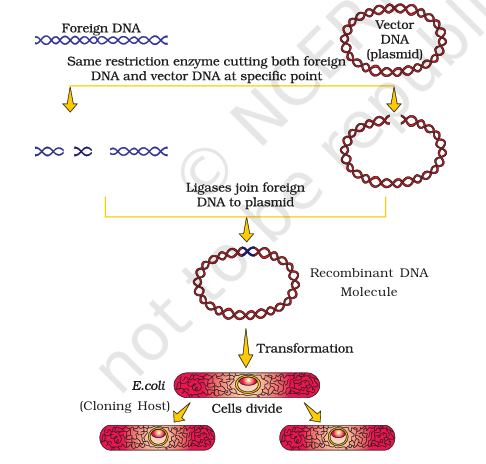
In the diagrammatic representation of recombinant DNA technology, what key action must occur immediately before the transformation of the E. coli cloning host?
QUESTION 12 OF 20
Based on the diagram, what is the consequence if the vector DNA and foreign DNA are cut by different restriction enzymes before applying ligase?
QUESTION 13 OF 20
Match the electrophoresis parameter with its defining characteristic:
| List I | List II |
|---|---|
| 1. Anode | P. Moves the farthest in the gel |
| 2. DNA fragments | Q. Extracted from sea weeds |
| 3. Agarose | R. Negatively charged molecules |
| 4. Smallest fragment | S. The positive electrode |
QUESTION 14 OF 20
Consider the dynamics of agarose gel electrophoresis:
I. The sieving effect is dependent on the size of the DNA fragment.
II. All DNA fragments move at the exact same speed regardless of size.
III. The matrix provides a physical barrier that restricts larger fragments more than smaller ones. Which statements accurately describe the sieving effect?
QUESTION 15 OF 20
Arrange the steps logically to isolate a specific gene from a genomic DNA sample for cloning:
1. Cut out the separated band from the agarose gel.
2. Expose the gel to UV radiation to locate the desired band.
3. Digest genomic DNA with a specific restriction endonuclease.
4. Load the sample onto an agarose gel and run electrophoresis.
5. Stain the gel with ethidium bromide.
QUESTION 16 OF 20
Why does ethidium bromide require UV radiation to allow visualization of DNA, rather than just showing up under visible light?
QUESTION 17 OF 20
Which of the following issues would NOT cause a failure in identifying DNA bands on a gel?
QUESTION 18 OF 20
Which statement is INCORRECT regarding the elution step and its purpose?
QUESTION 19 OF 20
While restriction enzymes and ligases cut and join DNA in vitro, what is the indispensable function of the DNA polymerase enzyme in vivo after transformation?
QUESTION 20 OF 20
In constructing an artificial recombinant DNA molecule, if the vector used is a native plasmid lacking an origin of replication (ori), what will be the fate of the alien DNA?
Test Complete!
Answer Review
1 Analyze the following statements about the history of restriction enzymes:
I. The discovery of restriction enzymes was vital because they allowed precise pasting of DNA ends together.
II. Stanley Cohen isolated the first restriction endonuclease from a plasmid.
III. Herbert Boyer observed that restriction enzymes clip DNA strands in a particular fashion leaving 'sticky ends'. Which of the statements is/are correct based on the text?
Statement I is incorrect; restriction enzymes cut (scissors), they do not paste (ligases do that). Statement II is incorrect; restriction enzymes were isolated from bacteria, not synthesized by Cohen from a plasmid. Statement III is correct; Boyer's observations on staggered cuts leading to "sticky ends" were foundational.
The correct answer is (B). Restriction enzymes function as "molecular scissors" (cutting), not "glue" (pasting/ligating), making Statement I false. Restriction enzymes are natural bacterial proteins used for defense, not synthetic products of Stanley Cohen, making Statement II false. Herbert Boyer's work in observing these specific staggered cuts—which generate single-stranded "sticky ends"—is a recognized historical fact in the development of recombinant DNA technology, making Statement III correct.
- Option A → Includes Statement I and II, both of which are incorrect.
- Option C → Includes Statement II, which is incorrect regarding the origin and nature of restriction enzymes.
- Option D → Incorrect because Statements I and II are factually inaccurate in the context of biological history.
Used Elimination.
Application: Identify the "pasting" role in Statement I as belonging to ligases, not restriction enzymes. This immediately eliminates A, C, and D.
Final Logic: Only the statement regarding Boyer's observation of sticky ends is historically accurate.
"Cut = Restriction Enzyme; Paste = Ligase."
2 Chronologically order the events leading to the foundational breakthrough of biotechnology:
1. Hind II was isolated and characterized.
2. Two enzymes restricting bacteriophage growth in E. coli were isolated.
3. Boyer and Cohen recombined DNA segments and inserted them into bacterial cells.
4. Boyer observed enzymes leaving 'sticky ends'.
1963: Isolation of restriction and methylation enzymes (2). 1968: Hind II isolated/characterized (1). Post-discovery: Observation of sticky ends (4). 1972: Construction of the first recombinant DNA (3).
The correct answer is (A). The sequence begins with the 1963 discovery of the two enzymes in E. coli (2), followed by the characterization of Hind II as the first restriction endonuclease in 1968 (1). Following this, researchers like Boyer observed the significance of "sticky ends" in DNA fragments (4), which ultimately enabled the 1972 breakthrough where Cohen and Boyer constructed the first successful recombinant DNA molecule (3).
- Options B, C, and D propose incorrect chronological sequences that violate the established timeline of molecular biology milestones.
Used Logical Sequencing.
Application: Use the known historical anchor points (1963 for initial enzymes, 1968 for Hind II) to fix the start of the sequence as 2, then 1.
Final Logic: Discovery (1963) → Characterization (1968) → Mechanism (Sticky Ends) → Application (Recombination).
"Discover, Define, Understand, Do."
3
Genus: Bacillus (B). Species: amyloliquefaciens (am). Strain: H. Order: I. Result: BamHI.
The correct answer is (B). According to standard nomenclature: the first letter comes from the genus (Bacillus = B), the next two letters from the species (amyloliquefaciens = am), the fourth letter represents the strain (H), and the Roman numeral denotes the order of discovery (I). Combining these gives "BamHI".
- Option A → "BacHI" uses only one species letter.
- Option C → "BmaIH" incorrectly rearranges the species letters.
- Option D → "BcaIH" incorrectly uses "ca" instead of "am" for the species name.
Used Substitution.
Application: Apply the G-S-S-O rule (Genus-Species-Strain-Order) systematically to the organism name provided.
Final Logic: B + am + H + I = BamHI.
"B-am-H-I."
4
The Roman numeral indicates the order of isolation/discovery. "III" means it was the third restriction enzyme isolated from that particular strain. It does not refer to species or physical parameters like base pairs or temperature.
The correct answer is (C). The naming convention for restriction endonucleases specifies that the Roman numeral suffix is solely assigned based on the order in which the enzyme was isolated from that particular bacterial strain. It has no relation to biological classification (species), recognition site length, or enzymatic kinetics (temperature).
- Option A → Species is determined by the species name part of the enzyme, not the numeral.
- Option B → Recognition site length varies by enzyme, not by discovery order.
- Option D → Optimal temperature is an enzymatic property, not part of the standard nomenclature.
Used Contextual Matching.
Application: Use the definition provided in the passage: "Roman numbers... indicate the order in which the enzymes were isolated."
Final Logic: Roman numeral = Order of discovery.
"III = 3rd one found."
5 Why would an exonuclease be entirely ineffective if a researcher attempts to cut a native, unbroken circular plasmid isolated from Salmonella typhimurium?
Exonucleases work from ends. Circular plasmids are continuous (closed loops) and have no 5' or 3' ends. Without an end to "latch onto," the enzyme cannot function.
The correct answer is (B). Exonucleases are enzymes that specifically degrade DNA by removing nucleotides one by one starting from either the 5' or 3' free end of a DNA molecule. A circular plasmid is a covalently closed, continuous loop of DNA with no free ends. Consequently, an exonuclease has no starting point and cannot act upon it.
- Option A → Plasmids consist of standard DNA nucleotides.
- Option C → Plasmids are not coated in proteins (unlike viruses).
- Option D → Exonucleases act on DNA, not exclusively RNA.
Used Elimination.
Application: Analyze the physical requirement of the enzyme (an "end") versus the structure of the substrate (circular/loop).
Final Logic: No ends = No exonuclease activity.
"Circle = No ends = No Exo."
6 Which of the following attributes is NOT characteristic of a true restriction endonuclease?
Endonucleases cut internally, not linearly from an end. Linear removal from an end is the definition of an exonuclease. Therefore, (B) is the incorrect attribute.
The correct answer is (B). Restriction endonucleases function by making cuts at specific, internal palindromic sites within the DNA molecule. The attribute of degrading DNA linearly from the 5' end (or any end) describes an exonuclease, not a restriction endonuclease.
- Option A → Characteristic; they cut at specific internal sites.
- Option C → Characteristic; they inspect/scan sequences to locate the cut site.
- Option D → Characteristic; they cut the sugar-phosphate backbone of both strands.
Used Elimination.
Application: Identify the statement that defines an exonuclease and classify it as "NOT characteristic" of a restriction endonuclease.
Final Logic: Restriction Endonuclease $\neq$ Linear/End-based removal.
"Endo = Internal; Linear = Exonuclease."
7 Identify whether the following abstract sequences (assume 5'->3' direction on the top strand) are palindromic (P) or non-palindromic (N) based on DNA base-pairing rules:
1. GAATTC
2. GATATC
3. GAAAAG
4. CCCGGG
1. GAATTC: Complement 3'-CTTAAG-5' (Read 5'-GAATTC-3') -> Palindromic (P). 1. GATATC: Complement 3'-CTATAG-5' (Read 5'-GATATC-3') -> Palindromic (P). 1. GAAAAG: Complement 3'-CTTTTC-5' (Read 5'-CTTTTC-3') -> Non-Palindromic (N). 1. CCCGGG: Complement 3'-GGGCCC-5' (Read 5'-CCCGGG-3') -> Palindromic (P).
The correct answer is (A). A sequence is palindromic if the sequence on the top strand (5' to 3') is identical to the sequence on the bottom strand (read 5' to 3'). GAATTC (5'-3') matches its complement's 5'-3'. (P) GATATC (5'-3') matches its complement's 5'-3'. (P) GAAAAG (5'-3') does not match its complement (CTTTTC). (N) CCCGGG (5'-3') matches its complement (CCCGGG). (P)
- Options B, C, and D fail because they misidentify the symmetry of sequence 3 or 4.
Used Substitution.
Application: Apply the base-pairing rule (A=T, C=G) and check the 5'-3' symmetry for each sequence.
Final Logic: Palindrome = Same forward and backward (on complementary strands).
"5' to 3' matches 5' to 3' of the complement."
8 If the sequence 5' - AAGCTT - 3' is recognized by an enzyme, what must be the sequence on the opposite strand reading from 3' to 5' to qualify as a DNA palindrome?
If Top is 5'-AAGCTT-3'. Bottom (complement) is 3'-TTCGAA-5'. This forms the standard DNA double-helix base pairing.
The correct answer is (A). For the top strand 5'-AAGCTT-3', the complementary bottom strand must follow standard base-pairing rules (A-T, G-C). Thus, the complement is 3'-TTCGAA-5'. This satisfies the requirement for a DNA palindrome, where the sequences are identical when read in the same 5' to 3' orientation.
- Option B → Incorrect; this would mean the sequence is identical to the top strand in orientation, creating A-A pairings, which is biologically impossible in DNA.
- Option C → Incorrect base pairing.
- Option D → Incorrect base pairing.
Used Contextual Matching.
Application: Apply Watson-Crick base pairing rules to create the complementary strand.
Final Logic: A=T, G=C.
"A pairs with T, G pairs with C."
9 If a restriction enzyme cuts exactly at the center of its palindromic recognition site on both strands, what will be the result?
Cutting at the center = Blunt ends. Cutting away from the center = Sticky ends. The center cut severs the backbone exactly at the symmetry point, resulting in no overhang.
The correct answer is (C). Restriction endonucleases produce blunt ends when they cut the sugar-phosphate backbone at the exact center of the palindromic recognition sequence on both strands. Since both strands are cleaved at the same position, there are no single-stranded, unpaired nucleotides (overhangs).
- Option A → This requires an off-center (staggered) cut.
- Option B → The enzyme will cut the backbone; the type of end created is the variable.
- Option D → Restriction enzymes act on DNA, not RNA; they do not synthesize primers.
Used Substitution.
Application: Map the action ("cut at center") to the definition ("blunt ends").
Final Logic: Center cut = Blunt end.
"Blunt = Straight (Center)."
10 During the action of joining two DNA molecules, which of the following is NOT true regarding the sticky ends?
Restriction enzymes (not polymerase) create sticky ends. The stickiness is due to the sequence overhangs produced by the restriction enzyme. Statement B is therefore false.
The correct answer is (B). The "stickiness" of the ends is entirely a function of the restriction endonuclease cutting the DNA in a staggered manner, exposing single-stranded regions. DNA polymerase is involved in DNA synthesis and has no role in creating the sticky ends or the H-bonds between them.
- Option A → True; H-bonding is the basis of the "sticky" interaction.
- Option C → True; sticky ends hold the fragments in position so ligase can seal them.
- Option D → True; for fragments to be joined by ligase, they must have complementary sticky ends (which usually means they were cut by the same enzyme).
Used Elimination.
Application: Identify the biological role of polymerase (synthesis) versus the described role (creating sticky ends). Because these roles conflict, (B) is the false statement.
Final Logic: Polymerase $\neq$ Sticky end creator.
"Polymerase makes long chains, not sticky ends."
11 In the diagrammatic representation of recombinant DNA technology, what key action must occur immediately before the transformation of the E. coli cloning host?
Transformation involves introducing the completed recombinant plasmid into the host. The recombinant plasmid is formed by ligating the foreign DNA and vector. Therefore, ligation must occur before transformation.
The correct answer is (B). In the standard workflow of recombinant DNA technology, the process flows as follows: isolation of DNA → cutting with restriction enzymes → ligation (joining) of the foreign DNA into the vector (creating the recombinant plasmid) → transformation of the host cell. Ligation must be completed to generate the recombinant plasmid molecule that is then introduced into the host.
- Option A → Exonuclease digestion is not part of the cloning assembly.
- Option C → Staining is used for visualization, not assembly.
- Option D → While plasmids may originate from different sources, extraction is not the immediate precursor to transformation; the construction (ligation) is.
Used Logical Sequencing.
Application: Identify the "recombinant" step in the workflow. The transformation happens after the recombinant molecule is created.
Final Logic: Construction (Ligation) > Transformation.
"Ligate first, Transform second."
12 Based on the diagram, what is the consequence if the vector DNA and foreign DNA are cut by different restriction enzymes before applying ligase?
Sticky ends must be complementary (match) to H-bond. Different enzymes usually produce different overhangs. If overhangs don't match, they won't stick, and ligase cannot join them.
The correct answer is (B). The specificity of restriction enzymes means each enzyme produces a unique set of sticky ends. If the vector and foreign DNA are cut by different enzymes, their sticky ends will likely not be complementary, preventing them from base-pairing (H-bonding). Without H-bonding, the ends cannot align, and DNA ligase cannot form the phosphodiester bonds needed to create the recombinant molecule.
- Option A → Mismatch does not speed up ligation; it prevents it.
- Option C → The host cell does not "repair" mismatched ligation in the context of plasmid construction.
- Option D → Non-recombinant molecules cannot multiply if they are not correctly formed.
Used Substitution.
Application: Recognize that complementarity is the prerequisite for H-bonding and ligation.
Final Logic: Non-complementary = No joining.
"Match ends = Recombinant; Mismatch = Failure."
13 Match the electrophoresis parameter with its defining characteristic:
| List I | List II |
|---|---|
| 1. Anode | P. Moves the farthest in the gel |
| 2. DNA fragments | Q. Extracted from sea weeds |
| 3. Agarose | R. Negatively charged molecules |
| 4. Smallest fragment | S. The positive electrode |
Anode = Positive electrode (S). DNA = Negative (R). Agarose = Seaweed extract (Q). Smallest = Farthest migration (P).
The correct answer is (A). Anode (1) is the positive electrode (S). DNA fragments (2) are negatively charged molecules (R). Agarose (3) is a polysaccharide extracted from seaweeds (Q). Smallest fragment (4) moves the farthest due to less resistance (P).
- Options B, C, and D contain incorrect mapping of these fundamental concepts.
Used Substitution.
Application: Verify the most direct definitions (e.g., Anode = S, DNA = R). Option (A) is the only one matching these correctly.
Final Logic: Consistent matching verifies (A).
"Anode-Plus, DNA-Minus, Agarose-Seaweed."
14 Consider the dynamics of agarose gel electrophoresis:
I. The sieving effect is dependent on the size of the DNA fragment.
II. All DNA fragments move at the exact same speed regardless of size.
III. The matrix provides a physical barrier that restricts larger fragments more than smaller ones. Which statements accurately describe the sieving effect?
Sieving depends on size (Statement I true). Different sizes move at different speeds (Statement II false). Matrix restricts larger fragments more (Statement III true).
The correct answer is (B). The fundamental principle of agarose gel electrophoresis is size-based separation (Statement I). The agarose matrix creates a porous network that acts as a sieve; larger fragments are hindered by this matrix more significantly than smaller ones (Statement III). Statement II is incorrect because speed is strictly inversely proportional to size.
- Options A, C, and D are incorrect because they include the false Statement II.
Used Elimination.
Application: Identify Statement II as false (different sizes must move at different speeds for separation to occur). Eliminate options containing II.
Final Logic: Separation = Different speeds = Size dependent.
"Sieve = Size Filter."
15 Arrange the steps logically to isolate a specific gene from a genomic DNA sample for cloning:
1. Cut out the separated band from the agarose gel.
2. Expose the gel to UV radiation to locate the desired band.
3. Digest genomic DNA with a specific restriction endonuclease.
4. Load the sample onto an agarose gel and run electrophoresis.
5. Stain the gel with ethidium bromide.
Cut DNA (3). Load/Electrophoresis (4). Stain (5). UV view/Locate (2). Cut/Extract (1).
The correct answer is (A). The logical sequence is: Digest DNA with restriction enzymes (3) → Load/Electrophorese fragments (4) → Stain with EtBr (5) → Identify the band under UV light (2) → Excise the band for extraction (1).
- Other options (B, C, D) place steps out of order (e.g., staining before electrophoresis or cutting before running).
Used Logical Sequencing.
Application: Follow the experiment: Digest (Prepare) -> Separate (Run) -> Visualize (Stain/UV) -> Recover (Extract).
Final Logic: Preparation → Separation → Visualization → Recovery.
"Digest, Run, Stain, See, Cut."
16 Why does ethidium bromide require UV radiation to allow visualization of DNA, rather than just showing up under visible light?
EtBr is a fluorochrome. It is specifically excited by UV light. Excitation results in visible orange light emission (fluorescence).
The correct answer is (C). Ethidium bromide is a fluorescent dye. It requires UV light to trigger its excitation phase; upon absorbing the UV photons, the EtBr molecules bound to the DNA re-emit this energy as visible light in the orange spectrum, which allows the researcher to see the bands.
- Option A → EtBr does not naturally emit light without excitation.
- Option B → UV light does not break DNA for visualization.
- Option D → Visible light has no destructive effect on the agarose gel matrix.
Used Contextual Matching.
Application: Identify the principle of fluorescence (Absorption of UV → Emission of visible light).
Final Logic: UV excitation = Visible fluorescence.
"UV In, Orange Light Out."
17 Which of the following issues would NOT cause a failure in identifying DNA bands on a gel?
Agarose is extracted from seaweed; this is the standard, correct method. This would not cause a failure. Options A, B, and D are all failures that would prevent band identification.
The correct answer is (C). Agarose is a natural polysaccharide extracted from seaweeds and is the standard material used for creating the gel matrix in electrophoresis. Using it is the correct procedure, so it would not cause a failure in identification.
- Option A → Missing EtBr means no fluorescence.
- Option B → Visible light is not enough to excite EtBr fluorescence.
- Option D → Without UV, there is no excitation of the EtBr dye.
Used Odd One Out.
Application: Identify the three "failures" and the one "standard procedure." Agarose from seaweed is standard.
Final Logic: Seaweed agarose = Correct material.
"Seaweed Agarose = Normal."
18 Which statement is INCORRECT regarding the elution step and its purpose?
Elution happens after the electric field is turned off and bands are visualized. They cannot occur simultaneously. The other options correctly describe parts of the elution/recovery workflow.
The correct answer is (C). The electric field is used during the electrophoresis run to separate the fragments. Once the separation is complete and the fragments are identified under UV light, the power is turned off. Only then does the researcher cut the gel and perform the elution. Therefore, they do not happen at the same time.
- Options A, B, and D are correct descriptions of the elution process.
Used Elimination.
Application: Identify the temporal conflict between electrophoresis (power on) and elution (power off).
Final Logic: Electrophoresis first, Elution later.
"Run first, Extract later."
19 While restriction enzymes and ligases cut and join DNA in vitro, what is the indispensable function of the DNA polymerase enzyme in vivo after transformation?
Once inside the cell, the recombinant DNA needs to copy itself. DNA polymerase carries out this replication. This is essential for the DNA to be maintained by the host.
The correct answer is (C). After the recombinant DNA molecule (typically a plasmid) is introduced into a host cell (transformation), it must be replicated to be maintained as the cell divides. The host cell's DNA polymerase binds to the plasmid's "origin of replication" (ori) and synthesizes copies of the introduced DNA.
- Option A → Restriction enzymes, not polymerase, recognize palindromes.
- Option B → Selectable markers (like antibiotic resistance genes) are carried by the plasmid, not by DNA polymerase.
- Option D → Elution is an in vitro laboratory process; it does not happen in the host cytoplasm.
Used Substitution.
Application: Identify the function of DNA polymerase (Replication). Match to (C).
Final Logic: DNA Polymerase = Replication of recombinant DNA.
"Polymerase = Copy-maker in host."
20 In constructing an artificial recombinant DNA molecule, if the vector used is a native plasmid lacking an origin of replication (ori), what will be the fate of the alien DNA?
'ori' is the signal for replication. No 'ori' = No replication initiation. Result: The DNA is lost during cell division.
The correct answer is (C). The 'origin of replication' (ori) is the specific DNA sequence that controls the copy number and initiates the replication of the plasmid in the host cell. Without this sequence, the host's DNA polymerase cannot initiate replication of the plasmid, meaning the recombinant DNA will not be duplicated and will be lost as the host cells divide.
- Option A → Plasmids do not automatically integrate into chromosomes.
- Option B → Exponential multiplication is impossible without an 'ori'.
- Option D → Plasmids do not have the ability to spontaneously activate host defense mechanisms.
Used Elimination.
Application: Understand the definition of 'ori' as the "start button" for replication. No 'ori' = No replication.
Final Logic: No 'ori' = No replication = Failure to multiply.
"No 'ori' = No copy."