
CUET UG Biology Booster Test 3- Foundations and Principles of Biotechnology
📌 Answers are locked once submitted — results and explanations appear at the end.
QUESTION 1 OF 20
QUESTION 2 OF 20
QUESTION 3 OF 20
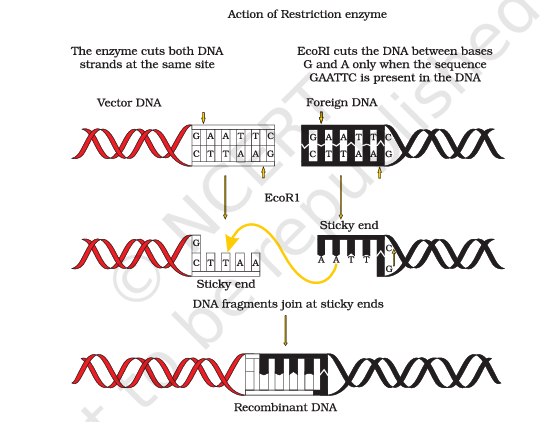
Analyzing Figure, how does the specific cutting action discovered by Boyer (demonstrated here by EcoRI) technically ensure the precise "pasting" of DNA pieces?
QUESTION 4 OF 20
In the context of Cohen's plasmid research and Figure, what essential molecular mechanism must occur after the sticky ends of the vector DNA (plasmid) and foreign DNA align?
QUESTION 5 OF 20
Critique the following statements regarding the shift from traditional to modern biotechnology:
I. Modern biotechnology strictly excludes any microbe-mediated processes like making curd or wine.
II. The shift to modern biotechnology was heavily dependent on the ability to alter the chemistry of DNA/RNA.
III. Traditional processes could not achieve the massive scale and genetic specificity seen in modern bioprocess engineering.
QUESTION 6 OF 20
Match the terms from the EFB definition to their real-world biotechnology counterparts:
| Column I | Column II |
|---|---|
| 1. Natural Science | i. A synthesized functioning gene |
| 2. Parts thereof | ii. Recombinant protein production or disease correction |
| 3. Molecular analogues | iii. Plasmids or restriction enzymes |
| 4. Products and services | iv. Chemistry and Physics applied to biology |
QUESTION 7 OF 20
In the context of altering the chemistry of genetic material, which of the following analytical statements is FALSE?
QUESTION 8 OF 20
From an analytical engineering perspective, arrange the required conditions to move from a genetic concept to a viable biotechnological product:
Extraction and downstream processing of the product.
Maintenance of sterile ambience in a bioreactor.
Introduction of altered genetic material into a host.
Scale-up of the host cell culture.
QUESTION 9 OF 20
Analytically, why was linking an antibiotic resistance gene to a plasmid a genius proof-of-concept for the birth of biotechnology?
QUESTION 10 OF 20
Evaluate the properties of the Salmonella typhimurium plasmid that made it analytically suitable for the first recombinant DNA experiment: I. It possessed its own origin of replication. II. It was a circular, extra-chromosomal DNA element. III. It naturally targeted and destroyed human cells.
QUESTION 11 OF 20
Which of the following is NOT an analytical challenge when attempting the basic step of "identification of DNA with desirable genes"?
QUESTION 12 OF 20
Maintenance of introduced DNA requires specific cellular interactions. Analytically, what ensures the alien DNA isn't simply degraded by the host cell's internal defense mechanisms or lost during cell division?
QUESTION 13 OF 20
Match the critical molecular tools with their deep analytical function in replication and cloning:
| Column I | Column II |
|---|---|
| 1. Origin of Replication (ori) | i. Acts as the glue to finalize the recombinant molecule |
| 2. Plasmid Vector | ii. Dictates the initiation of multiplication and copy number |
| 3. Restriction Enzyme | iii. Acts as the delivery vehicle and replication housing |
| 4. DNA Ligase | iv. Defines the specific insertion boundaries (sticky ends) |
QUESTION 14 OF 20
If an alien piece of DNA is introduced into a host cell without an origin of replication and without genomic integration, its analytical fate during cell division is:
QUESTION 15 OF 20
In the analytical scaling up of bacterial cells as factories, which factor is NOT a benefit of using continuous culture systems over closed-batch systems?
QUESTION 16 OF 20
Analytically sequence the complex downstream processing involved after specific protein production in a bioreactor:
1. Formulation with suitable preservatives.
2. Separation and purification of the protein from the biomass.
3. Strict quality control testing and clinical trials (if a drug).
4. Completion of the biosynthetic stage in the bioreactor.
QUESTION 17 OF 20
Analytically, how does In vitro Fertilization (IVF) align with the European Federation of Biotechnology's definition?
QUESTION 18 OF 20
Which analytical statement regarding DNA vaccine development as a modern application is INCORRECT?
QUESTION 19 OF 20
The analytical complexity of synthesizing a functional gene lies not just in assembling the sequence, but ensuring it:
QUESTION 20 OF 20
Analyze the prerequisites for correcting a defective gene in a patient using biotechnology:
I. Identification and precise isolation/synthesis of the healthy, functional gene.
II. Use of an appropriate vector to ferry the healthy gene into the targeted human cells.
III. Ensuring the gene integrates or remains stable enough to express the functional protein.
Test Complete!
Answer Review
1
Sexual reproduction involves the fusion of gametes, leading to whole-genome recombination. Genetic engineering uses molecular tools to target specific gene sequences. The primary advantage of engineering is the elimination of "linkage drag" (unwanted genes).
The correct answer is ( A). Traditional sexual reproduction results in the combination of vast genomic information where desirable genes are often linked with undesirable ones, making it difficult to segregate them. Genetic engineering allows for the precision manipulation of DNA, enabling scientists to isolate and introduce only the specific gene(s) of interest, thereby achieving the desired phenotype without the "noise" of unwanted genetic material.
- Option A → Incorrect because genetic engineering is targeted, not random.
- Option C → Incorrect because genetic engineering aims to create new, beneficial traits, not maintain identity.
- Option D → Incorrect because sexual reproduction does not utilize molecular scissors (restriction enzymes).
Used Elimination.
Application: Options A, C, and D are factually contradictory to the fundamental definition of genetic engineering; (
- A) directly addresses the passage's comparison of traditional breeding vs. engineering.
Final Logic: Genetic engineering provides the surgical precision that natural sexual reproduction lacks.
"Select to Inject": Engineering selects the specific gene and injects it; Sexual reproduction is a "bulk mix."
2
Sexual reproduction involves whole-genome inheritance. Genes located close together on a chromosome are inherited together (linkage). Traditional methods cannot "cut out" just the good part.
The correct answer is ( A). In traditional plant and animal breeding, the entire genome of the parent is crossed with the other. Since genes are physically located on chromosomes, undesirable traits physically linked to the desired ones are invariably carried over. Recombinant DNA technology allows us to bypass this by isolating the gene of interest away from the rest of the genome.
- Option A → Incorrect; hybridization is sexual, not asexual.
- Option C → Incorrect; breeders do not target defects to build immunity.
- Option D → Incorrect; traditional breeding does not use restriction enzymes.
Used Contextual Matching.
Application: The passage explicitly mentions that hybridization leads to the inclusion of undesirable genes. Option (
- A) provides the biological mechanism (linkage/whole genome) that explains this phenomenon.
Final Logic: Linkage of undesirable traits is the primary limitation of non-molecular breeding.
"Linkage Drag": In traditional breeding, good genes drag the bad ones along with them.
3 Analyzing Figure, how does the specific cutting action discovered by Boyer (demonstrated here by EcoRI) technically ensure the precise "pasting" of DNA pieces?
Restriction enzymes like EcoRI recognize specific palindromic sequences. "Staggered" cuts create single-stranded protrusions. These "sticky ends" allow hydrogen bonding with complementary sequences.
The correct answer is (A). Restriction endonucleases recognize specific palindromic base sequences. By cutting at specific locations away from the center of these sites, they produce single-stranded overhangs known as "sticky ends." These are critical because they form hydrogen bonds with their complementary cut counterparts, facilitating the action of DNA ligase to join the fragments.
- Option A → Incorrect; blunt ends are produced by different enzymes and are harder to join.
- Option B → Incorrect; the site remains, though the sequence is cleaved.
- Option D → Incorrect; methylation is a bacterial defense mechanism, not a cutting method.
Used Substitution.
Application: The key to "pasting" (ligation) in biotechnology is the complementarity of the ends. Only sticky ends provide the physical mechanism for this.
Final Logic: Complementary overhangs are the "Velcro" of DNA engineering.
"Sticky = Matchy": Sticky ends have matching bases that stick to their partner.
4 In the context of Cohen's plasmid research and Figure, what essential molecular mechanism must occur after the sticky ends of the vector DNA (plasmid) and foreign DNA align?
Sticky ends align via base pairing (Hydrogen bonds). DNA ligase acts as the glue to create phosphodiester bonds. This forms the Recombinant DNA molecule.
The correct answer is (A). Once the sticky ends of the foreign DNA and the vector DNA align through complementary base pairing (Hydrogen bonds), the backbone is still nicked. DNA ligase is the enzyme required to form the covalent phosphodiester bonds that permanently seal the sugar-phosphate backbone, completing the construction of the recombinant molecule.
- Option B → Incorrect; transcription is not the step required for physical construction.
- Option C → Incorrect; the vector is essential for delivering and replicating the gene.
- Option D → Incorrect; exonucleases would destroy the sticky ends, preventing ligation.
Used Contextual/Tonal Matching.
Application: The question asks for the mechanism that "joins" DNA. Ligation is synonymous with joining in molecular biology.
Final Logic: Alignment is temporary (H-bonds), Ligation is permanent (Phosphodiester bonds).
"LIG-ase = LIG-together": The enzyme that puts DNA together.
5 Critique the following statements regarding the shift from traditional to modern biotechnology:
I. Modern biotechnology strictly excludes any microbe-mediated processes like making curd or wine.
II. The shift to modern biotechnology was heavily dependent on the ability to alter the chemistry of DNA/RNA.
III. Traditional processes could not achieve the massive scale and genetic specificity seen in modern bioprocess engineering.
Modern biotech builds upon traditional methods; it doesn't exclude them. Genetic engineering (altering DNA/RNA chemistry) is the cornerstone of modern biotech. Modern engineering uses controlled bioreactors for high-scale, specific protein production.
The correct answer is ( A). Statement I is incorrect because modern biotechnology includes both traditional and molecular techniques. Statement II is correct as the manipulation of genetic material (DNA/RN A) is the definition of the "modern" era of biotech. Statement III is correct as traditional processes lack the precision and sterile scale-up capabilities of modern bioreactors.
- Option A → Incorrect because I is false.
- Option C → Incorrect because I is false.
- Option D → Incorrect because I is false.
Used Elimination.
Application: Once it is identified that modern biotechnology includes traditional processes (like fermentation), statement I is eliminated, leaving only option B.
Final Logic: Modern = Molecular manipulation + Scaling (not exclusionary).
"Modern = Traditional + Precision": It's an expansion, not a replacement.
6 Match the terms from the EFB definition to their real-world biotechnology counterparts:
| Column I | Column II |
|---|---|
| 1. Natural Science | i. A synthesized functioning gene |
| 2. Parts thereof | ii. Recombinant protein production or disease correction |
| 3. Molecular analogues | iii. Plasmids or restriction enzymes |
| 4. Products and services | iv. Chemistry and Physics applied to biology |
Natural Science is the basis (Physics/Chemistry applied to biology). Parts thereof refer to tools like plasmids/enzymes. Molecular analogues refer to synthetic constructs like synthetic genes. Products and services are the outputs (recombinant proteins/cures).
The correct answer is ( A). According to the EFB definition, Biotechnology integrates natural science (iv) with organisms or parts thereof (iii—plasmids/enzymes) and molecular analogues (i—synthesized DN A) to create products and services (ii—protein production).
- Options B, C, and D are incorrect pairings based on the standard EFB definitions used in the chapter's introduction.
Used Option Grouping.
Application: Match the most obvious pairings first (Natural Science = Physics/Chem; Products = Protein/Services).
Final Logic: Match 1 to (iv) and 4 to (ii) to arrive at the correct sequence.
"Sci-Physics, Parts-Tools, Analogues-Syn-DNA, Products-Output."
7 In the context of altering the chemistry of genetic material, which of the following analytical statements is FALSE?
Genetic engineering manipulates nucleotide sequences. It does not transmute elements (e.g., carbon to non-carbon). It changes the "code," not the elemental composition of the host.
The correct answer is ( A). This statement is scientifically absurd. Genetic engineering modifies the sequence of nucleotides in DNA or RNA, not the atomic composition or elements of the organism. The other options (A, C, D) are correct descriptions of the processes and goals of genetic engineering.
- Option A → True; this is the definition of recombinant DNA.
- Option C → True; changing genotype changes phenotype.
- Option D → True; enzymes like ligases and restriction endonucleases are essential.
Used Extreme Word Filter.
Application: Look for scientifically impossible claims. "Altering atomic structure" is a nuclear physics concept, not a biology one.
Final Logic: Biology deals with molecular sequence; Alchemy deals with atomic transmutation.
"DNA is Chemistry, not Alchemy."
8 From an analytical engineering perspective, arrange the required conditions to move from a genetic concept to a viable biotechnological product:
Extraction and downstream processing of the product.
Maintenance of sterile ambience in a bioreactor.
Introduction of altered genetic material into a host.
Scale-up of the host cell culture.
Step 1: Get the DNA in (Transformation). Step 2: Maintain sterile conditions for growth. Step 3: Scale up the culture to get enough volume. Step 4: Extract and purify (Downstream).
The correct answer is ( A). The sequence begins with the introduction of recombinant DNA into a host (3). Once transformed, the host is grown in a bioreactor under sterile conditions (2). This culture is then scaled up (4) to maximize production. Finally, the product is extracted and purified (1) via downstream processing.
- Options B, C, and D are incorrect because they place the purification (1) before the growth or introduction steps.
Used Logical Sequencing.
Application: Follow the logical flow of "Create → Grow → Harvest."
Final Logic: You cannot harvest (1) until you have grown (4) and grown (2) what you have created (3).
"Transform → Sterile → Scale → Harvest."
9 Analytically, why was linking an antibiotic resistance gene to a plasmid a genius proof-of-concept for the birth of biotechnology?
Selection markers are crucial for verifying transformation. Antibiotic resistance provides a simple "yes/no" survival test. This confirms the foreign DNA is doing its job.
The correct answer is (A). In the first Recombinant DNA experiment, Cohen and Boyer used an antibiotic resistance gene as a selectable marker. This allowed them to distinguish between cells that had successfully taken up the recombinant plasmid (which survived) and those that had not (which died), providing clear evidence of integration and functional expression.
- Option A → Incorrect; antibiotic resistance allows survival, it does not "kill" the bacteria.
- Option C → Incorrect; this was not the primary proof, but the use of the selectable marker was.
- Option D → Incorrect; DNA and RNA are chemically distinct.
Used Contextual Matching.
Application: The purpose of a marker gene in biotechnology is always screening/selection.
Final Logic: Selectable markers = Proof of success.
"Selection = Survival": If they survive, the marker is inside!
10 Evaluate the properties of the Salmonella typhimurium plasmid that made it analytically suitable for the first recombinant DNA experiment: I. It possessed its own origin of replication. II. It was a circular, extra-chromosomal DNA element. III. It naturally targeted and destroyed human cells.
Origin of replication (ori) is necessary for the plasmid to replicate independently. Plasmids are naturally circular, extra-chromosomal DNA. The plasmid did not destroy human cells; it was just a vector.
The correct answer is ( A). A vector must be able to replicate independently within the host; therefore, the ori sequence (I) is essential. Plasmids (II) are naturally occurring circular extra-chromosomal DNA found in bacteria, making them ideal vehicles. Statement III is false as these plasmids are not pathogens targeting human cells.
- Options B, C, and D are incorrect because they include Statement III.
Used Elimination.
Application: Identify the biological impossibilities (III). Once (III) is eliminated, only (
- A) remains.
Final Logic: Vectors must replicate (I) and be extra-chromosomal (II); they don't hunt humans.
"Ori + Extra = Vector": Origin of replication plus extra-chromosomal DNA equals a perfect vehicle.
11 Which of the following is NOT an analytical challenge when attempting the basic step of "identification of DNA with desirable genes"?
"Teleportation" of DNA is not a biological process. Transformation (the actual entry of DN A) requires a vector or specific physical/chemical methods. Spontaneous, unmediated transfer of DNA into a host cell is impossible.
The correct answer is ( A). Genetic engineering relies on deliberate, engineered methods to move DNA (vectors, transformation, microinjection, etc.). DNA does not "spontaneously teleport"; therefore, this is not an "analytical challenge"—it is an impossibility that is never expected to happen in a laboratory setting. Options A, B, and D describe real hurdles researchers face during the identification and isolation phase.
- Option A → A real challenge; identifying one gene in a whole genome is like finding a needle in a haystack.
- Option B → A real challenge; gene sequence is not enough; it must be functional (the right protein).
- Option D → A real challenge; enzymes and physical forces can easily fragment DNA during isolation.
Used Extreme Word Filter.
Application: The word "spontaneously teleport" acts as a clear indicator of a scientifically incorrect statement.
Final Logic: Genetic engineering is an active, not spontaneous, process.
"No Teleporting": DNA needs a ride (vector).
12 Maintenance of introduced DNA requires specific cellular interactions. Analytically, what ensures the alien DNA isn't simply degraded by the host cell's internal defense mechanisms or lost during cell division?
DNA needs a mechanism to be replicated by the host's machinery. If it replicates independently (plasmi D) or gets merged into the genome, it survives cell division. Degradation is prevented by physical association with replication sites.
The correct answer is ( A). For introduced DNA to survive and be inherited by daughter cells, it must be replicated. This is achieved if the DNA has an ori (Origin of replication) to act as a plasmid or if it integrates into the host's chromosome. Without this, the cell's machinery ignores or degrades the alien fragment during division.
- Option A → DNA is not kept in a protein coat (that's a virus); it needs to be accessible for expression.
- Option C → Heat shock is only for initial entry (transformation); it would kill the cells if maintained.
- Option D → This is lethal to the cell; restriction enzymes are part of the host's normal immunity/regulation.
Used Substitution.
Application: The core requirement for "maintenance" in any cloning experiment is the presence of an ori or chromosomal integration.
Final Logic: Replication linkage = Stability.
"Link to Replicate": If it doesn't link, it's out of sync.
13 Match the critical molecular tools with their deep analytical function in replication and cloning:
| Column I | Column II |
|---|---|
| 1. Origin of Replication (ori) | i. Acts as the glue to finalize the recombinant molecule |
| 2. Plasmid Vector | ii. Dictates the initiation of multiplication and copy number |
| 3. Restriction Enzyme | iii. Acts as the delivery vehicle and replication housing |
| 4. DNA Ligase | iv. Defines the specific insertion boundaries (sticky ends) |
Ori tells the cell when to replicate. Plasmid is the housing for the gene. Restriction enzymes cut (define boundaries). Ligase glues (finalize).
The correct answer is ( A). Ori (1) dictates multiplication initiation (ii). Plasmid (2) is the vehicle/housing (iii). Restriction Enzyme (3) cuts at specific boundaries (iv). DNA Ligase (4) acts as the glue (i).
- Options B, C, and D incorrectly match the biological roles defined in the text.
Used Option Grouping.
Application: Identify the two most certain pairs first (e.g., Ligase = Glue, Ori = Replication initiation). Match those to the letter codes to confirm (A).
Final Logic: Proper functional mapping confirms (A).
"Ori-Init, Vector-House, Enzyme-Cut, Ligase-Glue."
14 If an alien piece of DNA is introduced into a host cell without an origin of replication and without genomic integration, its analytical fate during cell division is:
DNA that doesn't replicate is not copied. When a cell divides, only one daughter cell might get it, or it gets left behind. "Dilution" occurs as the cell population grows.
The correct answer is ( A). Replication is required to maintain the DNA copy number across generations. If the DNA piece lacks an ori and fails to integrate into the genome, it becomes a "passenger" that is not copied by DNA polymerase during the cell cycle. Consequently, as the host cells divide, the concentration of this foreign DNA drops until it is lost entirely from the population.
- Option A → False; it won't replicate, so no amplification.
- Option C → False; it's a piece of DNA, not a virus, and it doesn't become one.
- Option D → False; ori sites are specific sequences; they don't appear spontaneously.
Used Elimination.
Application: Recognize that (A), (A), and (D) are biologically impossible. (A) is the logical consequence of a lack of replication control.
Final Logic: No replication = Loss via dilution.
"No Ori, No Copy, No Stay."
15 In the analytical scaling up of bacterial cells as factories, which factor is NOT a benefit of using continuous culture systems over closed-batch systems?
Continuous culture requires constant nutrient inflow. "Halting inputs" would kill the culture (starvation phase). Bacteria do not "consume" their own plasmids to survive.
The correct answer is ( A). In a continuous culture system, fresh medium is added, and spent medium is removed to keep cells in a constant growth (log) phase. Halting nutrient input is the opposite of this process—it leads to the death phase in batch culture, not increased production. Furthermore, bacteria do not consume plasmids for nutrients.
- Option A → A true benefit; cells are more productive in the log phase.
- Option B → A true benefit; steady growth leads to higher biomass.
- Option D → A true benefit; higher biomass and active cells = higher protein yields.
Used Elimination.
Application: Identify that (
- A) contradicts the very definition of a "continuous" system.
Final Logic: Continuous flow = Constant food; starvation is the enemy of production.
"Continuous = Constant Feed."
16 Analytically sequence the complex downstream processing involved after specific protein production in a bioreactor:
1. Formulation with suitable preservatives.
2. Separation and purification of the protein from the biomass.
3. Strict quality control testing and clinical trials (if a drug).
4. Completion of the biosynthetic stage in the bioreactor.
First, make it (4). Then, get it out and clean it (2). Then, package it (1). Finally, test it (3).
The correct answer is ( A). The sequence must be: Completion of biosynthesis in the bioreactor (4) → Separation and purification (2) → Formulation for stability (1) → Quality control and clinical validation (3). Clinical trials must come last because the product must be purified and formulated before it can be tested on patients.
- Other sequences (B, C, D) place trials or formulation before separation, which is technically impossible.
Used Logical Sequencing.
Application: Think of the process as: "Brew (Bioreactor) → Filter (Purify) → Bottle (Formulate) → Approve (Trials)."
Final Logic: Bioreactor first, Clinical Trials last.
"Biosynth → Clean → Pack → Test."
17 Analytically, how does In vitro Fertilization (IVF) align with the European Federation of Biotechnology's definition?
IVF is a service/product of biotechnology. It involves gametes (cells/parts thereof). It uses scientific knowledge to solve a biological problem.
The correct answer is (A). The EFB defines biotechnology as the integration of natural science and organisms, cells, or parts thereof for products and services. IVF takes egg and sperm cells (parts thereof), uses clinical science (natural science) to fertilize them, and provides a "service" to assist with conception.
- Option A → False; it uses natural gametes, not "artificial humans."
- Option C → False; IVF is not about antibiotics.
- Option D → False; bacterial origins are for DNA cloning, not human fertilization.
Used Contextual Matching.
Application: Apply the EFB definition broadly. IVF fits the "Product/Service" and "Cells/Parts thereof" criteria perfectly.
Final Logic: IVF = Science + Gametes = Service.
"IVF = Service for Cells."
18 Which analytical statement regarding DNA vaccine development as a modern application is INCORRECT?
DNA vaccines work by using the central dogma. The host reads the DNA, makes the antigen protein, and then the immune system reacts to the protein. Bypassing the central dogma would make the vaccine ineffective.
The correct answer is (A). This statement is incorrect because DNA vaccines are entirely dependent on the central dogma. The vaccine delivers a DNA sequence to the host cells, which then transcribe it into mRNA and translate it into the antigen protein. The immune system recognizes this protein.
- Option A → True; you must pick the gene that triggers the immune system.
- Option C → True; it's molecular, not whole-pathogen (like attenuated or killed virus).
- Option D → True; that is the core mechanism of DNA vaccination.
Used Elimination.
Application: The central dogma is the basis of all life; a vaccine cannot work by "bypassing" the very mechanism that makes proteins.
Final Logic: Central Dogma = Vaccine's engine.
"DNA Vax = DNA → RNA → Protein."
19 The analytical complexity of synthesizing a functional gene lies not just in assembling the sequence, but ensuring it:
Having a gene sequence is useless if the host doesn't "read" it. Expression requires the right promoters, codons, and regulatory signals. "Expression" is the key to functionality.
The correct answer is ( A). Synthesizing a sequence is just the start. For the gene to be "functional," it must be recognized by the host's transcription and translation machinery. This means it needs the right promoter sequences, correct codons (codon bias), and stability to actually produce the protein inside the cell.
- Option A → False; palindromes are often necessary for restriction sites or regulatory proteins.
- Option C → False; you want it to be better or functional, not to match a defective gene.
- Option D → False; you never replace the host's ribosomes; you use them.
Used Substitution.
Application: Focus on what "functional" means in biology—expression and production of the protein.
Final Logic: Gene = Protein output (Expression).
"Seq = Hardware; Expression = Software."
20 Analyze the prerequisites for correcting a defective gene in a patient using biotechnology:
I. Identification and precise isolation/synthesis of the healthy, functional gene.
II. Use of an appropriate vector to ferry the healthy gene into the targeted human cells.
III. Ensuring the gene integrates or remains stable enough to express the functional protein.
Gene therapy requires: 1. The healthy gene. 2. A way to deliver it (vector). 3. Proof it's working (expression/integration). All three are necessary for the cure.
The correct answer is (D). Gene therapy (a form of gene correction) follows the standard steps of recombinant DNA: Identify the gene (I), use a vector for delivery (II, e.g., viral vectors), and confirm its stable expression within the cell (III). All three are essential for the therapeutic effect.
- Options A, B, and C are incomplete because all three steps are mandatory for successful correction.
Used Option Grouping.
Application: Evaluate each step as a standard requirement for gene therapy. Since all three are standard, choose the "all-inclusive" option (D).
Final Logic: Identify, Deliver, Express.
"Get Gene, Get Vector, Get Expression."