
CUET UG Biology Booster Test 2-Microbes in Household and Food Production
📌 Answers are locked once submitted — results and explanations appear at the end.
QUESTION 1 OF 20
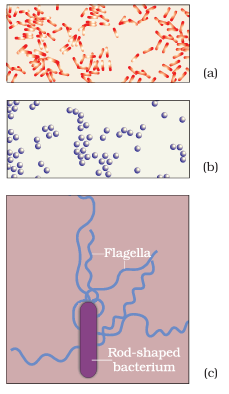
Based on the image showing bacterial diversity, which structural feature is exclusively visible in Figure (c) that differentiates it from the bacteria in Figure (a) and (b)?
QUESTION 2 OF 20
While the bacteria shown in the image represent common shapes, some microbes are adapted to highly extreme environments. According to the text, where might extreme-loving microbes exist at temperatures as high as?
QUESTION 3 OF 20
Microbes are a major component of biological systems. Which of the following microbes described in the text are uniquely "proteinaceous infectious agents"?
QUESTION 4 OF 20
Which of the following statements regarding the laboratory culturing of microbes is INCORRECT based on the provided text?
QUESTION 5 OF 20
Evaluate the following statements regarding the action of Lactic Acid Bacteria (LAB):
1. During growth, LAB produce acids that completely digest the milk proteins to form curd.
2. A large amount of curd must be added to fresh milk as a starter to initiate coagulation.
QUESTION 6 OF 20
Match the microbial process with its direct benefit to human welfare:
| Column 1 | Column 2 |
|---|---|
| 1. LAB growth in milk | P. Imparts a particular flavour |
| 2. LAB presence in human stomach | Q. Causes dough to puff up |
| 3. Fungal growth on Roquefort cheese | R. Checks disease causing microbes |
| 4. Yeast fermentation in bread dough | S. Improves nutritional quality by increasing Vitamin B12 |
QUESTION 7 OF 20
How does the presence of Lactic Acid Bacteria (LAB) in the human stomach primarily act as a beneficial biological agent?
QUESTION 8 OF 20
Regarding the 'starter' or inoculum used in household curd production, which statement is NOT true?
QUESTION 9 OF 20
Arrange the sequence of metabolic and physical events that occur when preparing dosa or idli dough:
1. Puffed-up appearance of the dough
2. Inoculation and growth of fermenting bacteria
3. Formation of gas
4. Metabolic breakdown of the dough nutrients
QUESTION 10 OF 20
Match the substrate to the primary microbe responsible for producing gas leading to its structural alteration:
| Column 1 | Column 2 |
|---|---|
| 1. Dosa dough | P. Saccharomyces cerevisiae |
| 2. Bread dough | Q. Lactic Acid Bacteria (Primarily produces acid, not for structural expansion) |
| 3. Swiss cheese | R. Bacteria (Natural fermenters in the dough) |
| 4. Curd | S. Propionibacterium sharmanii |
QUESTION 11 OF 20
QUESTION 12 OF 20
QUESTION 13 OF 20
Which of the following characteristics does NOT apply to the beverage 'Toddy'?
QUESTION 14 OF 20
The traditional beverage 'Toddy' derives its characteristic properties due to the direct action of microbes on which substrate?
QUESTION 15 OF 20
Consider these statements about the utilization of microbes in diverse food traditions:
1. Microbes are used to ferment soyabean to make traditional foods.
2. Microbes are uniquely restricted to dairy and baking; they are never used to ferment animal products like fish.
QUESTION 16 OF 20
The processing of bamboo shoots into edible food products relies heavily on:
QUESTION 17 OF 20
Sequence the biological process responsible for the texture of Swiss cheese:
1. Production of a large amount of CO2
2. Growth of Propionibacterium sharmanii in the cheese matrix
3. Formation of characteristic large holes
4. Metabolic activity of the bacterium
QUESTION 18 OF 20
The distinct physical appearance of Swiss cheese, specifically its large holes, is a direct visible indicator of which underlying biological phenomenon?
QUESTION 19 OF 20
Which of the following assertions about 'Roquefort cheese' is INCORRECT?
QUESTION 20 OF 20
In Roquefort cheese, what is the primary biological driver for the development of its particular flavour?
Test Complete!
Answer Review
1 Based on the image showing bacterial diversity, which structural feature is exclusively visible in Figure (c) that differentiates it from the bacteria in Figure (a) and (b)?
Bacteria show immense variation in their physical structures and shapes. Figure (a) represents spherical cocci and Figure (b) represents rod-shaped bacilli. Figure (c) specifically illustrates a rod-shaped bacterium featuring prominent hair-like flagella.
- In the foundational NCERT diagrams illustrating diverse bacterial shapes under high magnification, the three primary structural types are laid out systematically. Figure (a) shows the spherical Coccus forms, while Figure (b) details the simple rod-shaped Bacillus morphology. Figure (c) explicitly introduces a specialized variant: a rod-shaped bacterium that possesses long, whip-like, thread-shaped surface appendages known as flagella. These structures pierce through the cell wall to provide active cellular motility. Therefore, the presence of visible flagella serves as the exclusive diagnostic differentiator for Figure (c) compared to the unflagellated cell boundaries shown in panels (a) and (b).
- Option A → A spherical shape is the defining characteristic of Coccus bacteria shown in Figure (a), not Figure (c).
- Option C → Individual bacterial cells are microscopic, single-celled entities that cannot be classified as macroscopic structures.
- Option D → The diagram illustrates single, isolated individual bacterial cells under high magnification rather than aggregated colonial groupings.
Used: Elimination
Application: Analyze the clear visual differences between basic bacterial shapes in standard textbook diagrams. Spherical configurations match panel (a) exclusively, whereas macroscopic scale or colonizing setups do not apply to these individual cell profiles.
Final Logic: Option B is isolated because flagella are the only unique physical structures drawn attached to the cell body in Figure (c).
C for Cilia-like Flagella: Figure (c) brings the cord-like flagella into view for swimming.
2 While the bacteria shown in the image represent common shapes, some microbes are adapted to highly extreme environments. According to the text, where might extreme-loving microbes exist at temperatures as high as?
Extreme thermophiles can survive in environments with temperatures exceeding 100°C. Hydrothermal vents and active geysers maintain these blistering heat conditions naturally. NCERT explicitly links these extreme high-temperature habitats to thermal vents.
- Microorganisms show incredible metabolic and structural adaptations that allow them to live in brutal environmental conditions. When looking at places that feature high temperatures (often scaling near or above 100°C), the textbook explicitly highlights deep-sea hydrothermal vents and terrestrial hot springs (geysers). Specialized thermophilic archaebacteria possess highly stable cell walls and heat-resistant enzymes that keep their cellular machinery functional under intense heat. This makes deep geysers the exact habitat mentioned for these extreme temperatures.
- Option A → Highly acidic environments are defined by low pH values rather than high temperatures, though thermoacidophiles can experience both.
- Option C → Environments beneath deep layers of snow represent extreme cold, sub-zero conditions favored by psychrophilic organisms.
- Option D → The internal human stomach environment maintains a steady body temperature near 37°C and is characterized by its high acidity, not boiling heat.
Used: Contextual/Tonal Matching
Application: Match the physical metric given in the text—high temperature—with its natural geographic equivalent. Boiling conditions point directly toward volcanic or thermal features.
Final Logic: Option B is selected because geysers and thermal vents are the only habitats listed that experience high temperatures.
Thermal means Temperature: Thermal vents match the high-temperature habitats of extremophiles.
3 Microbes are a major component of biological systems. Which of the following microbes described in the text are uniquely "proteinaceous infectious agents"?
Prions stand out because they lack any form of DNA or RNA genetic material. They are composed entirely of abnormally folded infectious proteins. NCERT defines them strictly under the category of proteinaceous infectious agents.
- While most infectious biological pathogens rely on nucleic acid genomes (DNA or RNA) to replicate inside a host, prions are a unique exception. A prion is a defective, abnormally folded protein structural unit that can force healthy proteins in host nervous tissue to misfold as well. Because they completely lack genetic transcripts, they are explicitly classified in the textbook as proteinaceous infectious agents. This differentiates them from other microscopic agents like viroids, which consist of naked RNA strands.
- Option A → Viroids are infectious agents composed purely of low-molecular-weight, free, naked RNA strands without any protective protein coat.
- Option B → Fungi are complex, eukaryotic cellular organisms containing chitinous walls, standard organelles, and nucleic acid genomes.
- Option D → Protozoa are unicellular eukaryotic animals with standard cellular structures and genomic DNA matrices.
Used: Substitution
Application: This question uses direct terminology matching. Replacing the phrase "proteinaceous infectious agent" with its literal definition yields prions according to the text.
Final Logic: Option C is selected because prions are the only pathogens listed that are made entirely of protein.
P for Protein: Prions = Purely Proteinaceous Pathogens.
4 Which of the following statements regarding the laboratory culturing of microbes is INCORRECT based on the provided text?
Cellular microbes like bacteria and fungi multiply easily on basic agar plates. This growth forms visible colonies that make studying them much easier. Viruses are obligate intracellular parasites and cannot grow on simple, cell-free nutrients.
- The technique of laboratory culturing involves inoculating cellular microbes onto an agar-based nutrient medium. Bacteria and fungi utilize these nutrients to form macroscopically visible colonies, which are highly useful for research and scientific study. However, viruses are entirely acellular, obligate intracellular parasites. They completely lack their own metabolic machinery and can only replicate inside living host cells. Because of this, viruses cannot grow, divide, or form visible colonies on simple, cell-free nutritive media. This makes statement D completely incorrect, and therefore the right answer for this negative question.
- Option A → This is a correct statement; bacteria and molds readily multiply on common nutrient agar formulations.
- Option B → This is a correct statement; isolating macroscopic colonies is essential for runing diagnostic and structural studies.
- Option C → This is a correct statement; individual microscopic cells multiply exponentially into large clusters that can be seen with the naked eye.
Used: Extreme Word Filter
Application: The word "All" in option D is an extreme modifier. It claims that all viruses can grow on simple nutrient media, ignoring the biological fact that viruses require living host cells to replicate.
Final Logic: Option D is chosen because viruses cannot grow on cell-free agar, making the statement false.
Viruses Need Life: Viruses can never grow on plain agar plates; they always require a living cell host.
5 Evaluate the following statements regarding the action of Lactic Acid Bacteria (LAB):
1. During growth, LAB produce acids that completely digest the milk proteins to form curd.
2. A large amount of curd must be added to fresh milk as a starter to initiate coagulation.
LAB produce organic acids that partially digest milk proteins, not completely. Only a tiny spoonful of starter curd is needed to inoculate fresh milk. Since both statements contain factual errors, option B is the correct choice.
- Let's evaluate the accuracy of both statements: Statement 1 is incorrect: As LAB grow in milk, they produce lactic acid. This acid lowers the pH to partially digest and coagulate the milk protein casein, rather than completely breaking it down. Complete digestion would liquefy the milk into amino acids instead of turning it into curd. Statement 2 is incorrect: You do not need a large volume of curd to start the process. Only a small sample or spoonful of starter (inoculum) is required, as it already contains the millions of active LAB needed to populate the fresh milk. Since both statements are factually wrong, option B is correct.
- Option A → Incorrectly validates both statements, missing the errors regarding complete protein digestion and large starter volumes.
- Option C → Incorrectly states that Statement 1 is true, failing to notice that milk proteins are only partially digested during curdling.
- Option D → Incorrectly labels Statement 2 as a valid instruction, when only a small amount of starter is needed.
Used: Extreme Word Filter
Application: Look closely at the modifier words "completely" in Statement 1 and "large amount" in Statement 2. Both represent extreme claims that contradict the partial digestion and small starter volumes outlined in the textbook.
Final Logic: Option B is selected because both statements contradict the biological and practical steps of dairy fermentation.
Partial and Small: Curdling requires partial digestion and a small spoonful of starter.
6 Match the microbial process with its direct benefit to human welfare:
| Column 1 | Column 2 |
|---|---|
| 1. LAB growth in milk | P. Imparts a particular flavour |
| 2. LAB presence in human stomach | Q. Causes dough to puff up |
| 3. Fungal growth on Roquefort cheese | R. Checks disease causing microbes |
| 4. Yeast fermentation in bread dough | S. Improves nutritional quality by increasing Vitamin B12 |
LAB growth in dairy milk boosts baseline Vitamin B12 levels. Active gut LAB help protect the body by keeping harmful pathogens in check. Penicillium mold strains develop the signature flavors of Roquefort cheese. Yeast releases carbon dioxide gas, causing bread dough to puff up and rise.
- Breaking down the correct pairings for each microbial process: 1. LAB growth in milk improves the nutritional value of dairy by increasing Vitamin B12 (S). 2. LAB presence in the human stomach acts as a health shield that checks disease-causing microbes (R). 3. Fungal growth on Roquefort cheese breaks down fats and proteins to impart a particular flavor (P). 4. Yeast fermentation in bread dough produces carbon dioxide gas that causes dough to puff up (Q). Matching these processes to their benefits gives the sequence 1-S, 2-R, 3-P, 4-Q, which matches option B.
- Option A → Incorrectly pairs dairy LAB growth with pathogen control in the stomach (1-R) and switches the other properties around.
- Option C → Correctly pairs the first two items but mismatches the last two, pairing bread dough with cheese characteristics (3-Q) and vice-versa (4-P).
- Option D → Pairs milk fermentation with cheese flavoring (1-P) and mixes up the remaining entries.
Used: Elimination / Option Grouping
Application: Find a definitive match like 4-Q (yeast causes bread dough to puff up). Looking at the options, only B matches 4 with Q, which helps narrow down and confirm the correct option group.
Final Logic: Option B is chosen because it accurately pairs all four industrial microbes with their proper household benefits.
Yeast Puffs, Stomach Checks: Connect yeast directly to the rising dough (4-Q) and gut bacteria to pathogen protection (2-R) to find the right path.
7 How does the presence of Lactic Acid Bacteria (LAB) in the human stomach primarily act as a beneficial biological agent?
LAB function as natural, living probiotics within the human gut. They release organic acids that keep harmful pathogens from multiplying. This competitive inhibition is an essential part of maintaining balanced gut health.
- Lactic Acid Bacteria (LAB) are highly beneficial probiotics that support human health. Inside the stomach and intestinal tract, these bacteria compete with harmful pathogens for space and nutrients. By producing organic acids that lower the surrounding pH, LAB create an environment that suppresses opportunistic pathogens. This active protection helps maintain balanced gut health, which the textbook describes as checking disease-causing microbes.
- Option B → Humans lack the enzymes needed to digest cellulose, and stomach LAB cannot break down these complex plant fibers (a process that occurs in ruminant livestock instead).
- Option C → Producing high volumes of gas inside the stomach would cause painful bloating, rather than offering a health benefit.
- Option D → Penicillin is an antibiotic synthesized exclusively by filamentous fungi like Penicillium notatum, not by lactic dairy bacteria.
Used: Contextual/Tonal Matching
Application: Look for the option that describes a realistic, positive health benefit for the human stomach. Suppressing harmful bacteria fits this criteria perfectly.
Final Logic: Option A is selected because protecting the digestive tract from infection is a primary function of gut probiotics like LAB.
LAB acts as a Shield: Inside the stomach, LAB works like a security guard to check and stop harmful germs.
8 Regarding the 'starter' or inoculum used in household curd production, which statement is NOT true?
A starter culture is added to fresh milk to kickstart the curdling process. The bacteria in the starter produce acids that coagulate milk proteins. Claiming the starter prevents coagulation contradicts how curd is formed.
- To turn milk into curd, a small spoonful of starter culture (inoculum) is mixed into warm milk. This sample contains millions of active Lactic Acid Bacteria (LAB) that multiply quickly if kept at a suitable temperature. As they grow, they produce lactic acid, which drops the pH and causes milk proteins to clump together. Because the primary purpose of the starter is to cause this clumping, statement C—which claims it prevents coagulation—is completely false, making it the correct answer for this negative question.
- Option A → This is a true statement; even a tiny drop of starter culture is packed with millions of active LAB cells.
- Option B → This is a true statement; the milk must be kept lukewarm because extreme cold or boiling heat will stall bacterial growth.
- Option D → This is a true statement; a single spoonful of starter contains more than enough bacteria to inoculate a whole bowl of fresh milk.
Used: Elimination / Logic Check
Application: Analyze what actually happens during fermentation. Since curd is solid, the starter must promote coagulation. Any statement claiming it stops coagulation is logically incorrect.
Final Logic: Option C is chosen because it contradicts the fundamental biological mechanism behind curd formation.
Starter Starts Coagulation: The starter is added specifically to cause coagulation, never to prevent it.
9 Arrange the sequence of metabolic and physical events that occur when preparing dosa or idli dough:
1. Puffed-up appearance of the dough
2. Inoculation and growth of fermenting bacteria
3. Formation of gas
4. Metabolic breakdown of the dough nutrients
Fermentation begins when wild bacteria enter and populate the fresh batter. These bacteria feed on carbohydrates, breaking down nutrients to generate energy. This metabolic activity releases carbon dioxide gas as a natural byproduct. The expanding gas bubbles lift the thick batter, giving it a puffed-up look.
- The fermentation of traditional dosa and idli batter follows a clear chronological sequence. The process begins with the inoculation and growth of fermenting bacteria (2) from the environment into the wet mixture. Once established, these bacteria begin the metabolic breakdown of dough nutrients (4) like starches and sugars. This pathway releases carbon dioxide (CO2) gas, leading to the formation of gas (3) bubbles within the mixture. As these trapped bubbles expand, they cause the visible puffed-up appearance of the dough (1). This gives us the correct sequence of 2 → 4 → 3 → 1, which matches option A.
- Option B → 4, 2, 1, 3 incorrectly suggests that nutrients break down before the bacteria have even inoculated or started growing in the batter.
- Option C → 2, 3, 4, 1 implies that gas forms before the bacteria actually metabolize or break down any nutrients to produce it.
- Option D → 1, 2, 3, 4 presents the steps completely backward, putting the final puffed-up appearance before bacterial inoculation has even occurred.
Used: Elimination
Application: Identify the first and last steps of the biological process. The bacteria must populate the batter first (2), and the final visual result is the puffed-up look of the dough (1). This leaves option A as the only logical choice.
Final Logic: Option A correctly maps the process from initial bacterial inoculation to final gas expansion.
B-M-G-P Sequence: Bacteria enter (2) → Metabolism runs (4) → Gas forms (3) → Puffed rise (1).
10 Match the substrate to the primary microbe responsible for producing gas leading to its structural alteration:
| Column 1 | Column 2 |
|---|---|
| 1. Dosa dough | P. Saccharomyces cerevisiae |
| 2. Bread dough | Q. Lactic Acid Bacteria (Primarily produces acid, not for structural expansion) |
| 3. Swiss cheese | R. Bacteria (Natural fermenters in the dough) |
| 4. Curd | S. Propionibacterium sharmanii |
Dosa dough relies on wild, gas-producing bacteria for its fermentation. Bread dough is leavened using commercial strains of baker's yeast. Swiss cheese gets its large holes from specialized propionibacteria. Curd production focuses on acid development rather than gas expansion.
- Let's link each food substrate with the primary microbe that drives its structural changes: 1. Dosa dough undergoes natural fermentation driven by wild, airborne Bacteria (R). 2. Bread dough is leavened using the classic fungal baker's yeast, Saccharomyces cerevisiae (P). 3. Swiss cheese develops its signature large pockets from the gas produced by Propionibacterium sharmanii (S). 4. Curd is created by Lactic Acid Bacteria (Q), which focus on producing acid to clot proteins rather than generating gas to expand structure. This gives us the matching sequence 1-R, 2-P, 3-S, 4-Q, which matches option D.
- Option A → Wrongly states that Swiss cheese bacteria ferment dosa dough (1-S) and places wild bacteria in Swiss cheese production (3-R).
- Option B → Incorrectly links dosa dough with yeast (1-P) and mispairs Swiss cheese with standard lactic acid cultures (4-S).
- Option C → Swaps the organisms for bread and Swiss cheese, incorrectly pairing bread with Propionibacterium (2-S) and cheese with yeast (3-P).
Used: Elimination / Option Grouping
Application: Find a clear, familiar match like Swiss cheese pairing with Propionibacterium sharmanii (3-S). Checking the options reveals that only option D contains this correct pairing, instantly ruling out A, B, and C.
Final Logic: Option D is selected because it correctly matches each food product with its specific fermentation microbe.
Dosa-B, Bread-Y: Remember that Dosa uses wild Bacteria (1-R), while Bread relies on Yeast (2-P) to rise.
11
Yeast is a unicellular fungus widely used in baking and brewing. The scientific binomial name for standard baker's and brewer's yeast is Saccharomyces cerevisiae. It utilizes fermentable sugars in the dough to produce ethanol and carbon dioxide.
- Saccharomyces cerevisiae is commonly known as baker's yeast or brewer's yeast. In the baking process, this organism ferments the carbohydrates present in flour, generating carbon dioxide (CO2) gas and alcohol. The trapped CO2 gas causes dough to expand or rise, which yields the soft, porous texture characteristic of baked bread. According to NCERT text, this specific binomial name is universally applied to the microbial agent of bakery fermentation.
- Option A → Lactobacillus is a genus of lactic acid-producing bacteria used primarily in dairy conversions (e.g., milk to curd), not bread making.
- Option C → Propionibacterium sharmanii is a bacterium responsible for the production of Swiss cheese, characterized by large hole formation.
- Option D → Aspergillus niger is a filamentous fungus utilized industrially for the production of citric acid, not for baking.
Used: Contextual/Tonal Matching
Application: The question specifically requests the "scientific binomial name" corresponding directly to the common term "baker's yeast" provided in the reading passage. Matching the literal terms from the text isolates the correct species name.
Final Logic: Option B is the unique option that explicitly matches the scientific name of baker's yeast stated in the passage text.
Yeast Cereal: Saccharomyces cerevisiae sounds like cereal, which comes from grains used to make flour for bread.
12
Baker's yeast metabolizes sugars under anaerobic conditions. This anaerobic metabolic breakdown is known biologically as fermentation. The process yields carbon dioxide, which structurally alters the dough matrix.
- The process highlighted in the passage for utilizing dough is fermentation. Yeast carries out alcoholic fermentation, breaking down hexose sugars into ethanol and carbon dioxide (CO2). In bread preparation, the production of CO2 gas is critical because the gas bubbles expand inside the gluten matrix when baked, driving the mechanical rising of the dough. The passage explicitly confirms that dough is "fermented using baker's yeast."
- Option A → Distillation is a physical separation process based on boiling point differences, used to purify liquids or increase alcohol content in beverages, not a metabolic process in dough.
- Option C → Oxidation involves the loss of electrons or reaction with oxygen; yeast fermentation occurs anaerobically (without oxygen).
- Option D → Sedimentation is a physical settling process where suspended particles settle out of a fluid under gravity, unrelated to microbial gas production.
Used: Elimination
Application: Eliminate physical industrial processing terms (Distillation, Sedimentation) and contradictory biochemical pathways (Oxidation) to isolate the standard anaerobic pathway used by yeast.
Final Logic: Fermentation is explicitly mentioned in the text as the operational mechanism for both bread and traditional drinks.
Bread Bubbles Ferment: Fermentation creates the bubbles that fluff up the flour.
13 Which of the following characteristics does NOT apply to the beverage 'Toddy'?
Toddy is a historic, localized alcoholic beverage. It is derived exclusively by fermenting the sugary sap collected from palm trees. Bamboo shoots are processed separately as food items and are not used to make Toddy.
- The question requires identifying the INCORRECT statement regarding 'Toddy'. NCERT explicitly defines Toddy as a traditional drink from some parts of southern India, made by fermenting sap from palms. It relies completely on natural wild yeasts and bacteria to convert the sugary sap into an alcoholic beverage. Stating that it is made from bamboo shoots is false, making Option C the correct choice for this negative-type query.
- Option A → This applies to Toddy; it is a long-standing traditional beverage.
- Option B → This applies to Toddy; it is specifically native to regions within southern India.
- Option D → This applies to Toddy; it undergoes natural microbial fermentation to achieve its alcohol content and flavor profile.
Used: Extreme Word Filter / Negative Filter
Application: Look for the false statement that contradicts basic factual descriptions of raw agricultural substrates in NCERT food microbiology.
Final Logic: Since Toddy is derived from palm sap, the option attributing it to bamboo shoots is factually incorrect and thus selected.
Palm-Toddy: Palms produce Toddy (PT teacher). Bamboo is for food, not for brewing Toddy.
14 The traditional beverage 'Toddy' derives its characteristic properties due to the direct action of microbes on which substrate?
Toddy production requires a fluid high in natural sugars. The raw materials are harvested by tapping the inflorescence of palm trees. Natural microflora ferment this sugary sap into the final beverage.
- Microbes require a carbohydrate-rich substrate to generate alcohol and unique aromatic flavor complexes via fermentation. For the preparation of Toddy, the raw substrate is the sap collected from palm trees (such as coconut palms or palmyra palms). When exposed to wild microbes, the sugars in the sap undergo rapid conversion, yielding the traditional beverage. This matches the explicit factual description provided in the core NCERT textbook.
- Option A → Fish extracts are fermented to produce traditional fish sauces or preserved fish products, not beverages like Toddy.
- Option C → Milk proteins are targeted by Lactic Acid Bacteria to form curd, yogurt, and cheeses.
- Option D → Soyabean paste is used to create fermented items like tofu, tempeh, or soy sauce.
Used: Substitution
Application: Directly substitute the core textbook definitions of traditional Indian fermented items to check which substrate links with the specific product name.
Final Logic: Sap from palms is the uniquely defined biological source material for Toddy fermentation.
Toddy-Palm association: Picture a Palm tree swaying over a Toddy shop in southern India.
15 Consider these statements about the utilization of microbes in diverse food traditions:
1. Microbes are used to ferment soyabean to make traditional foods.
2. Microbes are uniquely restricted to dairy and baking; they are never used to ferment animal products like fish.
Soybeans are routinely fermented globally to yield nutritional foods (e.g., tempeh, tofu, soy sauce). Microbes are widely used to ferment animal products, including fish, for preservation purposes. Statement 2 contains an absolute restriction ("never") which is biologically false.
- Statement 1 is correct: The fermentation of soybeans using specific molds and bacteria is a well-documented ancient and modern food tradition. Statement 2 is incorrect: Microbes are definitely not restricted to dairy and baking; NCERT explicitly states that microbes are also used to ferment fish, meat, and bamboo shoots to make foods. Therefore, Statement 1 is true and Statement 2 is false.
- Option A → Incorrect because Statement 2 is completely false due to its claim that animal products are never fermented.
- Option B → Incorrect because Statement 1 is completely accurate regarding soybean fermentation.
- Option D → Incorrect because it reverses the true/false status of both statements.
Used: Extreme Word Filter
Application: Statement 2 contains the extreme restriction keywords "uniquely restricted" and "never used". In biological systems and food sciences, such absolute exclusions are almost always false.
Final Logic: Filtering out the absolute claim in Statement 2 leaves Statement 1 as true and Statement 2 as false, matching Option C.
Fish, Soy, Bamboo: The NCERT "trio" of miscellaneous fermented foods. They are not restricted to just bread and milk.
16 The processing of bamboo shoots into edible food products relies heavily on:
Raw bamboo shoots contain cyanogenic glycosides and tough fibers. Natural microbial fermentation breaks down toxins and softens the tissue. This bioprocess renders the shoots safe, digestible, and flavorful for human consumption.
- The culinary processing of tough, raw bamboo shoots into tender, palatable food products relies on fermentation by indigenous microbes (primarily lactic acid bacteria). Fermentation decreases anti-nutritional factors, enhances shelf-life, and develops a characteristic sour, savory profile. NCERT groups bamboo shoots alongside fish and soy as core examples of food items processed through microbial fermentation.
- Option A → Mechanical agitation (stirring or shaking) cannot chemically alter or detoxify plant tissues or break down complex fibers without biochemical intervention.
- Option C → Synthetic vitamin addition is a fortification step, not the primary processing method that renders the shoot edible.
- Option D → Fungal ripening for blue veins is an explicit technical descriptor for Roquefort cheese production, completely unrelated to plant processing.
Used: Odd One Out / Option Grouping
Application: Options C and D refer to highly specialized, unrelated processes (vitamin fortification and blue cheese manufacturing). Option A ignores biological activity. Option B aligns with the overarching theme of Chapter 8.
Final Logic: Fermentation by microbes is the single consistent theme uniting all household processing examples in this section of the syllabus.
Microbes make it chewable: Raw bamboo is too tough for humans until microbes ferment it.
17 Sequence the biological process responsible for the texture of Swiss cheese:
1. Production of a large amount of CO2
2. Growth of Propionibacterium sharmanii in the cheese matrix
3. Formation of characteristic large holes
4. Metabolic activity of the bacterium
First, the bacterium Propionibacterium sharmanii must populate the curd matrix. Active growth leads to bacterial metabolic pathways (propionic acid fermentation). This metabolism generates large amounts of carbon dioxide gas (CO2). The escaping gas becomes trapped, creating characteristic large holes.
- The chronological biological sequence must progress from the cause (microbe presence) to the visible effect (holes). 1. Step 2: The bacterium Propionibacterium sharmanii grows inside the cheese matrix. 2. Step 4: The growing cells engage in active metabolic anaerobic fermentation. 3. Step 1: This specific propionic metabolic pathway produces a high volume of CO2 gas. 4. Step 3: The accumulation of gas forms physical pockets, resulting in large holes. Thus, the correct logical flow is 2 → 4 → 1 → 3.
- Option A → Incorrect because it places gas production (1) before the metabolic breakdown (4) that actually synthesizes the gas.
- Option B → Incorrect because it places gas production (1) before the bacterium even populates or metabolizes the medium (2, 4).
- Option C → Incorrect because metabolic activity (4) cannot occur in the matrix before the actual presence and growth of the bacteria (2).
Used: Elimination
Application: A logical sequence must begin with the organism's introduction/presence. Only options starting with Step 2 are viable. Next, determine that metabolic activity (4) is the direct prerequisite for gas production (1).
Final Logic: Tracking the cause-and-effect chain safely isolates sequence 2, 4, 1, 3.
B-M-G-H: Bacterium grows →Metabolism starts →Gas evolves →Holes appear.
18 The distinct physical appearance of Swiss cheese, specifically its large holes, is a direct visible indicator of which underlying biological phenomenon?
Swiss cheese is characterized by macroscopic round cavities. These cavities are formed by carbon dioxide gas (CO2). The gas is produced by the bacterium Propionibacterium sharmanii and trapped in the curd.
- The large holes characteristic of Swiss cheese are purely mechanical artifacts of gas accumulation. During the curing process, Propionibacterium sharmanii ferments lactic acid into propionic acid, acetic acid, and carbon dioxide (CO2). Because the cheese curd is dense and semi-solid, the large volume of generated (CO2) gas cannot easily diffuse out; it collects in expanding pockets, leaving permanent round holes behind once the cheese solidifies.
- Option A → Proteolysis by fungi determines the soft texture and surface characteristics of other cheeses (like Camembert or Roquefort), not the open hole structure of Swiss cheese.
- Option C → While ethanol can evaporate during curing, it does not exert the localized gaseous pressure required to forge large structural holes.
- Option D → Lactic acid coagulation is the initial biochemical step to form solid curd from liquid milk, which occurs long before hole formation.
Used: Substitution / Identity Link
Application: Link the phrase "large holes" directly to its diagnostic chemical agent (CO2 gas) as emphasized repeatedly in secondary education biology curricula.
Final Logic: Gas production is the only mechanism physically capable of displacing solid curd matter to leave hollow voids.
Swiss Holes = Gas Pockets: Holes mean something was taking up space; that "something" was trapped CO2 gas.
19 Which of the following assertions about 'Roquefort cheese' is INCORRECT?
Roquefort cheese is a blue cheese ripened by the growth of a mold (Penicillium roqueforti). The ripening fungus grows throughout the cheese, giving it specific flavor profiles. It does NOT possess the large gas holes characteristic of Swiss cheese.
- The question seeks the INCORRECT claim about Roquefort cheese. Roquefort cheese is a semi-soft blue cheese matured using specific fungal strains (Penicillium roqueforti) grown directly inside the curd matrix. This fungal activity creates distinct blue veins, textures, and flavors. It does not exhibit large holes, which are a defining characteristic of Swiss cheese driven by propionic bacteria. Therefore, Option C is false and stands as the correct answer.
- Option A → This assertion is true; Roquefort cheese relies strictly on specific fungal spores for its signature ripening.
- Option B → This assertion is true; microbial metabolic lipolysis and proteolysis create its sharp, characteristic taste.
- Option D → This assertion is true; the specialized mold profile is the direct driver of its unique flavor.
Used: Option Grouping / Cross-Contamination Filter
Application: Recognize that "large holes due to heavy bacterial production" is the hallmark trait of Swiss cheese. Its insertion into a question about Roquefort cheese represents a clear cross-contamination of facts.
Final Logic: Option C describes an entirely different class of cheese, making it the incorrect statement sought by the question.
Roquefort = Fungal Flavor: Roquefort relies on Fungi for Flavor (FF), not bacteria for holes.
20 In Roquefort cheese, what is the primary biological driver for the development of its particular flavour?
Roquefort cheese owes its flavor to a ripening process. This process requires inoculation with a specific mold (Penicillium roqueforti). The breakdown of fats and proteins by the fungus generates the unique flavor profile.
- The unique, sharp, pungent flavor of Roquefort cheese is developed by ripening the cheese blocks with a specific fungus (Penicillium roqueforti). The mold is grown directly inside the curd matrix, where its extracellular enzymes hydrolyze milk fats and proteins into fatty acids, methyl ketones, and peptides. This precise biochemical breakdown delivers the signature flavor profile. This aligns with the NCERT text: "Roquefort cheese are ripened by growing a specific fungi on them, which gives them a particular flavour."
- Option A → Saccharomyces cerevisiae is baker's/brewer's yeast used in bread and ethanol industries; it plays no role in ripening blue cheeses.
- Option C → Soybeans are not mixed into traditional dairy cheeses like Roquefort; this confuses cheese with soy products like tofu.
- Option D → Sap from palms is the raw fermentable material for the beverage Toddy, completely separate from European cheese production.
Used: Substitution / Elimination
Application: Eliminate options that mention unrelated food industries (baking/brewing in A, soy processing in C, palm sap harvesting in D) to arrive at the cheese ripening mechanism.
Final Logic: Ripening via specific molds is the único biological explanation that fits the identity of Roquefort cheese.
Mold Mold Mold: Roquefort is blue because of mold, and that mold gives it its signature bold flavor.