
CUET UG Biology Booster Test 2-Protozoan Helminthic and Fungal Diseases
📌 Answers are locked once submitted — results and explanations appear at the end.
QUESTION 1 OF 20
Match the Plasmodium species with their pathological features:
| List I | List II |
|---|---|
| 1. Plasmodium species variety | 1. Causes malignant malaria |
| 2. Plasmodium falciparum | 2. Responsible for different types of malaria |
| 3. Plasmodium vivax | 3. Tiny protozoan |
| 4. Pathogen type | 4. Causes a non-malignant form of malaria |
QUESTION 2 OF 20
Why is malignant malaria specifically highlighted as a severe health risk in the NCERT text compared to other types?
QUESTION 3 OF 20
Which of the following statements regarding the entry of sporozoites is INCORRECT?
QUESTION 4 OF 20
Arrange the chronological sequence of the human cycle of Plasmodium after the mosquito bite:
1. Parasites attack and rupture the red blood cells.
2. Sporozoites enter the human bloodstream.
3. Release of the toxic substance haemozoin.
4. Parasites initially multiply within the liver cells.
QUESTION 5 OF 20
QUESTION 6 OF 20
QUESTION 7 OF 20
Consider the following statements about the malarial vector cycle:
I. The female Anopheles mosquito acts purely as a mechanical carrier like the housefly.
II. The malarial parasite requires two hosts—human and mosquitoes—to complete its life cycle.
III. The female Anopheles mosquito is the transmitting agent (vector). Which of the statements are correct?
QUESTION 8 OF 20
Which of the following is NOT true regarding the development of Plasmodium within the mosquito?
QUESTION 9 OF 20
Which combination of symptoms accurately diagnoses an Entamoeba histolytica infection as per NCERT?
QUESTION 10 OF 20
What is the primary reason houseflies are designated as "mechanical carriers" in the transmission of Amoebiasis?
QUESTION 11 OF 20
Consider the following statements about Ascaris:
I. It is a helminth known to be pathogenic to humans.
II. It is a protozoan parasite found in the large intestine.
III. A healthy person acquires the infection through contaminated water, vegetables, and fruits. Which statements are correct?
QUESTION 12 OF 20
Match the pathological manifestations of Ascariasis to their corresponding causes/locations:
| List I | List II |
|---|---|
| 1. Blockage | 1. Excreted eggs in faeces |
| 2. Contamination source | 2. Intestinal passage |
| 3. Transmission vehicle | 3. Intestinal helminth |
| 4. Parasite classification | 4. Contaminated soil, water, plants |
QUESTION 13 OF 20
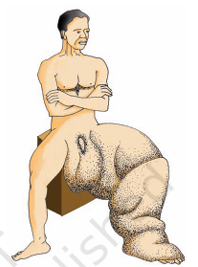
Based on the image showing gross morphological changes in the lower limb, which specific pathogen(s) are responsible for this condition?
QUESTION 14 OF 20
The profound swelling seen in the lower limb in the provided image is specifically due to the chronic inflammation of which anatomical structures?
QUESTION 15 OF 20
Which of the following is NOT a genus responsible for causing ringworms in humans?
QUESTION 16 OF 20
Arrange the steps of acquiring and developing a ringworm infection:
1. Fungi thrive in skin folds such as the groin or between toes.
2. Healthy individual acquires the fungi from soil or by using an infected person's towel/comb.
3. Intense itching accompanies the lesions.
4. Appearance of dry, scaly lesions on the skin, nails, or scalp.
QUESTION 17 OF 20
Why is the elimination of breeding places considered more effective for vector-borne diseases compared to air-borne diseases?
QUESTION 18 OF 20
Which of the following is an INCORRECT interpretation of biological vector control as per NCERT?
QUESTION 19 OF 20
What dual-purpose strategy involves both personal sleeping habits and structural home modifications to protect from vector-borne diseases?
QUESTION 20 OF 20
The recent widespread incidences of dengue and chikungunya have elevated the importance of which specific vector control?
Test Complete!
Answer Review
1 Match the Plasmodium species with their pathological features:
| List I | List II |
|---|---|
| 1. Plasmodium species variety | 1. Causes malignant malaria |
| 2. Plasmodium falciparum | 2. Responsible for different types of malaria |
| 3. Plasmodium vivax | 3. Tiny protozoan |
| 4. Pathogen type | 4. Causes a non-malignant form of malaria |
Different Plasmodium species cause distinct clinical variants of malaria. Plasmodium falciparum stands out as the causative agent of lethal, malignant malaria. Plasmodium vivax causes a milder, benign, or non-malignant form of malaria. Morphologically, Plasmodium is categorized fundamentally as a tiny protozoan pathogen.
- According to the NCERT textbook, malaria is caused by Plasmodium, a tiny protozoan. Different species of Plasmodium (P. vivax, P. malariae, and P. falciparum) are responsible for different types of malaria. Among these, malignant malaria caused by Plasmodium falciparum is the most serious and can even be fatal. Plasmodium vivax causes a non-malignant (benign tertian) form. Matching these facts: A links with 2, B links with 1, C links with 4, and D links with 3. This matches option C perfectly.
- Option A → Incorrectly matches Plasmodium species variety (A) directly with being a tiny protozoan (3), and mispairs P. falciparum with non-malignant forms.
- Option B → Incorrectly maps Plasmodium species variety (A) to causing malignant malaria (1), which is a specific trait of P. falciparum.
- Option D → Correctly links A to 2, but incorrectly states that P. falciparum (B) matches with being a tiny protozoan (3) instead of its specific pathological role of causing malignant malaria.
Used: Option Grouping
Application: By identifying that Plasmodium falciparum (B) must match with "Causes malignant malaria" (1), you can immediately narrow down your choices to option C, as it is the only option featuring the B-1 combination.
Final Logic: Pairing the most dangerous species with its signature fatal condition isolates the correct answer immediately.
Falciparum = Fatal (Malignant).
2 Why is malignant malaria specifically highlighted as a severe health risk in the NCERT text compared to other types?
Malignant malaria is uniquely destructive due to its high mortality rate. It is caused specifically by the protozoan Plasmodium falciparum. Its complications involve severe vascular blockage and cerebral involvement.
- The NCERT textbook explicitly highlights that among all types of malaria, the one caused by Plasmodium falciparum is malignant malaria. It is singled out precisely because it is the most severe, clinically aggressive variant that regularly leads to death if untreated.
- Option A → All types of malaria are caused by protozoan parasites of the genus Plasmodium, not just malignant malaria.
- Option C → Malaria is a vector-borne blood disease; it does not spread through contaminated food and water (which is characteristic of amoebiasis or ascariasis).
- Option D → Malignant malaria is actively transmitted by the female Anopheles mosquito vector just like the other variants.
Used: Extreme Word Filter
Application: Eliminating Option A because of the extreme word "only," and discarding C and D because they contradict standard vector transmission facts, leaves B as the logically and conceptually sound statement.
Final Logic: The clinical severity and lethality of P. falciparum is the unique property that justifies its special mention.
Malignant = Most severe.
3 Which of the following statements regarding the entry of sporozoites is INCORRECT?
Sporozoites constitute the specific infectious lifecycle stage for humans. Transmission requires the blood-feeding behavior of a female mosquito vector. Male mosquitoes feed purely on plant sap and cannot transmit the disease.
- The malarial parasite enters the human body as sporozoites (infectious form) through the bite of an infected female Anopheles mosquito. Male Anopheles mosquitoes do not feed on human blood and therefore cannot act as vectors or introduce sporozoites into the host. Consequently, statement C is false and is the correct answer to this negative question.
- Option A → This is a correct statement; the lifecycle stage that infects humans is indeed the sporozoite.
- Option B → This is a correct statement; infection occurs via vector mosquito inoculation during blood feeding.
- Option D → This is a correct statement; upon entry into the bloodstream, the sporozoites travel directly to the liver to initiate reproduction.
Used: Odd One Out
Application: Comparing Option B and Option C reveals an explicit contradiction regarding the sex of the mosquito vector. Identifying that only female mosquitoes require blood meals reveals C as the incorrect statement.
Final Logic: Spotting the word "male" contradicts fundamental biological facts regarding disease vectors.
Only Female vectors bite because they need blood for Fertility (egg development).
4 Arrange the chronological sequence of the human cycle of Plasmodium after the mosquito bite:
1. Parasites attack and rupture the red blood cells.
2. Sporozoites enter the human bloodstream.
3. Release of the toxic substance haemozoin.
4. Parasites initially multiply within the liver cells.
The bite introduces sporozoites directly into the host's bloodstream. The bloodstream carries them straight to the liver for their initial multiplication phase. Emerging liver parasites then migrate to infect and multiply within RBCs. Erythrocytic rupture terminates the cycle by releasing toxic haemozoin crystals.
- The chronological lifecycle inside the human host begins when an infected mosquito bites a human, and sporozoites are introduced into the bloodstream (2). The parasites initially reach the liver via blood and multiply within liver cells (4). Next, they leave the liver to attack the red blood cells (RBCs) and multiply further, eventually causing them to rupture (1). The rupture of RBCs releases the toxic substance haemozoin (3). The exact sequence is therefore 2 → 4 → 1 → 3.
- Option B → Places the RBC attack (1) before liver multiplication (4), which reverses the natural tissue progression of the parasite.
- Option C → Suggests that liver multiplication (4) occurs before the sporozoites even enter the human bloodstream (2).
- Option D → Places the release of haemozoin (3) before the actual rupture of the red blood cells (1), which is physically impossible.
Used: Elimination
Application: The absolute starting point must be the entry into the bloodstream (2), which eliminates C. The absolute ending event must be the chemical release of haemozoin (3) as a consequence of cellular rupture (1), which eliminates B and D.
Final Logic: Chronological biological lifecycles move step-by-step from structural entry to tissue-specific pathobiology.
Bloodstream → Liver → RBC → Haemozoin (Bold Lions Roar Houdini).
5
Haemozoin is a crystalline byproduct formed from digested host hemoglobin. It remains safely contained inside the erythrocyte during parasite growth. Physical lysis of the host erythrocyte spills this toxin into circulation.
- The provided passage explicitly links the events: "The rupture of RBCs is associated with release of a toxic substance, haemozoin...". Therefore, the release of this specific toxin into the plasma cannot happen until the host red blood cell membrane physically splits open.
- Option A → Multiplication in liver cells happens during the asymptomatic pre-erythrocytic stage before haemozoin is generated.
- Option C → Initial entry of sporozoites introduces the parasite to the body but does not produce clinical toxins immediately.
- Option D → The mosquito bite delivers the initial infection; it is not the immediate cellular cause of toxin release days later.
Used: Contextual/Tonal Matching
Application: Directly matching the phrase "associated with release of a toxic substance, haemozoin" from the text textually aligns with the immediate preceding clause "The rupture of RBCs".
Final Logic: Relying strictly on the direct cause-and-effect relationship detailed in the reading passage.
Rupture of RBCs = Release of Haemozoin.
6
Erythrocytic schizogony operates on a highly synchronized time cycle. Synchronized cell lysis dumps large bursts of pyrogens into the bloodstream. This periodic chemical surge acts directly on the hypothalamus to trigger fevers.
- The passage states that the rupture of RBCs releases haemozoin, "which is responsible for the chill and high fever recurring every three to four days." The periodic cycle of fever matches the synchronous bursting of infected red blood cells and the resulting systemic flooding of haemozoin.
- Option A → Mosquito bites cause the initial infection; they do not happen continuously every 3 to 4 days to create a fever cycle.
- Option C → Liver cells do not secrete haemozoin, and their rupture does not produce the classic recurring malarial shaking chills.
- Option D → Chronic inflammation of the lymphatic system is the hallmark pathology of filariasis (elephantiasis), not malaria.
Used: Contextual/Tonal Matching
Application: The question asks for the direct cause of the recurring chill and fever. Reading the text reveals that haemozoin is explicitly described as "responsible for the chill and high fever."
Final Logic: Direct textual extraction links the clinical symptom to its chemical trigger.
Haemozoin = High fever.
7 Consider the following statements about the malarial vector cycle:
I. The female Anopheles mosquito acts purely as a mechanical carrier like the housefly.
II. The malarial parasite requires two hosts—human and mosquitoes—to complete its life cycle.
III. The female Anopheles mosquito is the transmitting agent (vector). Which of the statements are correct?
Biologic vectors support necessary parasite development within their bodies. Plasmodium undergoes mandatory sexual reproduction inside the mosquito gut. Mechanical carriers simply transport pathogens externally without any lifecycle development.
- Statement I is false because the female Anopheles mosquito is a biological vector, not a mechanical carrier. The parasite executes its sexual reproductive phase inside the mosquito's body. Statement II is correct because Plasmodium is digenetic, requiring both humans (assexual stage) and mosquitoes (sexual stage) to finish its lifecycle. Statement III is correct because the female mosquito serves as the active biological transmitting vector. Therefore, statements II and III are correct.
- Option B → Includes Statement I, which incorrectly labels a highly specialized biological vector as a basic mechanical carrier.
- Option C → Includes Statement I and omits Statement II, ignoring the dual-host requirement of the parasite's lifecycle.
- Option D → Includes all statements, failing to recognize that Statement I is completely false.
Used: Elimination
Application: Evaluate Statement I first. Since the mosquito is a biological vector where the parasite actively develops (unlike the passive housefly), Statement I is false. Eliminating all Options containing I (B, C, and D) leaves A as the only option standing.
Final Logic: Disproving a single statement can eliminate all incorrect option combinations simultaneously.
Mosquito = Biological vector (Breeds inside); Housefly = Mechanical carrier (Movement only).
8 Which of the following is NOT true regarding the development of Plasmodium within the mosquito?
Fertilization and initial development happen within the mosquito's intestinal tract. Mature, motile sporozoites exit the gut wall and migrate through the hemolymph. They concentrate in the salivary glands to ensure transmission during the next feed.
- Once the parasite completes its development inside the stomach wall of the mosquito, the mature sporozoites escape and migrate specifically to the mosquito's salivary glands for storage. They do not stay permanently in the gut. If they remained in the gut, they could not be injected into a human host during blood feeding. Thus, statement B is factually incorrect and is the sought-after answer.
- Option A → This is a true statement; sporozoites are formed through multiplication (sporogony) inside the mosquito.
- Option C → This is a true statement; the saliva injected during a bite introduces these stored sporozoites into human blood.
- Option D → This is a true statement; the salivary glands serve as the staging reservoir for the infectious sporozoites.
Used: Elimination
Application: Recognizing that a parasite must be positioned in the mouthparts/salivary system to be transmitted via biting allows you to identify Statement B as the anatomically impossible option.
Final Logic: Vector-borne transmission relies on pathogens migrating to delivery structures like salivary glands rather than staying in storage sites like the gut.
Sporozoites travel to Salivary glands for Spit delivery.
9 Which combination of symptoms accurately diagnoses an Entamoeba histolytica infection as per NCERT?
Entamoeba histolytica targets the mucosa of the human large intestine. Ulceration of the colon wall causes mucus and blood to leak into feces. Irritation of the smooth muscle walls triggers severe intestinal cramps.
- Entamoeba histolytica is the protozoan parasite responsible for amoebiasis (amoebic dysentery) in the large intestine. The classic diagnostic clinical symptoms stated explicitly in NCERT are constipation, abdominal pain, localized muscle cramps, and stools containing excess mucous secretions alongside dark blood clots. This directly matches option B.
- Option A → Describes the classic clinical profile of typhoid fever (Salmonella typhi).
- Option C → Outlines the diagnostic symptoms of an intestinal roundworm infection (Ascariasis).
- Option D → Lists the classic upper respiratory symptoms associated with the common cold (Rhino viruses).
Used: Contextual/Tonal Matching
Application: Aligning the target organ (the large intestine) with intestinal symptoms (mucous and blood clots in stool) allows you to instantly eliminate respiratory
- Options: (D) and non-specific systemic profiles (A, C).
Final Logic: Every specific intestinal pathogen creates a signature change in stool composition based on where it attaches to the gut wall.
Amoebiasis = Abdominal pain + Abnormal stools (Mucous/BlooD).
10 What is the primary reason houseflies are designated as "mechanical carriers" in the transmission of Amoebiasis?
Houseflies lack biting mouthparts and cannot inject pathogens into the bloodstream. They collect fecal pathogens externally on their sticky legs and body hairs. Contamination happens passively when they land directly onto clean human food.
- Houseflies (Musca domestica) serve as mechanical carriers for Entamoeba histolytica because they transmit the parasite passively. They land on infected feces, collect the parasite cysts on their bodies, legs, and mouthparts, and then transfer them directly to human food products. The parasite does not grow, reproduce, or infect the fly internally.
- Option A → Houseflies do not support the biological parasite lifecycle; the entire lifecycle takes place within the human host.
- Option B → Houseflies do not bite, nor do they harbor or incubate Entamoeba within their salivary tissues.
- Option D → Amoebiasis is an oral-fecal infection acquired by eating contaminated food; it is never injected directly into the bloodstream.
Used: Odd One Out
Application: Noting that houseflies are non-biting insects allows you to eliminate
- Options: B and D immediately, as both imply a biting mechanism. Option A is eliminated because "mechanical" means passive transport rather than biological hosting.
Final Logic: Mechanical transport means the vector acts purely as an uninfected physical vehicle.
Mechanical = Moving objects physically from Muck to Meals.
11 Consider the following statements about Ascaris:
I. It is a helminth known to be pathogenic to humans.
II. It is a protozoan parasite found in the large intestine.
III. A healthy person acquires the infection through contaminated water, vegetables, and fruits. Which statements are correct?
Ascaris lumbricoides is an intestinal roundworm classified as a helminth, not a protozoan. It primarily inhabits and colonizes the lumen of the human small intestine. Transmission occurs via the fecal-oral route through ingestion of embryonated eggs.
- Statement I is correct because Ascaris is a well-known roundworm (helminth) that causes ascariasis. Statement II is incorrect because Ascaris is an intestinal helminth (Aschelminthes), not a microscopic single-celled protozoan, and it lives in the small intestine rather than the large intestine. Statement III is correct because the eggs of the parasite are excreted along with the feces of infected persons, contaminating soil, water, and plants; healthy individuals acquire the infection by consuming this contaminated water or food. Thus, statements I and III are correct.
- Option A → Includes Statement II, which misclassifies a macroparasitic roundworm as a single-celled protozoan.
- Option B → Includes Statement II and misses the correct taxonomic classification stated in Statement I.
- Option D → Incorrectly accepts all statements, failing to catch the fundamental biological errors regarding taxonomy and habitat in Statement II.
Used: Elimination
Application: Evaluate Statement II. Knowing that Ascaris is a multicellular roundworm (helminth) and not a protozoan makes Statement II false. Eliminating all Options containing II (A, B, and D) instantly isolates C as the correct option.
Final Logic: Disproving a prominent structural or taxonomic error allows rapid elimination of multiple Options
Ascaris is an Antestinal (Intestinal) Aschelminthes (Helminth).
12 Match the pathological manifestations of Ascariasis to their corresponding causes/locations:
| List I | List II |
|---|---|
| 1. Blockage | 1. Excreted eggs in faeces |
| 2. Contamination source | 2. Intestinal passage |
| 3. Transmission vehicle | 3. Intestinal helminth |
| 4. Parasite classification | 4. Contaminated soil, water, plants |
Heavy Ascaris infestations physically jam the narrow lumen of the small intestine. The diagnostic contamination source tracks back to eggs passed out in human stool. Environmental vectors like soil, water, and crops carry these eggs to new hosts. Taxonomically, the worm is classified as an intestinal endoparasitic helminth.
- According to NCERT text details on Ascariasis: A heavy infection of Ascaris can cause physical blockage of the intestinal passage (A matches 2). The core contamination source originates from the excreted eggs in the faeces of an infected individual (B matches 1). The actual transmission vehicles that bring the eggs into contact with a healthy host are contaminated soil, water, and plants/fruits (C matches 4). Finally, the parasite classification is an intestinal helminth (D matches 3). This aligns perfectly with the layout of option B.
- Option A → Pairs physical blockage (A) with eggs in faeces (1), which confuses a clinical complication with a diagnostic element.
- Option C → Incorrectly pairs the initial contamination source (B) with environmental components (4) and switches the roles of transmission vehicles.
- Option D → Erroneously links blockage (A) directly to the parasite classification category (3).
Used: Option Grouping
Application: Pair the distinct clinical term "Blockage" (A) with its unique physical site, the "Intestinal passage" (2). Because A-2 is only present in Options B and C, you can eliminate Options A and D. Then, verify that the parasite classification (D) matches "Intestinal helminth" (3) to finalize option B.
Final Logic: Pinpointing mechanical and anatomical correlations locks in the correct matrix choices.
Blockage happens in the Bowel (Intestinal passage).
13 Based on the image showing gross morphological changes in the lower limb, which specific pathogen(s) are responsible for this condition?
The classic medical image showing extreme leg swelling illustrates elephantiasis. This deformity is caused by microscopic, thread-like filarial roundworms. Wuchereria bancrofti and Wuchereria malayi are the specific etiologic agents.
- The NCERT textbook includes a classic diagnostic photograph showing severe swelling of a lower limb, which represents elephantiasis or filariasis. The text states that this slowly developing chronic inflammation is caused by the filarial worms, specifically Wuchereria bancrofti and Wuchereria malayi. This explicitly points to option C.
- Option A → These are fungal genera responsible for superficial skin infections like ringworm, which do not cause massive deep-tissue swelling.
- Option B → This roundworm causes ascariasis, an internal intestinal infection presenting with abdominal symptoms, not limb swelling.
- Option D → This protozoan triggers intestinal amoebiasis, presenting with dysentery and mucus-laden stools.
Used: Contextual/Tonal Matching
Application: Aligning the clinical description of "gross morphological changes in the lower limb" with the textbook image of elephantiasis automatically singles out the filarial worms (Wuchereria).
Final Logic: Matching signature visual diagnostic signs directly to their textbook pathogens.
Wuchereria causes Worst-case swelling (Walking elephant leg).
14 The profound swelling seen in the lower limb in the provided image is specifically due to the chronic inflammation of which anatomical structures?
Filarial worms selectively migrate to and colonize human lymphatic pathways. Persistent blockages cause chronic inflammation and scar tissue formation over several years. Obstructed lymph fluid backs up into nearby tissues, causing severe elephantiasis.
- Filarial worms (Wuchereria) actively inhabit the lymphatic vessels of the lower limbs for years. Their prolonged presence triggers chronic inflammatory reactions, endothelial proliferation, and fibrotic changes that block normal lymph fluid drainage. This fluid accumulation leads to the characteristic deep-tissue swelling of filariasis.
- Option A → The parasites do not colonize or obstruct the high-pressure arterial circulatory system.
- Option B → Calf muscle fibers may experience pressure atrophy, but they are not the primary site of parasite colonization or inflammation.
- Option D → The infection targets the lymphatic drainage network, not the joint cavities or synovial membranes.
Used: Elimination
Application: Knowing the core pathology of filariasis is "lymphatic obstruction" allows you to eliminate blood vessels (A), muscle fibers (B), and joint structures (D) immediately.
Final Logic: Pathogens target specific anatomical systems, meaning tissue-specific localization explains the resulting clinical symptoms.
Limb swelling in filariasis is caused by Larvae blocking the Lymphatics.
15 Which of the following is NOT a genus responsible for causing ringworms in humans?
Ringworm is a superficial skin infection caused by a group of fungi called dermatophytes. Microsporum, Trichophyton, and Epidermophyton are the three primary dermatophyte genera. Wuchereria is a genus of animal roundworms, not a fungus.
- Ringworm infections are fungal dermatophytoses. The NCERT textbook specifies three distinct fungal genera responsible for this condition: Microsporum, Trichophyton, and Epidermophyton. Wuchereria is an intestinal roundworm (helminth) genus that causes filariasis, making option D the correct answer to this negative question.
- Option A → This is a valid dermatophyte genus that attacks human keratinized structures like hair and skin.
- Option B → This is a primary fungal genus responsible for athlete's foot and skin ringworm.
- Option C → This is a specialized genus of dermatophyte that targets human skin and nails.
Used: Odd One Out
Application: Grouping Options A, B, and C together shows they are all fungal dermatophytes. Wuchereria (D) stands out as an animal helminth parasite, making it the odd one out.
Final Logic: Separating macroparasitic worms from fungal pathogens reveals the incorrect option.
The fungal trio is Micro, Tricho, and Epider (Many Tasty Eclairs).
16 Arrange the steps of acquiring and developing a ringworm infection:
1. Fungi thrive in skin folds such as the groin or between toes.
2. Healthy individual acquires the fungi from soil or by using an infected person's towel/comb.
3. Intense itching accompanies the lesions.
4. Appearance of dry, scaly lesions on the skin, nails, or scalp.
The infection cycle begins when fungal spores are transferred from contaminated objects or soil. Warmth and moisture in skin folds let these spores hatch and grow. The fungal growth breaks down skin tissue, producing dry, scaly patches. Localized inflammation triggers intense itching around the raw edges of the rash.
- The progression of a ringworm infection begins with exposure: a healthy person acquires the infectious fungal elements from environmental soil or shared personal items like towels and combs (2). Once on the body, heat and moisture help these fungi thrive in warm skin folds, such as the groin or between the toes (1). This growth leads to the appearance of characteristic dry, scaly lesions on the skin, nails, or scalp (4). Finally, these lesions cause localized nerve irritation, resulting in intense itching (3). This sequence corresponds to 2 → 1 → 4 → 3.
- Option A → Places the appearance of advanced dry lesions (4) before the fungi have a chance to grow and establish themselves in warm skin folds (1).
- Option B → Suggests that the fungi grow in skin folds (1) before the person even catches them from an infected object (2).
- Option D → Reverses the entire process, stating that advanced clinical lesions (4) and itching occur before exposure to the pathogen (2).
Used: Elimination
Application: The absolute starting event must be environmental acquisition (2), which eliminates Options B and D. The absolute final event is the symptomatic feedback loop of intense itching (3) caused by the physical lesions (4). This eliminates option A and leaves option C.
Final Logic: Pathological chains must follow a logical timeline from initial contact to tissue colonization, followed by tissue damage and physical symptoms.
Contact (2) → Colonize folds (1) → Crusting lesions (4) → Crawling itch (3).
17 Why is the elimination of breeding places considered more effective for vector-borne diseases compared to air-borne diseases?
Vector-borne pathogens depend on specific insects to complete their lifecycles and spread. These insect vectors rely on stagnant water to lay eggs and raise larvae. Air-borne pathogens spread directly through airborne respiratory droplets, bypassing water cycles.
- Vector-borne diseases (such as malaria and filariasis) depend heavily on specific aquatic insects to spread. Eliminating stagnant water disrupts the lifecycle of these insects, stopping the disease from spreading. In contrast, air-borne diseases (like pneumonia or the common cold) spread through respiratory droplets coughed or sneezed into the air. Because they do not use an aquatic insect vector, cleaning up stagnant water has no effect on air-borne pathogens. This makes option A the correct statement.
- Option B → Air-borne diseases spread directly through the air via respiratory droplets; they do not use dry-environment insects as vectors.
- Option C → Removing stagnant pools of water has no impact on the production or spread of respiratory droplets from a person's lungs.
- Option D → Air-borne diseases do not rely on houseflies for transmission; they spread through direct inhalation of airborne droplets.
Used: Contextual/Tonal Matching
Application: Match the transmission mechanism to the intervention. Stagnant water is a breeding site for insects, meaning cleaning it up only works against vector-borne diseases that rely on those insects, not air-borne ones.
Final Logic: Preventive measures must directly target the specific transmission pathway of a disease to be effective.
No vector = No water needed.
18 Which of the following is an INCORRECT interpretation of biological vector control as per NCERT?
Gambusia affinis is a predatory freshwater fish known as the mosquitofish. These fish feed heavily on mosquito larvae beneath the water surface. They cannot catch or feed on winged adult mosquitoes flying through the air.
- Introducing Gambusia fish into ponds and drainage ditches is a classic biological control method. These fish live in the water and eat mosquito larvae, preventing them from developing into flying adults. They cannot hunt adult mosquitoes flying above the water surface. Therefore, statement B is an incorrect statement and the correct answer.
- Option A → This is a true statement; Gambusia is commonly introduced into freshwater ponds for biological pest management.
- Option C → This is a true statement; the primary target of these fish is the vulnerable larval stage of the mosquito.
- Option D → This is a true statement; reducing mosquito populations lowers transmission rates for both malaria (Anopheles) and filariasis (Culex).
Used: Contextual/Tonal Matching
Application: Note the conflict between habitats. Fish live underwater, while adult mosquitoes fly in the air. This mismatch reveals statement B as the factually incorrect option.
Final Logic: : Biological control agents can only hunt pests that share their immediate physical environment.
Gambusia gulps Grub/Larvae inside water, not flyers.
19 What dual-purpose strategy involves both personal sleeping habits and structural home modifications to protect from vector-borne diseases?
Mosquito nets provide personal protection while sleeping. Wire window mesh forms a structural barrier that keeps vectors out of buildings. Combining both methods provides layered defense against indoor mosquito bites.
- The question asks for a dual strategy that combines a personal behavior with a structural change to a home. Using mosquito nets is a personal habit used while sleeping. Adding wire mesh to doors and windows is a permanent modification to the building's structure. Both methods prevent mosquitoes from reaching humans inside, perfectly matching option C.
- Option A → Spraying insecticides is a chemical treatment method, not a structural modification to a building.
- Option B → Cleaning water coolers and draining puddles are sanitation practices focused on eliminating vector breeding sites.
- Option D → Introducing predatory fish is a biological control method, while cleaning cesspools is a public sanitation measure.
Used: Contextual/Tonal Matching
Application: Break down the requirements in the prompt: "personal sleeping habits" maps to mosquito nets, and "structural home modifications" maps to wire mesh on doors and windows. This points directly to option C.
Final Logic: Matching the specific categories in the question to the corresponding practical interventions.
Nets for Night safety (personal); Mesh for Modification (structural).
20 The recent widespread incidences of dengue and chikungunya have elevated the importance of which specific vector control?
Dengue and chikungunya are viral diseases transmitted by mosquitoes. The primary vector for both viruses is the daytime-biting Aedes aegypti mosquito. Aedes breeds in clean, stagnant water inside or near homes, rather than open ponds.
- The NCERT textbook notes that vector control strategies have become more critical due to widespread outbreaks of dengue and chikungunya. Both of these viral infections are transmitted by the Aedes mosquito vector. Therefore, preventing and managing these outbreaks requires targeting Aedes populations and their unique breeding sites.
- Option A → Culex mosquitoes transmit filariasis (elephantiasis) and West Nile virus, not dengue or chikungunya.
- Option C → Anopheles mosquitoes are the specialist vectors for malaria, not these viral conditions.
- Option D → Houseflies are mechanical vectors for intestinal infections like amoebiasis; they do not transmit blood-borne viruses.
Used: Elimination
Application: Connect each vector to its specific disease. Anopheles maps to malaria, Culex maps to filariasis, and houseflies map to amoebiasis. Eliminating these leaves the Aedes mosquito (B) as the correct vector for dengue and chikungunya.
Final Logic: Matching the specific insect vector to the diseases it transmits.
Aedes transmits Acute viral fevers (Ae = Dengue + Chikungunya).