
CUET UG Biology Booster Test 2-Concepts of Health and Bacterial Diseases
📌 Answers are locked once submitted — results and explanations appear at the end.
QUESTION 2 OF 20
Arrange the historical developments of health concepts in correct order:
1. Biology states that the neural and endocrine systems influence our immune system.
2. Greeks like Hippocrates and Ayurveda assert the balance of 'humors'.
3. William Harvey discovers blood circulation using experimental methods.
4. The 'good humor' hypothesis is disproved by temperature demonstration.
QUESTION 1 OF 20
The "good humor" hypothesis suggested that persons with 'blackbile' belonged to a hot personality and would have fevers. Why was this hypothesis ultimately discarded?
QUESTION 3 OF 20
Which of the following statements reflect the positive outcomes of achieving complete physical, mental, and social well-being?
I. People are more efficient at work, leading to economic prosperity.
II. It increases the longevity of people.
III. It reduces infant and maternal mortality.
QUESTION 4 OF 20
Which of the following is NOT classified under the 'life style' factors that affect our health?
QUESTION 5 OF 20
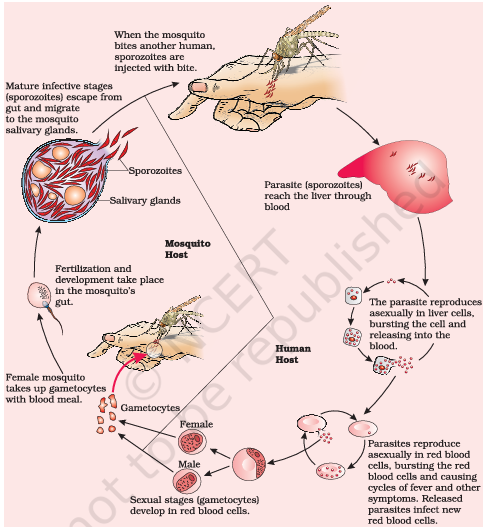
The image shows the life cycle of Plasmodium, an infectious pathogen. Based on the characteristics of this disease transmission, what serves as the vector transmitting the infectious sporozoites to a healthy human?
QUESTION 6 OF 20
While the image details an infectious parasitic disease, which of the following is considered the major cause of death among non-infectious diseases?
QUESTION 7 OF 20
Match the pathogen characteristic with its corresponding host challenge:
| Column 1 | Column 2 |
|---|---|
| 1. Survival in stomach | a. Causing morphological damage |
| 2. Multiplication in host | b. Biting mosquitoes |
| 3. Evasion of cellular barriers | c. Low pH and digestive enzymes |
| 4. Vector transmission | d. Phagocytosis by macrophages |
QUESTION 8 OF 20
A pathogen enters a human host, multiplies, and severely interferes with normal vital activities. According to biological principles, what is the ultimate direct consequence for the host's body?
QUESTION 9 OF 20
Which of the following symptoms is NOT typically associated with a Salmonella typhi infection?
QUESTION 10 OF 20
A patient presents with a sustained fever of 39.5°C, stomach pain, and constipation. The physician suspects an intestinal pathogen. Which diagnostic test should be recommended to confirm typhoid fever?
QUESTION 11 OF 20
Consider the following modes of transmission for pneumonia:
I. Inhaling droplets/aerosols released by an infected person.
II. Drinking contaminated water containing faecal matter.
III. Sharing glasses and utensils with an infected person. Which of these accurately describe how a healthy person acquires pneumonia caused by Streptococcus pneumoniae?
QUESTION 12 OF 20
Which of the following is NOT an outcome of the fluid accumulation in the alveoli during pneumonia?
QUESTION 13 OF 20
QUESTION 14 OF 20
QUESTION 15 OF 20
Match the disease with its primarily associated source of contamination and transmission route:
| Column 1 | Column 2 |
|---|---|
| 1. Typhoid | a. Contaminated soil, water, and plants with parasite eggs |
| 2. Amoebiasis | b. Contaminated food/water via faecal matter and houseflies |
| 3. Ascariasis | c. Contaminated food and water carrying Salmonella |
| 4. Common Cold | d. Droplets and contaminated objects like doorknobs |
QUESTION 16 OF 20
Arrange the following practices in the correct order representing an individual's hygiene protocol to prevent acquiring a food-borne illness:
1. Washing hands to keep the body clean.
2. Ensuring vegetables and fruits are cleaned.
3. Consuming clean drinking water and food.
4. Avoiding consumption if food is exposed to mechanical carriers like houseflies.
QUESTION 17 OF 20
Which of the following is NOT a direct objective of proper waste and excreta disposal in public hygiene?
QUESTION 18 OF 20
Why is the periodic cleaning and disinfection of water reservoirs, pools, and tanks considered crucial for public health?
QUESTION 19 OF 20
The discovery of antibiotics significantly changed medical practice. How do antibiotics contribute to human health?
QUESTION 20 OF 20
The complete eradication of a deadly disease like smallpox was made possible through which specific medical advancement?
Test Complete!
Answer Review
2 Arrange the historical developments of health concepts in correct order:
1. Biology states that the neural and endocrine systems influence our immune system.
2. Greeks like Hippocrates and Ayurveda assert the balance of 'humors'.
3. William Harvey discovers blood circulation using experimental methods.
4. The 'good humor' hypothesis is disproved by temperature demonstration.
Early paradigms began with traditional humoral philosophy (Greeks and Ayurveda). Experimental science emerged with William Harvey's circulatory discoveries. The formal falsification of the old model led directly to modern neuroendocrine-immune biology.
The historical timeline of health concepts proceeds logically from ancient philosophy to advanced molecular physiology: First, ancient Greek thinkers like Hippocrates and traditional Indian Ayurveda systems laid out the basic concept of health resting on balanced fluids or humors (Step 2). Centuries later, William Harvey revolutionized medical science by discovering the circulatory system through physical experimentation (Step 3). This breakthrough allowed scientists to measure temperatures and explicitly disprove the old humoral claims (Step 4). Finally, modern biology progressed to show how the mind interacts with health via the nervous, endocrine, and immune networks (Step 1). This timeline yields the sequence 2, 3, 4, 1, which perfectly fits Option A.
- Option B → Places Harvey's discovery (3) chronologically before ancient Greek philosophy and Ayurveda (2), which reverses thousands of years of medical history.
- Option C → Suggests the good humor hypothesis was disproved (4) before Harvey actually discovered the circulatory system (3) that provided the framework to test it.
- Option D → Reverses the entire timeline by placing advanced modern neuro-immune pathways (1) at the dawn of medical history.
Used: Chronological / Anchor Alignment
Application: Identify the absolute historic baseline. Ancient Greek philosophy and Ayurveda (2) must represent the starting point. This leaves options A and C. Since Harvey's discovery (3) had to occur to provide the scientific basis for disproving the old model (4), 3 must precede 4.
Final Logic: The sequence 2 →3 →4 →1 tracks the historical shift from ancient philosophy to experimental proof, concluding with modern integrated systems.
Old to New: Start with the Greeks (2), find the Blood (3), prove it Cool (4), and finish with modern Minds/Nerves (1).
1 The "good humor" hypothesis suggested that persons with 'blackbile' belonged to a hot personality and would have fevers. Why was this hypothesis ultimately discarded?
The "good humor" hypothesis paired blackbile with hot temperaments and fevers. William Harvey introduced experimental, quantitative methods to physiology. Clinical measurements using a thermometer proved that blackbile individuals lacked elevated temperatures.
The "good humor" hypothesis of health was a purely philosophical doctrine backed by early medical authorities. It asserted that health relies on an equilibrium of bodily humors, stating that individuals featuring a dominance of "blackbile" possessed a hot temperament and were prone to high fevers. William Harvey fundamentally shook this framework by discovering blood circulation and applying experimental methods. By measuring the actual body temperature of individuals classified as having blackbile, he demonstrated that their body temperatures were completely normal, functionally disproving the speculative baseline of the old hypothesis.
- Option A → William Harvey did not claim blackbile was non-existent in the body; rather, he demonstrated that its presence did not correlate with an elevated body temperature.
- Option C → Hippocrates lived centuries before William Harvey's experimental breakthroughs and never retracted his classical views or conducted advanced modern blood tests.
- Option D → The Indian Ayurveda system historically supported and shared a similar humoral framework rather than stepping in to disprove or replace it.
Used: Elimination
Application: Identifying that Hippocrates lacked access to modern blood tests (eliminating C) and that Ayurveda ran parallel to humoral concepts (eliminating D) reduces confusion. Between A and B, the core scientific proof rested specifically on checking temperature.
Final Logic: Option B accurately captures the precise experimental condition (temperature verification via thermometer) used to invalidate the hypothesis.
Harvey's Cool Facts: William Harvey used a thermometer to show that blackbile was cool (normal temperature), melting down the old "hot personality" myth.
3 Which of the following statements reflect the positive outcomes of achieving complete physical, mental, and social well-being?
I. People are more efficient at work, leading to economic prosperity.
II. It increases the longevity of people.
III. It reduces infant and maternal mortality.
True health enhances an individual's operational output and physical productivity. Biological health extends individual lifespans by lowering disease rates. Safe, health-conscious communities structurally minimize systemic maternal and newborn death risks.
Achieving a comprehensive state of health—defined by physical stability, mental clarity, and social support—has broad positive impacts on society. Statement I is correct because healthy individuals exhibit greater work efficiency, boosting overall economic productivity. Statement II is correct because a body and mind free from chronic stress and disease enjoy greater natural longevity. Statement III is correct because improved systemic health and medical awareness directly reduce infant and maternal mortality rates during childbirth. Since all three statements are valid benefits of comprehensive health, Option D is the correct choice.
- Option A → This choice overlooks the critical public health improvement of lowering maternal and infant mortality rates (Statement III).
- Option B → This option leaves out the direct link between a healthy workforce's efficiency and a nation's economic prosperity (Statement I).
- Option C → This configuration misses the fundamental demographic outcome of increased average human lifespan (Statement II).
Used: Contextual/Tonal Matching
Application: In public health and biology textbooks, comprehensive health is always linked to broad positive socio-economic and demographic benefits. Restrictive options can be safely ruled out.
Final Logic: Since statements I, II, and III all represent positive outcomes of global health as outlined in NCERT, Option D is selected.
Health Raises Everything: True health boosts Wealth (efficiency), Life (longevity), and Baby/Mother Survival (reduced mortality).
4 Which of the following is NOT classified under the 'life style' factors that affect our health?
Lifestyle factors consist of behavioral choices made throughout an individual's life. Dietary intake, rest, and personal habits fall entirely under voluntary behaviors. Inborn defects are fixed genetic issues determined before birth.
NCERT classifies the factors influencing human health into distinct categories: genetic disorders, infections, and lifestyle. "Lifestyle" refers strictly to an individual's ongoing habits and behavioral choices, such as their diet, water intake, patterns of rest, exercise routines, and personal habits. Conversely, "deficiencies with which a child is born" are classified as genetic disorders. Because these are hereditary defects passed down through chromosomes from birth, they are not shaped by lifestyle choices, making Option B the correct answer.
- Option A → Choosing what food and water to consume is a core daily behavioral choice, placing it under lifestyle.
- Option C → Regulating rest and physical exercise is a personal habit that directly impacts bodily health, classifying it as a lifestyle factor.
- Option D → Developing or lacking routine habits (such as sleep schedules or substance use) falls entirely within the definition of personal lifestyle.
Used: Odd One Out / Categorization
Application: Options A, C, and D are all dynamic, everyday choices an individual can modify. Option B is a fixed, congenital condition determined at birth, placing it in a completely separate biological category.
Final Logic: Since congenital deficiencies belong under genetic factors rather than lifestyle factors, Option B is the correct choice for this "NOT" question.
Born vs. Chosen: Genetic factors are what you are born with (Option B); lifestyle factors are everything you choose to do along the way (Options A, C, D).
5 The image shows the life cycle of Plasmodium, an infectious pathogen. Based on the characteristics of this disease transmission, what serves as the vector transmitting the infectious sporozoites to a healthy human?
Plasmodium requires a living biological vector to move between hosts. The infectious stage of the parasite (sporozoite) resides within the vector's salivary glands. Transmission occurs directly when the vector punctures the host's skin for a blood meal.
The malaria parasite, Plasmodium, relies on a two-host life cycle to complete its development and spread. The infectious forms of the parasite, known as sporozoites, are stored in the salivary glands of the infected female Anopheles mosquito. When this mosquito bites a healthy human to feed on blood, it injects the sporozoites directly into the bloodstream, initiating the human phase of the infection. This makes the female Anopheles mosquito the biological vector for malaria.
- Option A → Contaminated water transmits enteric pathogens like Salmonella typhi or Amoeba cysts, not blood-borne sporozoites.
- Option C → Houseflies act as mechanical carriers that transport fecal pathogens to food surfaces, rather than biological vectors that inject blood parasites.
- Option D → Contaminated food products are a primary transmission route for gastrointestinal diseases, not vector-borne blood infections.
Used: Contextual/Tonal Matching
Application: Aligning the term "sporozoites" with its specific biological host confirms that the female Anopheles mosquito is the unique vehicle for malaria transmission.
Final Logic: Option B is selected because it identifies the specific vector that carries and injects the infectious stage of the Plasmodium parasite.
Female Vector Focus: The Female Anopheles mosquito delivers the Fatal malaria parasite, acting as its biological vehicle.
6 While the image details an infectious parasitic disease, which of the following is considered the major cause of death among non-infectious diseases?
Non-infectious diseases cannot be passed from person to person. Uncontrolled cellular proliferation leads to malignant tumors. This disease represents a leading cause of non-communicable deaths worldwide.
Diseases are broadly split into infectious (communicable) and non-infectious (non-communicable) categories. Non-infectious conditions are caused by internal factors, lifestyle habits, or genetic mutations rather than transmissible pathogens. Among all non-infectious conditions, cancer is highlighted by NCERT as a major cause of death globally. It involves a breakdown in normal cell growth control, leading to malignant tumors that damage internal organs.
- Option A → While drug and alcohol abuse cause severe health issues and lifestyle diseases, they are classified as behavioral addictions rather than a primary non-infectious disease entity.
- Option B → Typhoid is a classic infectious disease caused by an external bacterial pathogen (Salmonella typhi).
- Option D → Pneumonia is a communicable respiratory infection caused by bacteria like Streptococcus pneumoniae.
Used: Elimination / Categorization
Application: First, eliminate options B and D because typhoid and pneumonia are infectious bacterial diseases. Between A and cancer, cancer is identified as a primary medical cause of mortality.
Final Logic: Option C is selected because cancer is explicitly defined as a leading cause of death among non-communicable conditions.
Non-Infectious Killer: Cancer is the leading Chronic, non-infectious cause of mortality globally.
7 Match the pathogen characteristic with its corresponding host challenge:
| Column 1 | Column 2 |
|---|---|
| 1. Survival in stomach | a. Causing morphological damage |
| 2. Multiplication in host | b. Biting mosquitoes |
| 3. Evasion of cellular barriers | c. Low pH and digestive enzymes |
| 4. Vector transmission | d. Phagocytosis by macrophages |
Gastric survival requires tolerance to high acidity and active digestive enzymes. Rapid microbial growth inside tissues leads directly to structural cell injury. Evading internal body defenses requires resisting ingestion by immune cells like macrophages.
Evaluating the pathogen-host matches step-by-step: 1. Survival in stomach maps to c (Low pH and digestive enzymes), which are the primary chemical defenses of the gastric lumen. 2. Multiplication in host maps to a (Causing morphological damage), as rapid microbial growth physically breaks down host cell structures. 3. Evasion of cellular barriers maps to d (Phagocytosis by macrophages), which pathogens must actively avoid to survive in the bloodstream or tissues. 4. Vector transmission maps to b (Biting mosquitoes), which serves as the physical delivery mechanism for vector-borne parasites. This layout matches Option A.
- Option B → Misaligns 1 with a, suggesting that the stomach environment causes immediate structural tissue destruction rather than presenting a chemical barrier.
- Option C → Incorrectly pairs 2 with d, matching active microbial growth with engulfment by the host's immune cells.
- Option D → Incorrectly connects 1 with b, linking stomach survival directly to mosquito bites.
Used: Anchor Matching
Application: Identify the strongest chemical association. The stomach is defined by high acidity (low pH) and enzymes, making 1-c certain. This eliminates options B and D. Next, check vector transmission (4-b) to easily isolate the correct sequence.
Final Logic: Option A provides the only correct biological alignment across all four pathogen-host interactions.
Stomach and Acid go together: 1-c (Stomach = low pH) acts as your primary anchor to quickly solve the puzzle.
8 A pathogen enters a human host, multiplies, and severely interferes with normal vital activities. According to biological principles, what is the ultimate direct consequence for the host's body?
When a pathogen successfully invades a host, it uses the host's body as a resource to replicate. As the microbial population grows, it consumes vital nutrients, releases metabolic toxins, and ruptures host cells. This disruption directly compromises tissue structure and organ performance, leading to morphological (structural) and functional damage. This dual-layer damage creates the clinical signs of disease.
- Option A → Innate immunity is a fixed, non-specific baseline defense system; it does not increase or improve as a result of pathogen tissue damage.
- Option B → This is the correct, standard biological outcome of pathogen replication and interference within host tissues.
- Option C → Pathogens disrupt existing tissues and organs; they do not cause immediate, widespread mutations in the host's inherited genetic code.
- Option D → The adaptive immune system generates both primary and secondary responses over time; a severe infection is not limited to a primary response alone.
Used: Contextual/Tonal Matching
Application: Relying on standard NCERT definitions for pathogenic infection confirms that structural injury and physiological disruption are always described using the terms "morphological and functional damage."
Final Logic: Option B uses the exact terminology designated to define the pathological consequences of an uncontrolled infection.
Form and Function Fail: Pathogens destroy how tissues look (morphological damage) and how they work (functional damage).
9 Which of the following symptoms is NOT typically associated with a Salmonella typhi infection?
Typhoid fever targets the gastrointestinal tract and causes systemic symptoms. The infection causes high fevers, intestinal pain, and a loss of appetite. Fluid accumulation in the lungs' air sacs is a specific sign of respiratory infections like pneumonia.
Salmonella typhi is an enteric bacterium that infects the digestive tract. It causes symptoms like sustained high fever (39°C to 40°C), severe stomach pain, constipation, headache, weakness, and a loss of appetite. Conversely, alveoli getting filled with fluid is the definitive sign of a lower respiratory tract infection like pneumonia (caused by Streptococcus pneumoniae). It does not occur in a standard typhoid infection, making Option C the correct choice for this "NOT" question.
- Option A → A steady, high fever between (39°C to 40°C) is a classic clinical symptom of typhoid.
- Option B → Because the bacteria colonize and damage the small intestine, stomach pain and altered bowel habits like constipation are common symptoms.
- Option D → General systemic symptoms like weakness, headaches, and a loss of appetite occur regularly as the infection spreads into the bloodstream.
Used: Extreme Word Filter / Organ System Check
Application: Assess the affected organ systems. Options A, B, and D deal with systemic or digestive issues, which align with an enteric pathogen. Option C introduces a respiratory symptom, signaling an error.
Final Logic: Since fluid-filled alveoli are unique to pneumonia, Option C is the incorrect symptom sought by the question.
Typhoid stays down: Typhoid causes a fire in the belly and blood, not water in the lungs (Option C).
10 A patient presents with a sustained fever of 39.5°C, stomach pain, and constipation. The physician suspects an intestinal pathogen. Which diagnostic test should be recommended to confirm typhoid fever?
Identifying a specific infectious condition requires an appropriate diagnostic tool. Typhoid fever is confirmed by detecting specific serum antibodies against the pathogen. Advanced anatomical imaging cannot diagnose a specific bacterial infection.
The patient's symptoms—high fever, stomach pain, and constipation—point toward an infection by Salmonella typhi. In medical biology, the standard serological test used to confirm typhoid fever is the Widal test. This diagnostic tool works by detecting specific agglutinating antibodies in the patient's blood serum that target the O and H antigens of the typhoid bacteria, confirming the diagnosis.
- Option A → The ELISA (Enzyme-Linked Immunosorbent Assay) test is primarily used to screen for viral infections like HIV/AIDS, rather than serving as the classic test for typhoid.
- Option B → An MRI (Magnetic Resonance Imaging) provides high-resolution structural images of soft tissues, which cannot identify or confirm a bacterial infection.
- Option D → A CT (Computed Tomography) scan generates cross-sectional X-ray views of anatomy, which helps locate physical structural defects but cannot diagnose typhoid.
Used: Contextual/Tonal Matching
Application: Matching the clinical signs of typhoid fever directly with its classic diagnostic test as outlined in medical biology leads straight to the Widal test.
Final Logic: Option C is selected because the Widal test is the specific serological confirmation tool for typhoid infections.
Typhoid Wide-All: Use the Widal test to check widespread typhoid fevers.
11 Consider the following modes of transmission for pneumonia:
I. Inhaling droplets/aerosols released by an infected person.
II. Drinking contaminated water containing faecal matter.
III. Sharing glasses and utensils with an infected person. Which of these accurately describe how a healthy person acquires pneumonia caused by Streptococcus pneumoniae?
Pneumonia is a highly infectious respiratory bacterial disease. Transmission primarily happens when a healthy individual directly inhales respiratory droplets or aerosols released by an infected patient. It can also spread indirectly through fomites, such as sharing contaminated drinking glasses and eating utensils.
- Streptococcus pneumoniae and Haemophilus influenzae are the primary bacterial pathogens responsible for causing pneumonia in humans. Because it is a respiratory tract infection affecting the lungs, the pathogen exits the host body through regular respiratory emissions. NCERT states that a healthy individual acquires the infection by inhaling the droplets/aerosols (Statement I) released by an infected person. Additionally, indirect transmission via fomites is common; a healthy person can catch the disease by sharing glasses and utensils (Statement III) with an infected individual. Drinking water contaminated with faecal matter (Statement II) is the hallmark transmission route for intestinal diseases rather than respiratory ones, confirming that only statements I and III are valid, matching Option B.
- Option A →This option includes Statement II, which describes a water-borne faecal-oral route that does not transmit respiratory pathogens like Streptococcus pneumoniae.
- Option C →This choice incorrectly pairs the water-borne route (Statement II) with the utensil route while missing the primary airborne droplet transmission pathway (Statement I).
- Option D →This grouping mistakenly includes all three paths, incorrectly classifying pneumonia as a faecal-oral water-borne disease.
Used: Elimination
Application: Evaluate the anatomical site of infection to rule out mismatched transmission routes. Pneumonia targets the respiratory system. Statement II describes drinking water contaminated with faecal matter, which is the classic transmission vector for intestinal pathogens rather than respiratory drops.
Final Logic: Eliminating Statement II removes options A, C, and D immediately, leaving Option B as the only logically sound choice.
Pneumonia Passes through Pores: Droplets and Dishes (Inhalation and Implements) pass the pathogen.
12 Which of the following is NOT an outcome of the fluid accumulation in the alveoli during pneumonia?
Pneumonia targets the terminal respiratory units known as alveoli, causing them to fill with inflammatory fluid. This fluid buildup blocks normal gaseous exchange, leading to breathing difficulties and low oxygen levels. Intestinal perforation is a severe complication of typhoid fever, not a respiratory disease like pneumonia.
- In a healthy respiratory system, the alveoli are air-filled sacs responsible for the exchange of oxygen and carbon dioxide. When infected by pneumonia pathogens, these alveoli become filled with fluid, which causes them to lose their normal air capacity (Option A). This blockage leads to severe problems in respiration (Option B). In acute or severe phases, the lack of sufficient oxygenation causes cyanosis, a condition where the lips and fingernails turn from gray to a bluish color (Option C). However, intestinal perforation (Option D) is a classic severe complication seen in terminal, untreated cases of typhoid fever due to Salmonella typhi ulcerating the intestinal wall. It has no biological connection to alveolar fluid dynamics, making it the correct answer for this "NOT" question.
- Option A →This is a true clinical outcome; the entry of inflammatory exudate directly replaces the air volume inside the terminal alveolar sacs.
- Option B →This is a characteristic symptom; fluid barriers increase the diffusion distance for oxygen, causing labored breathing.
- Option C →This is a classic sign of hypoxemia; low oxygen saturation leads to a visible bluish color change in peripheral tissues like the nails.
Used: Extreme Word Filter
Application: Filter the options by matching the organ system mentioned in the question to the symptoms listed. The question focuses on a respiratory condition (alveoli). Options A, B, and C all describe respiratory and gas exchange issues, while Option D describes an intestinal issue.
Final Logic: Because an intestinal complication cannot be caused by a localized fluid buildup in the lungs, Option D is a mismatch and the correct choice.
Alveoli Are Airway Anchors: Alveoli fluid affects Air and Arterial oxygen; Intestinal issues belong to Intestinal infections (Typhoid).
13
The common cold and pneumonia are both respiratory ailments, but they target completely different parts of the respiratory tract. Rhinoviruses are restricted to the upper respiratory tract, infecting the nose and throat without reaching the lungs. Pneumonia is a lower respiratory tract infection that specifically targets the deep lung tissues and alveoli.
- While both illnesses are highly contagious and spread through respiratory droplets, they have distinct sites of infection. According to the provided passage and NCERT guidelines, Rhinoviruses infect the nose and respiratory passage but do not infect the lungs. This restriction keeps the common cold localized as an upper respiratory tract infection. In contrast, bacterial pathogens causing pneumonia target the lower respiratory tract, specifically tracking deep into the lungs to infect the terminal alveoli, where they cause fluid buildup. This anatomical difference separates the two conditions, making Option B the correct choice.
- Option A →This choice reverses the true sites of infection, incorrectly assigning lung infection to the cold virus and nasal infection to pneumonia bacteria.
- Option C →This statement claims that both pathogens infect the alveoli, ignoring the fact that rhinoviruses do not damage deep lung tissues.
- Option D →This option claims the nasal passage is entirely bypassed, which contradicts the text's description of nasal congestion and discharge.
Used: Contextual/Tonal Matching
Application: Match the choices directly against the clear details provided in the passage text. The text states: "They infect the nose and respiratory passage but not the lungs."
Final Logic: Comparing this line with the options confirms that Option B is the only choice that accurately preserves the anatomical distinction described in the text.
Cold Stays Clear of Lungs: Cold stays in the Conduits (nose/throat); Pneumonia Penetrates the Parenchyma (alveoli/lungs).
14
The common cold virus is highly contagious and spreads easily through both direct and indirect routes. When an infected person coughs or sneezes, droplets land on everyday objects like keyboards, pens, and doorknobs. A healthy person who touches these contaminated items and then touches their face can easily catch the virus.
- Rhinoviruses can spread through indirect contact via fomites. The passage explicitly states that droplets from an infected individual's coughs or sneezes are either inhaled directly "or transmitted through contaminated objects." Common items like pens, books, cups, doorknobs, and computer keyboards act as temporary holding zones for the virus. When a healthy student touches a keyboard contaminated with infectious droplets and then touches their nose or eyes, the virus enters their upper respiratory tract. This places the student at high risk of acquiring the common cold (Option B).
- Option A →This option changes the disease entirely, suggesting that exposure to an upper respiratory virus will cause a deep bacterial lung infection like pneumonia.
- Option C →This choice incorrectly states that exposure to a rhinovirus will lead to a bacterial infection in the lungs.
- Option D →This claim states there is no risk, which ignores the clear evidence that indirect contact with contaminated surfaces spreads the common cold.
Used: Contextual/Tonal Matching
Application: Read the final sentence of the provided passage text carefully. The text mentions that droplets are either inhaled directly or transmitted through contaminated objects like pens, books, or keyboards.
Final Logic: Because the text explicitly describes surface contamination as a valid transmission path for the common cold, Option B is the correct choice.
Fomites Forward Flu: Touching contaminated Tools and Technology transfers the virus directly to a healthy host.
15 Match the disease with its primarily associated source of contamination and transmission route:
| Column 1 | Column 2 |
|---|---|
| 1. Typhoid | a. Contaminated soil, water, and plants with parasite eggs |
| 2. Amoebiasis | b. Contaminated food/water via faecal matter and houseflies |
| 3. Ascariasis | c. Contaminated food and water carrying Salmonella |
| 4. Common Cold | d. Droplets and contaminated objects like doorknobs |
Typhoid spreads when food or water is contaminated with the bacterium Salmonella typhi. Amoebiasis is a protozoan infection spread by houseflies carrying fecal contaminants to food and water supplies. Ascariasis is a helminth infection transmitted when soil, water, or crops contain mature parasite eggs. The common cold spreads through airborne respiratory droplets and contact with contaminated surfaces.
- Let us map each disease to its exact transmission route based on the NCERT text: 1. Typhoid →(c) Contaminated food and water carrying Salmonella: This bacterial pathogen enters the human small intestine through contaminated food and water supplies. 2. Amoebiasis →(b) Contaminated food/water via faecal matter and houseflies: Entamoeba histolytica relies on houseflies acting as mechanical carriers to transfer the parasite from feces to food items. 3. Ascariasis →(a) Contaminated soil, water, and plants with parasite eggs: The eggs of this intestinal roundworm are excreted along with feces, contaminating soil and nearby agricultural crops. 4. Common Cold →(d) Droplets and contaminated objects like doorknobs: This respiratory illness spreads through airborne droplets or indirect contact with surfaces. This matching pattern follows the 1-c, 2-b, 3-a, 4-d sequence, which matches Option B.
- Option A →This layout incorrectly links typhoid directly with worm eggs in the soil (1-a) and misaligns the remaining categories.
- Option C →This option pairs typhoid with general housefly vectors (1-b) and matches amoebiasis with Salmonella bacteria (2-c).
- Option D →This choice incorrectly pairs amoebiasis with roundworm soil contamination (2-a) and links ascariasis to respiratory droplets (3-d).
Used: Option Grouping
Application: Choose a clear, distinct pairing to use as an anchor. The common cold is a respiratory virus that spreads via airborne droplets and contaminated everyday objects, meaning item 4 must pair with d. Scanning the options shows that only Option A and Option B contain this pairing, allowing you to instantly eliminate choices C and D.
Final Logic: Verifying that typhoid spreads through food and water contaminated with Salmonella (1-c) confirms that Option B is the correct choice.
Pathogen Path Matching: Typhoid has Salmonella →Amoeba has Flies →Ascaris has Eggs in soil →Cold has Droplets.
16 Arrange the following practices in the correct order representing an individual's hygiene protocol to prevent acquiring a food-borne illness:
1. Washing hands to keep the body clean.
2. Ensuring vegetables and fruits are cleaned.
3. Consuming clean drinking water and food.
4. Avoiding consumption if food is exposed to mechanical carriers like houseflies.
Personal hygiene begins by washing hands to remove pathogens before handling any food items. The next step is preparing raw ingredients safely by thoroughly washing all fruits and vegetables. Food should be kept covered during storage and serving to protect it from disease-carrying pests like houseflies. Following these steps ensures that the final food and water consumed are safe and clean.
- To prevent food-borne illnesses like typhoid, amoebiasis, and ascariasis, an individual should follow a structured hygiene protocol that moves from initial preparation to safe consumption: Step 1 (Event 1): The process begins with basic personal hygiene: washing hands to keep the body clean before touching food or utensils. Step 2 (Event 2): Next comes safe food preparation, which involves ensuring vegetables and fruits are cleaned thoroughly under running water to wash away parasite eggs or bacteria. Step 3 (Event 4): During storage and layout, hygiene relies on protection, specifically avoiding consumption if food is exposed to mechanical carriers like houseflies. Step 4 (Event 3): The final step is safe intake, resulting in consuming clean drinking water and food that is free from contaminants. This logical progression follows the 1, 2, 4, 3 sequence, found in Option A.
- Option B →This choice places washing fruits (2) before washing hands (1), and suggests protecting food from flies (4) occurs after final consumption (3).
- Option C →This sequence lists consuming the food (3) before checking if it has been exposed to or contaminated by houseflies (4).
- Option D →This layout starts the timeline at the serving stage with houseflies (4) before any baseline handwashing or ingredient preparation has happened.
Used: Sequence/Chronological Logic
Application: Organize the steps chronologically from food preparation to final consumption. The act of consuming the food and water (3) must be the final step in the hygiene sequence.
Final Logic: This chronological rule requires the sequence to end with 3, which eliminates options B, C, and D, leaving Option A as the correct answer.
Preparation Before Intake: Clean Hands →Clean Produce →Check for Pests →Safe Passage into the body.
17 Which of the following is NOT a direct objective of proper waste and excreta disposal in public hygiene?
Managing waste and sewage disposal is a core practice of public sanitation designed to block faecal-oral infections. Safe waste disposal prevents pathogens from contaminating water supplies, crop fields, and food products. Airborne respiratory diseases spread through airborne droplets and cannot be managed by sewage treatment or waste disposal systems.
- Proper disposal of waste and human excreta is an important part of public hygiene aimed at controlling infectious diseases that spread through environmental contamination. Safe waste management prevents feces from washing into public water systems, preventing the contamination of water reservoirs (Option D). It also isolates waste from pests, preventing houseflies from carrying parasites from faeces to food (Option B), and stops helminth life cycles by preventing the contamination of soil and plants with Ascaris eggs (Option A). However, airborne diseases like pneumonia or the common cold spread through respiratory droplets floating in the air. Their transmission is unaffected by waste or sewage disposal, making Option C the correct answer for this "NOT" question.
- Option A →This is a key goal of public sanitation; Ascaris eggs are passed in human feces, so proper sewage disposal keeps them from contaminating agricultural soil.
- Option B →This is a major public health objective; keeping waste covered stops breeding populations of houseflies from transferring pathogens onto open food supplies.
- Option D →This is a fundamental goal of sanitation; proper sewage treatment prevents dangerous bacteria like Salmonella typhi from leaking into municipal drinking water.
Used: Contextual/Tonal Matching
Application: Group the choices by their primary transmission mechanism. Options A, B, and D all deal with diseases spread through the faecal-oral route, which can be managed via proper waste disposal. Option C describes an airborne respiratory condition.
Final Logic: Since managing solid waste cannot block airborne droplets, Option C is irrelevant to waste management and the correct choice here.
Sanitation Stops Sewage Spread: Waste disposal targets Water and Worm contamination; Airborne paths are untouched by Sewage systems.
18 Why is the periodic cleaning and disinfection of water reservoirs, pools, and tanks considered crucial for public health?
Public water systems can act as shared reservoirs for water-borne pathogens. Regular cleaning and disinfection eliminate accumulations of disease-causing bacteria and protozoa. Keeping these systems clean breaks the transmission cycle for water-borne infections like typhoid and amoebiasis.
- Water acts as a widespread environmental vector for many intestinal pathogens. If municipal water tanks, pools, or reservoirs are left uncleaned, tiny amounts of fecal contaminants can introduce pathogens like Salmonella typhi or Entamoeba histolytica into the supply. These organisms can multiply within the water system, creating a public health risk. Periodic cleaning and chemical disinfection (such as chlorination) breaks the transmission cycle of infectious agents transmitted through water (Option C). This preventative measure protects large populations from outbreaks of water-borne illnesses like typhoid and amoebiasis, making Option C the correct answer.
- Option A →Regular cleaning prevents mosquitoes from breeding in stagnant water to control dengue, but disinfecting large closed drinking reservoirs is specifically done to kill water-borne bacteria.
- Option B →Disinfection measures are carried out to eliminate biological pathogens, rather than adjusting or balancing the chemical pH of the water.
- Option D →The fungi that cause ringworm are spread through direct skin-to-skin contact or shared towels, not through treated public drinking water systems.
Used: Contextual/Tonal Matching
Application: Look for the option that links water treatment with the specific water-borne illnesses described in the text. Option C explicitly connects water reservoir maintenance with controlling water-borne pathogens like typhoid and amoebiasis.
Final Logic: Because water treatment is designed to eliminate water-borne pathogens, Option C provides the most accurate explanation.
Clean Tanks Stop Transmission: Disinfecting Water reservoirs breaks the Water-borne cycle of Typhoid and Amoebiasis.
19 The discovery of antibiotics significantly changed medical practice. How do antibiotics contribute to human health?
Antibiotics are specialized chemical compounds that kill or slow down the growth of bacterial pathogens. Their widespread introduction transformed modern medicine by turning once-fatal infections into treatable conditions. Antibiotics only target bacterial infections and have no effect on viral pathogens or vector populations.
- The discovery and manufacturing of antibiotics during the twentieth century changed the field of clinical medicine. Before they were available, simple bacterial infections from wounds or contaminated food often led to widespread organ failure and death. Antibiotics work by disrupting essential life processes in bacteria, allowing doctors to effectively treat various infectious diseases (Option B) like buba, leprosy, diphtheria, and plague. This medical advancement significantly reduced mortality rates worldwide, making Option B the most accurate choice.
- Option A →Antibiotics target bacteria; they have no biological effect on viruses and cannot eliminate insect vectors like mosquitoes from the environment.
- Option C →Anamnestic or memory immune responses are triggered by vaccines and natural infections, not by taking antibiotic medications.
- Option D →Passive immunity against snake venom is provided by injecting specific pre-formed antibodies (antivenom), which is unrelated to antibiotic therapy.
Used: Broad vs. Narrow Scope
Application: Filter out options that attribute incorrect medical functions to antibiotics. Options A, C, and D misstate how antibiotics work by linking them to viral eradication, immune memory cells, or antivenom treatments.
Final Logic: Since antibiotics are specifically used to treat bacterial infections, Option B is the only accurate description of their medical role.
Antibiotics Target Bacteria: Antibiotics act as Anti-bacterial tools to cure infectious Bacterial conditions.
20 The complete eradication of a deadly disease like smallpox was made possible through which specific medical advancement?
Smallpox was a highly infectious and often fatal viral disease that caused widespread epidemics throughout human history. Because the smallpox virus relies entirely on human hosts, widespread vaccination was able to break its transmission cycle completely. Global mass immunization programs successfully eradicated smallpox, making it the first human disease to be completely wiped out by medicine.
- Smallpox was a highly contagious viral disease that caused severe skin lesions and high mortality rates for centuries. Because the virus could not survive long-term outside human hosts, global health organizations launched mass vaccination campaigns. Vaccines work by introducing a safe, inactive piece of a pathogen into the body, which trains the immune system to recognize and defend against the real virus later. The introduction of vaccines and immunization programmes (Option C) successfully broke the chain of transmission worldwide, leading to the complete eradication of smallpox from the planet by 1980. This achievement demonstrates the power of preventative immunization, validating Option C.
- Option A →Smallpox is caused by a virus, meaning antibacterial medications like antibiotics are completely ineffective for treating or preventing it.
- Option B →Improving public sanitation and waste disposal helps control food-borne and water-borne illnesses, but it cannot stop the spread of airborne viral diseases like smallpox.
- Option D →Advanced diagnostic imaging techniques like CT and MRI scans are useful for identifying internal structural issues, but they play no role in preventing or eradicating infectious viral epidemics.
Used: Contextual/Tonal Matching
Application: Match the nature of the pathogen to the appropriate medical treatment. Smallpox is a viral disease. This allows you to rule out Option A because antibiotics do not work against viruses. You can also eliminate choices B and D, as sanitation laws and imaging scans are insufficient to wipe out a highly contagious airborne virus.
Final Logic: Because mass immunization is the only medical tool capable of completely breaking a virus's transmission cycle across a population, Option C is the correct answer.
Vaccines Vanquish Viruses: Vaccines enabled mass Immunization, completely Eradicating smallpox (Vaccines Insure Eradication).