
CUET UG Biology Booster Test 3 Biological History and Human Evolution
📌 Answers are locked once submitted — results and explanations appear at the end.
QUESTION 1 OF 20
QUESTION 2 OF 20
QUESTION 3 OF 20
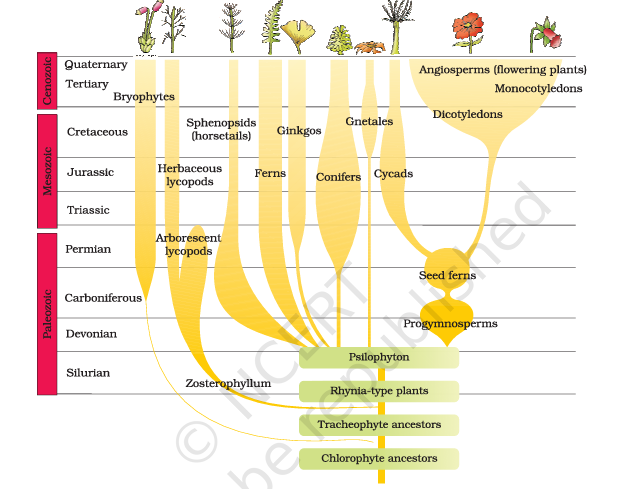
Based on Figure 6.9 detailing plant evolution, arrange the following plant groups in descending order of their evolutionary appearance (most recently evolved to oldest):
I. Bryophytes
II. Dicotyledons
III. Sphenopsids
IV. Rhynia-type plants
QUESTION 4 OF 20
Which of the following statements analytically interpret the rise of angiosperms based on evolutionary data?
I. They evolved from Seed ferns which were descendants of Progymnosperms.
II. Their dominance on Earth perfectly coincides with the complete absence of any surviving gymnosperms.
III. They appeared relatively late in the geological time scale compared to Rhynia-type plants.
QUESTION 5 OF 20
If Earth was formed 4.5 billion years ago, and life appeared 500 million years after its formation, how much time elapsed between the appearance of the first life forms and the formation of active invertebrates?
QUESTION 6 OF 20
Why is the discovery of the Coelacanth in 1938 considered an analytical breakthrough in evolutionary biology?
QUESTION 7 OF 20
Which of the following statements regarding the colonization of land is INCORRECT?
QUESTION 8 OF 20
Consider the evolutionary transition from lobefins to amphibians. Which of the following traits distinguish these early amphibians from the reptiles that succeeded them?
I. They lived on both land and water.
II. They laid thick-shelled eggs that did not dry up in the sun.
III. Their modern descendants include frogs and salamanders. Which of the statements is/are correct?
QUESTION 9 OF 20
Match the following reptilian lineages to their evolutionary status or descendants:
| Column 1 | Column 2 |
|---|---|
| 1. Pelycosaurs | A. Ancestors to Mammals |
| 2. Thecodonts | B. Early ancestors in the synapsid lineage before Therapsids |
| 3. Synapsids | C. Lineage leading to Dinosaurs, Crocodiles, and Birds |
| 4. Therapsids | D. Evolved directly from early Synapsids |
QUESTION 10 OF 20
Which of the following is NOT presented in the text as a plausible theory for the sudden disappearance of dinosaurs 65 million years ago?
QUESTION 11 OF 20
Match the consequence of continental drift with the geographical region for mammalian evolution:
| Column 1 | Column 2 |
|---|---|
| 1. South America | A. Pouched mammals survived due to lack of competition. |
| 2. North America | B. Mammals resembling horses, hippos, bears existed here originally. |
| 3. Australia | C. Its fauna overrode the joining continent's fauna. |
QUESTION 12 OF 20
Which of the following statements does NOT correctly explain why mammals were able to dominate the Earth post-dinosaur extinction?
QUESTION 13 OF 20
Analytically, what separates Ramapithecus from Dryopithecus in the hominid evolutionary tree despite both existing around 15 mya?
QUESTION 14 OF 20
Arrange the following early hominid and primate stages in correct order of their estimated historical existence:
I. Man-like primates walking upright in eastern Africa (not taller than 4 feet)
II. Australopithecines living in East African grasslands
III. Dryopithecus and Ramapithecus existing
QUESTION 15 OF 20
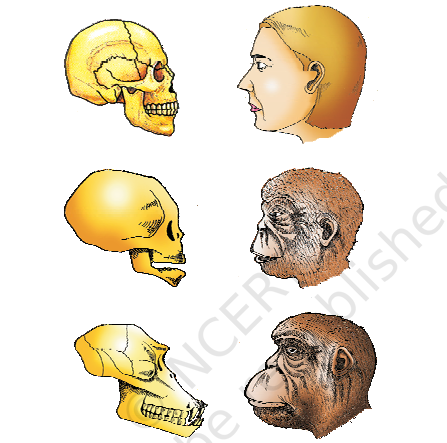
According to the caption of the provided skull image, which statement correctly analyzes the morphological affinities between humans and chimpanzees?
QUESTION 16 OF 20
Based on the anatomical principles demonstrated in the provided skull image, the progressive evolution towards Homo habilis and modern humans involved:
QUESTION 17 OF 20
Which of the following analytical statements is NOT true when comparing Homo habilis and Homo erectus?
QUESTION 18 OF 20
The fact that Neanderthals lived between 1,00,000-40,000 years back and buried their dead suggests that:
QUESTION 19 OF 20
The timeline of modern Homo sapiens development is characterized by several distinct phases. Which of the following is an analytical deduction based on the text?
QUESTION 20 OF 20
Evaluate the following statements regarding late human evolution:
I. Pre-historic cave art at Bhimbetka was created around 18,000 years ago.
II. Agriculture began approximately 10,000 years ago, leading to human settlements.
III. The advent of agriculture preceded the creation of pre-historic cave art.
Test Complete!
Answer Review
1
Sediments are laid down in layers over time (stratigraphy). Fossils within these layers represent life forms that existed during that specific time. This method provides relative dating, allowing scientists to order biological history.
The passage explicitly states that a cross-section of the Earth's crust shows sediments arranged one over the other during the long history of the Earth. Since fossils are found within these specific sediment layers, identifying the position of the layer allows scientists to correlate the fossil with the specific geological period it represents. This is the fundamental basis of relative dating in paleontology.
- Option A → The fossil record demonstrates the long, gradual history of Earth, contradicting claims of a young Earth.
- Option B → Sedimentary layers provide biological and structural history, not direct atmospheric/temperature data of the early Earth.
- Option D → Stratigraphy and radioactive dating are complementary techniques; one does not disprove the other.
Used: Elimination
Application: Options A, B, and D are either scientifically inaccurate or irrelevant to the specific mechanism described in the provided passage.
Final Logic: The passage defines fossil-bearing sediments as markers of time, directly supporting Option C.
"Sediments = History Books": Newest pages (layers) on top, oldest on the bottom.
2
Restricted fossil layers signify a specific period of existence. Different fossils in different layers show biological succession. This demonstrates that life forms are not static but change over time.
The presence of specific fossils in unique layers indicates that life forms appeared, thrived, and eventually died out during specific geological intervals. This confirms the concept of "descent with modification" and evolutionary succession. If life did not evolve, we would see the same fossils in every layer of the Earth's crust, which is not the case.
- Option A → Sedimentary layers can be formed in terrestrial environments; fossils are not limited to aquatic life.
- Option C → The passage focuses on paleontological (biological) evidence, not chemical evolution experiments.
- Option D → Spontaneous generation is a disproven theory; the fossil record actually supports evolution over long durations.
Used: Contextual Matching
Application: The question asks for the significance of fossil distribution in time; Option B directly addresses the temporal aspect of the passage.
Final Logic: Restricted distribution in time equals distinct periods of existence for different species.
"Layer = Era": Different layers tell us when different species had their "time in the spotlight."
3 Based on Figure 6.9 detailing plant evolution, arrange the following plant groups in descending order of their evolutionary appearance (most recently evolved to oldest):
I. Bryophytes
II. Dicotyledons
III. Sphenopsids
IV. Rhynia-type plants
Dicotyledons (Angiosperms) are the most advanced and recent. Sphenopsids (Pteridophytes) appeared before Angiosperms but after Bryophytes/early vascular plants. Bryophytes and Rhynia-type plants are ancient, with Rhynia being among the earliest land plants.
Based on the standard evolutionary tree of plants (NCERT Fig 6.9): Dicotyledons (Angiosperms) are the most recent evolution. Sphenopsids (primitive vascular plants) evolved earlier. Bryophytes (non-vascular) represent an earlier stage, and Rhynia-type plants are the common ancestors of all vascular plants (Tracheophytes). Arranging from recent to old: II (Angiosperms) > III (Sphenopsids) > I (Bryophytes) > IV (Rhynia-type).
- Option B → Incorrectly places Bryophytes as more recent than Sphenopsids.
- Option C → Incorrectly places Rhynia-type plants after Bryophytes.
- Option D → This is the ascending order (oldest to newest), not descending.
Used: Option Grouping
Application: Identifying the most recent (Angiosperms) and oldest (Rhynia) eliminates most options immediately.
Final Logic: Since Dicotyledons are the most recent and Rhynia the oldest, A is the only logical descending sequence.
"Angio-Spheno-Bryo-Rhynia": The reverse chronological ladder of plant complexity.
4 Which of the following statements analytically interpret the rise of angiosperms based on evolutionary data?
I. They evolved from Seed ferns which were descendants of Progymnosperms.
II. Their dominance on Earth perfectly coincides with the complete absence of any surviving gymnosperms.
III. They appeared relatively late in the geological time scale compared to Rhynia-type plants.
Angiosperms evolved via the seed fern lineage. Gymnosperms still exist today, making statement II false. Angiosperms are "recent" in the massive timeline of plant evolution.
Statement I is correct: Seed ferns (Pteridospermatophyta) were key evolutionary links to early flowering plants. Statement III is correct: Angiosperms appeared toward the end of the Mesozoic, millions of years after the Paleozoic Rhynia-type plants. Statement II is incorrect because gymnosperms (conifers, cycads, etc.) continue to be a successful, surviving group of plants.
- Option A → Includes statement II, which is factually incorrect as gymnosperms still survive.
- Option C → Excludes statement I, which is a standard evolutionary relationship in botany.
- Option D → Incorrectly identifies statement II as true.
Used: Extreme Word Filter
Application: Statement II uses the extreme phrasing "complete absence," which is easily falsified by looking at modern flora (gymnosperms exist).
Final Logic: Eliminate any option containing II; therefore, B is the only choice.
"Gymnos = Gyms": They are still 'training' and surviving, not extinct.
5 If Earth was formed 4.5 billion years ago, and life appeared 500 million years after its formation, how much time elapsed between the appearance of the first life forms and the formation of active invertebrates?
Earth formation: 4.5 bya. First life: 4.0 bya. Invertebrates (Cambrian): 0.5 bya (500 mya). Calculation: 4.0 bya - 0.5 bya = 3.5 billion years.
The first life appeared 4.0 billion years ago (4.5 bya - 0.5 bya). The Cambrian explosion, which marks the rapid diversification and appearance of most active marine invertebrates, occurred approximately 500 million years ago (0.5 bya). The difference between 4.0 bya and 0.5 bya is 3.5 billion years.
- Option A → Represents the time from Earth formation to life, not the requested interval.
- Option B → An arbitrary estimate not supported by the standard evolutionary timeline.
- Option D → Represents the total age of life, ignoring the time taken for invertebrate evolution.
Used: Dimensional/Unit Analysis
Application: Converting all values to "billion years" (bya) makes the math straightforward (4.0 - 0.5 = 3.5).
Final Logic: Simple arithmetic based on the timeline provided in the prompt.
"Life: 4, Inverts: 0.5": The gap between them is 3.5.
6 Why is the discovery of the Coelacanth in 1938 considered an analytical breakthrough in evolutionary biology?
Coelacanths are lobe-finned fish (Sarcopterygii). They possess skeletal structures in their fins that are homologous to tetrapod limbs. They are the "living fossils" that support the transition from water to land.
The Coelacanth was thought to be extinct since the Cretaceous. Finding a living specimen was monumental because it allowed scientists to study a "living fossil" that is closely related to the ancestors of the first amphibians. Its lobed fins show the precursor anatomy to the limbs of terrestrial vertebrates, confirming evolutionary links.
- Option A → Jawless fish (Agnathans) are a much older, more primitive group than Coelacanths.
- Option C → Spontaneous generation is not a scientific concept; it is an archaic belief.
- Option D → Living fossils do not refute natural selection; they simply indicate that an organism remained well-adapted to a stable niche.
Used: Substitution
Application: Substitute "Coelacanth" with "Lobe-finned fish" to immediately recall the NCERT link to the transition to land.
Final Logic: The defining evolutionary characteristic of Coelacanths is their role as a transition-type specimen.
"Coela-Land": Lobe-finned fish that hint at the move to land.
7 Which of the following statements regarding the colonization of land is INCORRECT?
Plants colonized land before animals. Animals invaded land only after plants had established a food source and environment. Statement C is chronologically and ecologically incorrect.
Evolutionary history shows that plants colonized land first. They modified the environment, created oxygen, and provided the necessary food source for heterotrophic organisms. Animals followed later. The claim that they invaded "simultaneously" is incorrect, as the terrestrial ecosystem required the structural presence of plants to support animal life.
- Option A → This is a generally accepted timeline for early land flora.
- Option B → Correct; plants were indeed the pioneers of the terrestrial environment.
- Option D → Correct; plants created the habitable conditions for animals.
Used: Odd One Out
Application: A, B, and D all describe a sequential, plant-first colonization, making C the outlier.
Final Logic: Since the question asks for the "INCORRECT" statement, the one proposing "simultaneity" is the clear choice.
"Plants First, Animals Second": Plants built the house, then animals moved in.
8 Consider the evolutionary transition from lobefins to amphibians. Which of the following traits distinguish these early amphibians from the reptiles that succeeded them?
I. They lived on both land and water.
II. They laid thick-shelled eggs that did not dry up in the sun.
III. Their modern descendants include frogs and salamanders. Which of the statements is/are correct?
Amphibians need water for reproduction (anamniotic eggs). Reptiles evolved thick-shelled (amniotic) eggs to conquer land. Therefore, II is a characteristic of reptiles, not early amphibians.
Early amphibians (like the ones transitioning from lobefins) were semi-aquatic and laid eggs in water because they lacked protective shells (Statement I is correct). Statement II is incorrect because the development of thick-shelled, desiccation-resistant eggs was the defining innovation of the reptiles, not the amphibians. Statement III is correct, as modern amphibians (Lissamphibia) are the descendants of these lineages.
- Option A → Includes II, which is the defining characteristic of the reptile lineage.
- Option C → Includes II, which is incorrect for early amphibians.
- Option D → Includes II, which is incorrect.
Used: Elimination
Application: Identifying that "thick-shelled eggs" belong to reptiles immediately invalidates any option containing II.
Final Logic: Amphibians = water-dependent eggs; Reptiles = land-adapted shells. B remains.
"Amphibian = Double Life": Lives in both; eggs in water.
9 Match the following reptilian lineages to their evolutionary status or descendants:
| Column 1 | Column 2 |
|---|---|
| 1. Pelycosaurs | A. Ancestors to Mammals |
| 2. Thecodonts | B. Early ancestors in the synapsid lineage before Therapsids |
| 3. Synapsids | C. Lineage leading to Dinosaurs, Crocodiles, and Birds |
| 4. Therapsids | D. Evolved directly from early Synapsids |
Synapsids: The parent group (D). Pelycosaurs: Early synapsids (B). Therapsids: Mammal ancestors (A). Thecodonts: Ancestors to Dinosaurs/Birds (C).
The evolutionary path follows: Synapsids are the broad group (D). Pelycosaurs were early synapsids (B). Therapsids evolved from them, leading to mammals (A). Thecodonts are a distinct lineage leading to Dinosaurs and Birds (C). Matching: 1-B, 2-C, 3-D, 4-A.
- Option A, B, C → Misalign the specific ancestral relationships provided in the evolutionary tree analysis.
Used: Substitution
Application: Verify the most well-known connection: Therapsids to Mammals (4-A). Only option D contains this match.
Final Logic: Match 4 with A, which isolates D as the correct option.
"Therapsid-Mammal" (The AM connection).
10 Which of the following is NOT presented in the text as a plausible theory for the sudden disappearance of dinosaurs 65 million years ago?
The text/NCERT discusses extinction theories: Climatic change and meteorite impact. While birds did evolve from a dinosaur lineage, they did not cause the extinction of the others. The extinction is usually attributed to external catastrophic causes, not their own evolution into birds.
The question asks for the theory not presented as a cause for the sudden disappearance. The extinction of dinosaurs is attributed to external factors (climate/meteorite). While the evolution of birds from dinosaurs is a biological fact, it is not an "extinction theory" for the dinosaur group as a whole. Option B mischaracterizes the event by implying that evolving into birds explains the mass extinction of all dinosaur species.
- Option A → Plausible theory discussed in texts.
- Option C → Plausible theory (the Alvarez hypothesis) discussed in texts.
- Option D → A synthetic view often proposed in evolutionary discussions.
Used: Contextual/Tonal Matching
Application: Differentiate between "Evolutionary Relationships" (Dinosaurs to Birds) and "Extinction Theories" (Meteor/Climate).
Final Logic: Option B mistakes an evolutionary lineage transition for an extinction mechanism.
"Extinction = Exit": Meteor/Climate pushed them out; bird evolution is a separate story.
11 Match the consequence of continental drift with the geographical region for mammalian evolution:
| Column 1 | Column 2 |
|---|---|
| 1. South America | A. Pouched mammals survived due to lack of competition. |
| 2. North America | B. Mammals resembling horses, hippos, bears existed here originally. |
| 3. Australia | C. Its fauna overrode the joining continent's fauna. |
South America: Isolated for a time, evolved unique placental mammals (B). North America: Joined later, its fauna overrode South American counterparts (C). Australia: Isolated, allowing marsupials (pouched mammals) to survive (A).
Continental drift isolated continents, leading to independent evolution. South America had unique fauna (like horse/hippo-like creatures). When the isthmus joined North and South America, the North American fauna displaced the South American ones (C). Australia remained isolated, allowing pouched (marsupial) mammals to flourish without placental competition (A).
- Option B, C, D → Incorrectly pair the evolutionary outcomes with the respective continents as described in evolutionary geography.
Used: Elimination
Application: Identifying that Australia's "pouched mammal" isolation is a classic textbook example (3-A) narrows the choice to A or B. Then, correctly identifying North America's stronger fauna displacement (2-C) confirms A.
Final Logic: Match 3-A and 2-C leads directly to A.
"Aus-Pouch": Australia = Pouched.
12 Which of the following statements does NOT correctly explain why mammals were able to dominate the Earth post-dinosaur extinction?
Mammals are characterized by viviparity (giving birth to live young), not egg-laying. Thick-shelled eggs are a trait of reptiles and birds. Statement C is biologically false for mammals.
Mammals are distinct because they are viviparous; they do not lay eggs (with the exception of monotremes, but this is not the general mammalian strategy for dominance). The trait of "thick-shelled eggs" belongs to the reptiles and birds. Therefore, this statement does not explain mammalian success.
- Option A → Viviparity is a key advantage for mammalian survival.
- Option B → Advanced brain and sensory systems provided a distinct survival edge.
- Option D → Removing the dominant reptilian niche allowed mammals to radiate into those empty habitats.
Used: Substitution
Application: Substitute "Mammals" with "Reptiles" in Option C to see that the statement describes reptiles, not mammals.
Final Logic: Mammals = Viviparous; therefore, C is the false statement.
"Mammals = Mom's womb": No eggs, just live birth.
13 Analytically, what separates Ramapithecus from Dryopithecus in the hominid evolutionary tree despite both existing around 15 mya?
Both existed 15 mya, but on different evolutionary trajectories. Dryopithecus was more similar to modern apes (hairy, knuckle-walking). Ramapithecus showed early skeletal/dental traits leaning toward the hominid (human) line.
In the hominid timeline, Dryopithecus is considered more ape-like in appearance, while Ramapithecus is noted for having features that were "more man-like." These represent the early divergence in the primate line leading toward humans.
- Option A → Neither used metal; metal is a very recent human development.
- Option C → 900cc is too high for these early primates (Homo erectus had ~900cc).
- Option D → Both were found in Africa/Eurasian regions; Australia is not a site for these early hominids.
Used: Contextual/Tonal Matching
Application: Identify the core distinction in hominid evolution: "Ape-like" (Dryo) vs "Man-like" (Rama).
Final Logic: B correctly identifies the established evolutionary comparison.
"Rama = Real human-like": Ramapithecus is closer to us.
14 Arrange the following early hominid and primate stages in correct order of their estimated historical existence:
I. Man-like primates walking upright in eastern Africa (not taller than 4 feet)
II. Australopithecines living in East African grasslands
III. Dryopithecus and Ramapithecus existing
Dryopithecus/Ramapithecus (15 mya) are the oldest group. "Man-like primates walking upright" (Australopithecus/early hominids) followed. Australopithecines (specifically the grassland-dwelling ones) are the subsequent, more distinct stage.
Dryopithecus and Ramapithecus are the earliest (15 mya). This was followed by the emergence of early man-like primates (upright walkers) and then the distinct Australopithecine forms that occupied the African grasslands. The chronological sequence is III -> I -> II.
- Option B, C, D → Incorrectly order the evolutionary timeline of early hominid development.
Used: Substitution
Application: Establish the oldest stage (Dryopithecus/Ramapithecus) as the starting point. This eliminates B and C. Then compare I and II.
Final Logic: A is the only sequence starting with the oldest group and ending with the more recent Australopithecines.
"Dry-Rama first, then walk, then grass": Timeline of early human evolution.
15 According to the caption of the provided skull image, which statement correctly analyzes the morphological affinities between humans and chimpanzees?
This refers to the classic NCERT illustration comparing human and ape development. Baby chimps lack the heavy brow ridges and protruding jaws of adult chimps. They resemble the human form more than the adult chimp does.
The comparison of skull morphology (NCERT) reveals that the juvenile chimpanzee skull lacks the extreme prognathism (jaw projection) and brow ridges seen in adults, showing a closer structural resemblance to human proportions than the adult chimpanzee.
- Option A → Completely false; there are massive morphological differences between them.
- Option C → Humans have a much flatter face and reduced jaw projection.
- Option D → Humans and chimpanzees share high structural homology due to common ancestry.
Used: Contextual/Tonal Matching
Application: Recall the specific comparative anatomy exercise found in the Biology textbook regarding "neoteny" or developmental comparison.
Final Logic: B is the correct observation from the standard textbook diagram.
"Baby Chimp = Human-like": The juvenile form looks more like us than the adult form does.
16 Based on the anatomical principles demonstrated in the provided skull image, the progressive evolution towards Homo habilis and modern humans involved:
Human evolution is characterized by encephalization (brain growth). Homo habilis had a cranial capacity of 650–800cc. Jaw size and snout protrusion actually reduced, not increased.
A primary trend in hominid evolution is the expansion of the brain (increasing cranial capacity). Homo habilis is specifically noted in NCERT for having a brain capacity in the range of 650–800cc, which is significantly larger than earlier Australopithecines.
- Option A → The trend is the opposite: jaw size decreased, and cranial capacity increased.
- Option B → Humans evolved smaller, less prominent canines, unlike chimps.
- Option D → The face flattened; snouts were reduced, not elongated, to accommodate the brain.
Used: Elimination
Application: Identify the hallmark of human evolution: Brain size (C). Options A and D describe primate-like, not human-like, trends.
Final Logic: Brain growth is the defining trait of Homo evolution.
"Big Brain = Homo": Homo habilis was the 'handy man' with a 'big brain' start.
17 Which of the following analytical statements is NOT true when comparing Homo habilis and Homo erectus?
Australopithecines are older than Homo erectus. Homo erectus appeared after Homo habilis and Australopithecines. Therefore, C is factually false.
Australopithecines evolved long before Homo erectus. The fossil record clearly places Homo erectus as a later hominid. Thus, it is impossible for them to have "preceded" Australopithecines.
- Option A → True; Homo erectus had a brain size of about 900cc.
- Option B → True; Homo erectus is associated with more complex hunting behaviors.
- Option D → True; Homo erectus is indeed more recent than Homo habilis.
Used: Elimination
Application: Compare the age of the species. Since Australopithecines are early (approx 2–4 mya) and Homo erectus is later (approx 1.5 mya), C is clearly the error.
Final Logic: Use the timeline to identify the false statement.
"Australo-First": The ancestors always come before the erect ones.
18 The fact that Neanderthals lived between 1,00,000-40,000 years back and buried their dead suggests that:
Burial customs indicate abstract thought, symbolic behavior, and social bonding. Neanderthals (1400cc) possessed high intelligence. This proves complex behavior preceded modern Homo sapiens.
Burial of the dead is a clear behavioral indicator of symbolic thinking and an awareness of mortality. This suggests that Neanderthals possessed advanced cognitive capabilities and social structures prior to the dominance of Homo sapiens.
- Option A → Contradicts the evidence; burial is a behavioral change.
- Option C → Brain capacity supports cognitive function, not just motor skills.
- Option D → Agriculture is a much more recent development (10,000 years ago) associated with Homo sapiens.
Used: Contextual/Tonal Matching
Application: Relate "burial" to "social rituals and mortality," which matches the analytical significance of B.
Final Logic: Burial = Symbolic/Cognitive advancement.
"Neanderthal = Ritual": They buried their dead, showing they had 'heart' and 'mind'.
19 The timeline of modern Homo sapiens development is characterized by several distinct phases. Which of the following is an analytical deduction based on the text?
Homo sapiens arose during the Ice Age (Pleistocene). As they migrated and settled in different regions, genetic/phenotypic variation (races) occurred. This is the standard evolutionary perspective in the text.
Homo sapiens emerged during the ice age between 75,000–10,000 years ago. Their migration across the globe to different environments led to the development of various human populations and phenotypes.
- Option A → Cave art is a very recent human development, long after Homo erectus.
- Option C → Evidence points to an African origin for Homo sapiens.
- Option D → Agriculture is 10,000 years old, while the brain expansion happened much earlier.
Used: Substitution
Application: Evaluate the plausibility of the timeline: A (False), C (False), D (False). B is the only historically/scientifically accurate statement regarding Homo sapiens.
Final Logic: B aligns with the known history of human migration and expansion.
"Ice Age Sapiens": They moved out of Africa into the cold world.
20 Evaluate the following statements regarding late human evolution:
I. Pre-historic cave art at Bhimbetka was created around 18,000 years ago.
II. Agriculture began approximately 10,000 years ago, leading to human settlements.
III. The advent of agriculture preceded the creation of pre-historic cave art.
Cave art (Bhimbetka) dates to approx 18,000 ya. Agriculture dates to approx 10,000 ya. Therefore, Cave art preceded agriculture, making III false.
Statement I is correct (18,000 years ago). Statement II is correct (10,000 years ago). Statement III is incorrect because 18,000 (art) is older than 10,000 (agriculture), meaning art came first. Therefore, only I and II are correct.
- Option B → Incorrectly includes III.
- Option C → Incorrectly includes III and excludes I.
- Option D → Includes III, which is chronologically false.
Used: Elimination
Application: Since I and II are both standard facts from the NCERT human evolution section, look for the option that includes both. A is the only choice.
Final Logic: I + II = correct timeline.
"Art before Agriculture": First they painted, then they planted.