
CUET UG Biology Booster Test 2 Adaptive Radiation and Population Genetics
📌 Answers are locked once submitted — results and explanations appear at the end.
QUESTION 1 OF 20
Consider the following statements regarding Darwin's finches:
Statement I: Darwin conjectured that all varieties of the finches evolved on the Galapagos island itself.
Statement II: Darwin's finches are considered one of the best examples of adaptive radiation.
QUESTION 2 OF 20
Which of the following features is NOT associated with the adaptive changes in the beak shapes of Darwin's finches?
QUESTION 3 OF 20
QUESTION 4 OF 20
QUESTION 5 OF 20
Arrange the conceptual sequence of Australian marsupial evolution accurately:
I. A number of different marsupials emerged.
II. All forms evolved within the Australian island continent.
III. An ancestral marsupial stock existed.
QUESTION 6 OF 20
The lack of competition from any other mammal that allowed pouched mammals of Australia to survive was primarily due to:
QUESTION 7 OF 20
Match the evolutionary concept with its corresponding description.
| List I | List II |
|---|---|
| 1. Similar isolated habitats selecting similar adaptive features | a. Adaptive Radiation |
| 2. Radiation of a single ancestral stock to different habitats | b. Convergent Evolution |
| 3. Darwin's finches | c. Diversification from a common ancestor into different ecological niches |
| 4. Australian marsupials and placental mammals | d. Independent evolution of similar adaptations |
QUESTION 8 OF 20
Which of the following is NOT an accurate comparison drawn by convergent evolution in mammals?
QUESTION 9 OF 20
In the context of Hardy-Weinberg equilibrium, a disturbance or change in the frequency of alleles in a population is interpreted as resulting in:
QUESTION 10 OF 20
Consider the following statements about allele frequencies:
Statement I: In a stable population, the probability that an allele A with a frequency of p appears on both chromosomes of a diploid individual is (p^2).
Statement II: The frequency of a recessive allele 'a' is represented by 2pq.
QUESTION 11 OF 20
Arrange the logical steps to formulate the Hardy-Weinberg equation for a diploid organism:
I. The sum of all allelic frequencies is 1 ((p+q=1)).
II. Alleles A and a have frequencies p and q respectively.
III. The probabilities of genotypes (AA), (AA), and (A) become (p^2), (2pq), and (q^2).
IV. The binomial expansion results in (p^2 + 2pq + q^2 = 1).
QUESTION 12 OF 20
Which of the following factors is NOT one of the five factors known to affect the Hardy-Weinberg equilibrium?
QUESTION 13 OF 20
Match the evolutionary factor with its corresponding outcome.
| List I | List II |
|---|---|
| 1. Gene Migration | a. Heritable variations enabling better survival leave more progeny |
| 2. Natural Selection | b. Alleles are transferred from one population to another |
| 3. Genetic Drift | c. Random changes in allele frequency, especially in small populations |
| 4. Mutation | d. Introduces new heritable variations into the gene pool |
QUESTION 14 OF 20
If an initial migration event causes an allele frequency change, what transforms this isolated event into "gene flow"?
QUESTION 15 OF 20
Which of the following statements is NOT a characteristic of genetic drift?
QUESTION 16 OF 20
The founder effect occurs when a change in allele frequency in a new sample of population is so extreme that:
QUESTION 17 OF 20
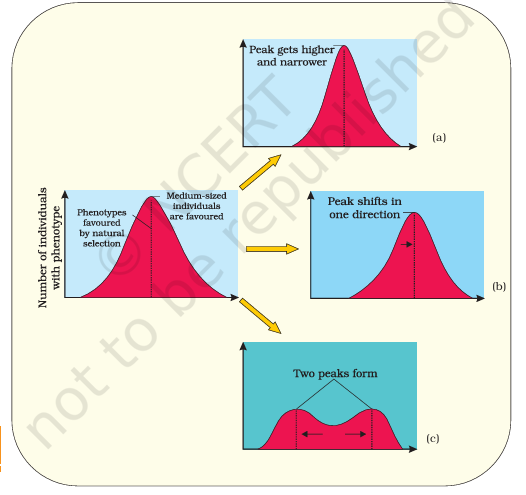
According to Figure (A), what happens to the population distribution curve when stabilizing selection operates?
QUESTION 18 OF 20
Based on Figure(C), disruptive selection is characterized by:
QUESTION 19 OF 20
How does variation due to recombination during gametogenesis contribute to evolution under natural selection?
QUESTION 20 OF 20
According to Hugo deVries' concept of mutation (saltation), how do mutations differ from Darwinian variations?
Test Complete!
Answer Review
1 Consider the following statements regarding Darwin's finches:
Statement I: Darwin conjectured that all varieties of the finches evolved on the Galapagos island itself.
Statement II: Darwin's finches are considered one of the best examples of adaptive radiation.
Darwin observed diverse finch species on the Galapagos archipelago. He hypothesized that these species diverged from a common ancestral stock after reaching the islands. This diversification is the classic textbook definition of adaptive radiation.
�� Darwin's study of the Galapagos finches led him to the conclusion that a single ancestral species migrated to the islands and then underwent rapid diversification (adaptive radiation) to exploit different niches. Both statements are accurate reflections of his observations and the evolutionary significance of these birds.
- Option A → Statement I is true, as the radiation occurred on the islands.
- Option B → Statement I is true, not false.
- Option D → Both statements are widely accepted evolutionary facts.
Used: Contextual/Tonal Matching
Application: Verify both statements against standard evolutionary biology curriculum.
Final Logic: Both statements align perfectly with established evolutionary theory regarding Darwin's finches.
"Finch radiation = Galapagos = Adaptive."
2 Which of the following features is NOT associated with the adaptive changes in the beak shapes of Darwin's finches?
Adaptive radiation relies on dietary differences (niche exploitation). Identical diets would not drive beak specialization. Finch beaks are highly varied precisely because their diets are varied.
�� Adaptive radiation is driven by the exploitation of different resources. The beak shapes changed specifically because different island populations had to adapt to different diets (insects, seeds, cactus fruits), not identical ones. Option B contradicts the core mechanism of adaptive radiation.
- Option A → True, they descended from a common seed-eating ancestor.
- Option C → True, niche specialization included insect-eating beaks.
- Option D → True, this is the primary phenomenon these finches exemplify.
Used: Elimination
Application: Eliminate statements that are "True" (A, C, D) to find the "NOT associated" statement (B).
Final Logic: Divergent diets drive radiation; identical diets would not.
"Different diet = Different beak."
3
The passage explicitly defines adaptive radiation as starting from a single point and radiating. It emphasizes the movement into different habitats. It is a process of diversification, not convergence.
�� The passage provides a direct definition: "This process of evolution of different species in a given geographical area starting from a point and literally radiating to other areas of geography (habitats) is called adaptive radiation." Option B paraphrases this exactly.
- Option A → This describes convergent evolution.
- Option C → Radiation results in different species, not identical ones.
- Option D → Adaptive radiation increases variation.
Used: Substitution
Application: Directly compare options to the passage text.
Final Logic: Option B is a restatement of the passage's definition.
"Radiation = Spread from Point of Origin."
4
Different radiations in the same area often lead to similar features in unrelated groups. This pattern of independent groups arriving at similar adaptive traits is convergent evolution. Australia (Marsupials vs. Placentals) is the classic example cited in NCERT.
�� The passage establishes that adaptive radiation happened in Australia for marsupials. When a different adaptive radiation (placental mammals) occurs in the same region, their independent evolution of similar traits (e.g., the placental wolf and the Tasmanian wolf) is called convergent evolution.
- Option A, B, D → These are mechanisms of population change or selection, not the name for the pattern of multiple independent radiations in one area.
Used: Contextual/Tonal Matching
Application: Recognize the pattern of "Different groups, same area, similar features" Convergent Evolution.
Final Logic: The text uses this specific terminology to describe the placental/marsupial relationship.
"Convergent = Different Radiation, Same Geography."
5 Arrange the conceptual sequence of Australian marsupial evolution accurately:
I. A number of different marsupials emerged.
II. All forms evolved within the Australian island continent.
III. An ancestral marsupial stock existed.
Ancestor (III) is always the starting point. Radiation (I) produces the variety. Isolation (II) is the geographical context that allowed it.
�� Evolutionary logic dictates starting with the ancestor (III), followed by the process of radiation/differentiation (I), all of which occurred within the specific geographical context of the Australian continent (II).
- Option B, C, D → All break the logical chain of ancestor-to-descendant-to-environment.
Used: Substitution
Application: Ancestor -> Differentiation -> Location.
Final Logic: A is the only chronologically sound order.
"Start with Ancestor, Diversify, Then Isolate."
6 The lack of competition from any other mammal that allowed pouched mammals of Australia to survive was primarily due to:
Australia drifted away from other landmasses. This separated marsupials from placental competitors. "Continental drift" is the geologic mechanism for this isolation.
�� Continental drift caused the separation of Australia from other landmasses, leaving the marsupials isolated. Without placental mammals crossing over to compete for resources, the marsupials were free to undergo adaptive radiation.
- Option A → Mutation rates are not the cause of geographic isolation.
- Option C → Volcanic activity is not the reason for marsupial-specific success.
- Option D → Artificial selection is human-driven.
Used: Elimination
Application: Rule out non-geological factors (A, C, D).
Final Logic: Continental drift is the geologic reality that explains the isolation of Australian fauna.
"Drift = Isolation = No Competition."
7 Match the evolutionary concept with its corresponding description.
| List I | List II |
|---|---|
| 1. Similar isolated habitats selecting similar adaptive features | a. Adaptive Radiation |
| 2. Radiation of a single ancestral stock to different habitats | b. Convergent Evolution |
| 3. Darwin's finches | c. Diversification from a common ancestor into different ecological niches |
| 4. Australian marsupials and placental mammals | d. Independent evolution of similar adaptations |
Similar environmental conditions can produce similar adaptations in unrelated organisms. Adaptive radiation results from diversification of a common ancestor. Darwin's finches illustrate adaptive radiation. Australian marsupials and placental mammals demonstrate convergent evolution.
The correct matching is: List I — List II 1. Similar isolated habitats selecting similar adaptive features — b. Convergent Evolution 2. Radiation of a single ancestral stock to different habitats — a. Adaptive Radiation 3. Darwin's finches — c. Diversification from a common ancestor into different ecological niches 4. Australian marsupials and placental mammals — d. Independent evolution of similar adaptations According to NCERT, adaptive radiation is the evolution of multiple species from a common ancestor that occupy different ecological niches, as illustrated by Darwin's finches. Convergent evolution occurs when unrelated organisms living under similar environmental conditions independently evolve similar adaptations. The resemblance between Australian marsupials and placental mammals is a classic example of convergent evolution. Therefore, the correct matching is 1-b, 2-a, 3-c, 4-d.
- Option B → Reverses the definitions of adaptive radiation and convergent evolution.
- Option C → Incorrectly matches Darwin's finches and Australian mammals with the wrong evolutionary concepts.
- Option D → Misaligns all the evolutionary descriptions.
Used: Concept Matching
Application: Match each evolutionary phenomenon with its defining characteristic and standard NCERT example.
Final Logic:
- Similar habitats → Convergent Evolution
- Single ancestral stock → Adaptive Radiation
- Darwin's finches → Adaptive Radiation
- Australian mammals → Convergent Evolution
Convergence → Different ancestors, similar forms.
8 Which of the following is NOT an accurate comparison drawn by convergent evolution in mammals?
Convergent evolution involves similar body forms. Seed-eating finches are birds; Placental mammals are mammals. These are not a convergent pair in evolutionary biology.
�� Convergent evolution compares placental and marsupial versions of the same ecological niche (e.g., wolves, anteaters). Darwin's finch is an example of adaptive radiation, not a convergent pair with a placental mammal.
- Option A → This is a classic convergent pair.
- Option B → This represents the entire group comparison for convergent study.
- Option D → This is the definition of convergent evolution.
Used: Odd One Out
Application: C relates to Adaptive Radiation (Finches), while A and B relate to Convergent Evolution.
Final Logic: C does not fit the category of Convergent Mammalian Forms.
"Convergent = Placental + Marsupial."
9 In the context of Hardy-Weinberg equilibrium, a disturbance or change in the frequency of alleles in a population is interpreted as resulting in:
H-W = No evolution. Change in allele frequency = Evolution. This is the definition of evolution at the population level.
�� Genetic equilibrium means the gene pool is stable. If allele frequencies change, the population is no longer in equilibrium, which is the definition of evolution at the population level.
- Option A → Spontaneous generation is irrelevant.
- Option B → Change doesn't eliminate drift.
- Option D → Stabilizing selection is one type of evolution, not the general interpretation of "any" change.
Used: Substitution
Application: "Evolution = Change in allele frequency."
Final Logic: Allelic change IS evolution.
"Frequency Change = Evolution."
10 Consider the following statements about allele frequencies:
Statement I: In a stable population, the probability that an allele A with a frequency of p appears on both chromosomes of a diploid individual is (p^2).
Statement II: The frequency of a recessive allele 'a' is represented by 2pq.
AA genotype freq = p^2 (Statement I is correct). Recessive allele freq = q (not 2pq). Aa freq = 2pq.
�� In the H-W formula: p = dominant allele freq, q = recessive allele freq. Statement I is correct because probability of AA is p × p = p^2. Statement II is incorrect because 2pq represents the frequency of the heterozygous genotype (AA), not the frequency of the allele 'a'.
- Option A → Statement II is definitely incorrect.
- Option C → Statement I is definitely correct.
- Option D → Statement I is correct.
Used: Elimination
Application: Test Statement I (Correct) vs Statement II (False).
Final Logic: I is true, II is false.
"Aa=2pq; a=q."
11 Arrange the logical steps to formulate the Hardy-Weinberg equation for a diploid organism:
I. The sum of all allelic frequencies is 1 ((p+q=1)).
II. Alleles A and a have frequencies p and q respectively.
III. The probabilities of genotypes (AA), (AA), and (A) become (p^2), (2pq), and (q^2).
IV. The binomial expansion results in (p^2 + 2pq + q^2 = 1).
Define alleles (II). Establish sum of frequencies (I). Expand to genotypes (III). Form the final equation (IV).
�� The formulation starts by defining the variables (allele frequencies p and q). Then, you apply the rule that the sum of these frequencies must be 1. Following this, you apply binomial probability to derive the genotype frequencies based on the random combination of alleles, leading to the final H-W equation.
- Option A, C, D → All attempt to place the allele frequency sum (I) either before the definition of p and q or out of its logical mathematical sequence.
Used: Contextual/Tonal Matching
Application: Logical derivation flow: Definitions -> Rules -> Probabilities -> Expansion.
Final Logic: II (Defining variables) must precede I (Summing them).
"Define -> Sum -> Expand."
12 Which of the following factors is NOT one of the five factors known to affect the Hardy-Weinberg equilibrium?
The five factors are: Mutation, Recombination, Gene flow (migration), Genetic drift, and Natural selection. "Artificial breeding" (or artificial selection) is not one of the five primary factors listed in the Hardy-Weinberg equilibrium framework.
�� According to the Hardy-Weinberg principle, the five evolutionary forces that disrupt equilibrium are: gene migration, genetic drift, mutation, genetic recombination, and natural selection. Artificial breeding is a human-directed process and not listed as one of these fundamental natural evolutionary forces.
- Option A, B, D → These are all recognized factors that disrupt Hardy-Weinberg equilibrium.
Used: Elimination
Application: Use the standard NCERT list of five factors to eliminate the one that doesn't belong.
Final Logic: C is an external/human-driven factor, not a primary evolutionary mechanism listed in the H-W chapter.
"M-R-G-G-S (Mutation, Recombination, Gene flow, Genetic drift, Selection)."
13 Match the evolutionary factor with its corresponding outcome.
| List I | List II |
|---|---|
| 1. Gene Migration | a. Heritable variations enabling better survival leave more progeny |
| 2. Natural Selection | b. Alleles are transferred from one population to another |
| 3. Genetic Drift | c. Random changes in allele frequency, especially in small populations |
| 4. Mutation | d. Introduces new heritable variations into the gene pool |
Gene migration transfers alleles between populations. Natural selection increases the frequency of favourable traits. Genetic drift causes random changes in allele frequencies. Mutation introduces new genetic variations.
The correct matching is: List I — List II 1. Gene Migration — b. Alleles are transferred from one population to another 2. Natural Selection — a. Heritable variations enabling better survival leave more progeny 3. Genetic Drift — c. Random changes in allele frequency, especially in small populations 4. Mutation — d. Introduces new heritable variations into the gene pool According to NCERT, gene migration (gene flow) introduces or removes alleles when individuals migrate between populations. Natural selection favours individuals with advantageous heritable variations, allowing them to leave more offspring. Genetic drift produces random fluctuations in allele frequencies, particularly in small populations, while mutations create new alleles and provide the raw material for evolution. Therefore, the correct matching is 1-b, 2-a, 3-c, 4-d.
- Option B → Incorrectly exchanges the roles of gene migration and natural selection.
- Option C → Incorrectly matches genetic drift and mutation.
- Option D → Misaligns all four evolutionary factors with their outcomes.
Used: Concept Matching
Application: Match each evolutionary factor with its direct effect on the gene pool according to NCERT.
Final Logic:
- Migration → Transfer of alleles
- Selection → Survival of the fittest
- Drift → Random allele changes
- Mutation → New genetic variation
Mutate → New Variation
14 If an initial migration event causes an allele frequency change, what transforms this isolated event into "gene flow"?
A single event is just migration/drift. "Flow" implies a continuous or repeating process.
�� The term "gene flow" denotes the ongoing, repeated exchange of genetic material between populations. A single, isolated migration event is usually categorized differently (like the founder effect); continuous movement is the defining trait of gene flow.
- Option A → Mutation is unrelated to the volume of migration.
- Option C → Stabilization is the opposite of gene flow (which changes frequencies).
- Option D → Habitat disruption doesn't define the "flow" process.
Used: Contextual/Tonal Matching
Application: Match the word "flow" with "continuous" or "multiple."
Final Logic: B is the definition of "flow" (continuous movement).
"Flow = Multiple."
15 Which of the following statements is NOT a characteristic of genetic drift?
Genetic drift is random. Random processes do not guarantee adaptive fitness (which requires selection).
�� Genetic drift is a stochastic (random) process. It does not select for "fitness"; rather, it can even cause the loss of beneficial alleles by sheer coincidence. Therefore, it does not guarantee an increase in adaptive fitness.
- Option A → True, drift is random.
- Option B → True, it shifts frequencies.
- Option D → True, founder effect is a type of drift.
Used: Extreme Word Filter
Application: "Guarantees" is an extreme word that contradicts the randomness of drift.
Final Logic: C is false.
"Drift = Chance, NOT Guaranteed Fitness."
16 The founder effect occurs when a change in allele frequency in a new sample of population is so extreme that:
Founder effect leads to rapid, drastic changes. This divergence can result in speciation.
�� When a small group of founders establishes a new population, their allele frequencies are often vastly different from the source. This isolation and change can lead to significant divergence, eventually resulting in the formation of a new species.
- Option A → They cannot revert to the original; they are isolated.
- Option C → Drift disrupts equilibrium.
- Option D → They continue to mutate.
Used: Substitution
Application: Define the outcome of the Founder Effect in NCERT context.
Final Logic: Divergence/Speciation is the established end-point of this process.
"Founder = New Species."
17 According to Figure (A), what happens to the population distribution curve when stabilizing selection operates?
Stabilizing = Favoring the mean. The "average" individuals survive better. The curve peaks higher at the center.
�� In stabilizing selection, the extremes are selected against. Consequently, the bell curve tightens and grows taller at the center (the mean), as a larger percentage of the population conforms to the average trait.
- Option A → This is directional selection.
- Option B → This is disruptive selection.
- Option D → This is not a standard selection mode.
Used: Substitution
Application: "Stabilizing" means "Focusing on the center."
Final Logic: C describes the physical "narrowing/peaking" of the distribution.
"Stabilizing = Mean Peak."
18 Based on Figure(C), disruptive selection is characterized by:
Disruptive selection = Favoring the extremes. The mean is selected against. Peaks form at both ends.
�� Disruptive selection happens when environmental conditions favor individuals at both ends of the phenotypic spectrum. This results in a bimodal distribution where the frequency of extreme traits increases significantly.
- Option A → This is stabilizing selection.
- Option C → Selection typically maintains or redirects variation, not eliminates it.
- Option D → This is directional selection.
Used: Substitution
Application: "Disruptive" means "Breaking the middle."
Final Logic: B accurately identifies the "extreme" phenotype preference.
"Disruptive = Extremes."
19 How does variation due to recombination during gametogenesis contribute to evolution under natural selection?
Recombination shuffles alleles. Natural selection filters these new combinations. If successful, the population evolves.
�� Genetic recombination creates novel allelic combinations. Natural selection then acts on these combinations, favoring those that increase reproductive fitness. Over time, this shifts the population's gene pool, which we perceive as an evolutionary change.
- Option A → Recombination disrupts equilibrium.
- Option C → Recombination rearranges alleles (though mutation creates new ones).
- Option D → Recombination does not eliminate mutations; selection does.
Used: Elimination
Application: Choose the only statement that describes the "Recombination + Selection = Evolution" sequence.
Final Logic: B is the accurate description of the evolutionary mechanism.
"Recombination + Selection = Change."
20 According to Hugo deVries' concept of mutation (saltation), how do mutations differ from Darwinian variations?
De Vries: Large, random mutations (saltation). Darwin: Small, directional variations.
�� Hugo de Vries proposed that mutations are sudden, random, and directionless ("saltation"). In contrast, Darwin's theory was based on the premise that variations are small, gradual, and accumulate in a direction favored by natural selection.
- Option A → Contradicts the definitions.
- Option C → De Vries explicitly argued they were not the same.
- Option D → Both theories discuss germ-line transmission for evolutionary impact.
Used: Contextual/Tonal Matching
Application: Match "De Vries" with "Saltation/Random" and "Darwin" with "Gradual/Directional."
Final Logic: B accurately contrasts the two schools of thought.
"De Vries = Sudden; Darwin = Gradual."