
CUET UG Biology Booster Test 3 Evidences for Biological Evolution
📌 Answers are locked once submitted — results and explanations appear at the end.
QUESTION 1 OF 20
Consider the following analytical statements regarding paleontological evidence:
I. Fossils in deeper, older sedimentary layers will generally represent life-forms more distinct from modern organisms than fossils in shallower layers.
II. The absence of a specific fossil in a particular sedimentary layer definitively proves that the organism had not yet evolved.
III. Paleontological evidence proves that the diversity of life was always the same since creation.
IV. The geological history of earth closely correlates with the biological history of earth. Which statements are correct based on evolutionary theory?
QUESTION 2 OF 20
If an entirely new, deeply buried sedimentary layer is discovered containing only unicellular fossil impressions, what can be logically deduced about the geological period of that sediment?
QUESTION 3 OF 20
Which of the following is NOT a logical consequence of applying radioactive-dating procedures to fossil records?
QUESTION 4 OF 20
Arrange the conceptual milestones in establishing geological time spans using biological evidence:
I. Identifying that new forms of life arose at different times in earth's history.
II. Observing a cross-section of earth's crust to find layered sediments.
III. Calculating specific fossil ages using radioactive-dating methods.
IV. Discovering that certain life forms are strictly restricted to certain sedimentary layers.
QUESTION 5 OF 20
Match the evolutionary concept to its underlying mechanism or example:
| Column I | Column II |
|---|---|
| I. Homology | P. Sweet potato and potato |
| II. Analogy | Q. Driven by adaptations to different needs from a common ancestor |
| III. Divergent Evolution | R. Wings of butterfly and birds |
| IV. Convergent Evolution | S. Common ancestry indicated by similar structural patterns |
QUESTION 6 OF 20
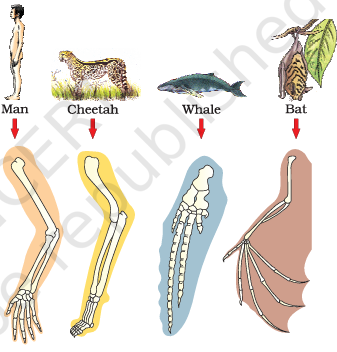
Analyzing figure, the structural similarity of the humerus, radius, and ulna across these diverse mammals mathematically relates to genetic inheritance. What evolutionary principle prevents these bones from being perfectly identical in size and shape across the species?
QUESTION 7 OF 20
Which of the following analytical statements is NOT a valid interpretation of convergent evolution?
QUESTION 8 OF 20
An evolutionary biologist examines a bird wing and a butterfly wing. At a microscopic tissue level, they are fundamentally different, yet aerodynamically they solve the same physical problem. This phenomenon indicates that:
QUESTION 9 OF 20
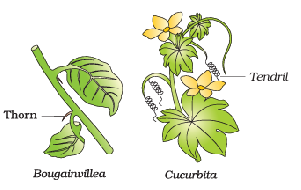
In figure the thorn of Bougainvillea and the tendril of Cucurbita arise from the same axillary bud position on the stem. How does this specific botanical observation analytically confirm homology rather than analogy?
QUESTION 10 OF 20
Sweet potato and potato modifications are considered analogous. If a geneticist compared the specific genes regulating the formation of the starch-storing tissues in both organs, what would they most likely find according to evolutionary theory?
QUESTION 11 OF 20
Based on von Baer's refutation, which of the following is NOT an analytically sound conclusion regarding the vestigial gill slits in human embryos?
QUESTION 12 OF 20
Karl Ernst von Baer's careful study structurally dismantled Heckel's theory. What evolutionary reality does Baer's observation support instead?
QUESTION 13 OF 20
Match the analytical conclusion to its primary category of evolutionary evidence:
| Column I | Column II |
|---|---|
| I. The presence of identical cytochrome c protein patterns across taxa | P. Anatomical Analogy |
| II. The structural map of humerus, radius, and ulna in tetrapods | Q. Paleontological Evidence |
| III. The functional similarity of sweet potato and potato | R. Biochemical Evidence |
| IV. The timeline of extinction events in distinct rock layers | S. Morphological Homology |
QUESTION 14 OF 20
Why does the presence of shared gene sequences performing a given function among diverse organisms provide stronger confirmation of common ancestry than morphological similarities alone?
QUESTION 15 OF 20
In arguing that nature could create new species over millions of years if man could create new breeds in centuries, what underlying assumption about the mechanism of selection is being made?
QUESTION 16 OF 20
Analyze the following statements concerning domesticated animal variation:
I. Intensive breeding programs selectively concentrate specific phenotypic variations within isolated populations.
II. The resulting breeds are distinct but remain part of the same biological group or species.
III. Domesticated breeds have evolved completely independent genetic codes.
IV. The variation observed validates the potential power of selection over time. Which statements are analytically correct?
QUESTION 17 OF 20
Arrange the complex sequence of population dynamics in the peppered moth case study spanning changing environmental phases:
I. Industrial pollution clears (post-1920s hypothetical or rural areas), lichens return, and melanic moth counts become low.
II. Pre-industrialisation: Thick white lichen covers trees; white-winged moths outcompete dark-winged moths in avoiding predation.
III. Industrialisation occurs: Smoke and soot kill lichens and darken tree trunks.
IV. Dark-winged moths possess a survival advantage via camouflage, increasing their relative proportion in the population.
QUESTION 18 OF 20
Which of the following analytical statements about the camouflage of moths is NOT supported by the evolutionary evidence?
QUESTION 19 OF 20
QUESTION 20 OF 20
Test Complete!
Answer Review
1 Consider the following analytical statements regarding paleontological evidence:
I. Fossils in deeper, older sedimentary layers will generally represent life-forms more distinct from modern organisms than fossils in shallower layers.
II. The absence of a specific fossil in a particular sedimentary layer definitively proves that the organism had not yet evolved.
III. Paleontological evidence proves that the diversity of life was always the same since creation.
IV. The geological history of earth closely correlates with the biological history of earth. Which statements are correct based on evolutionary theory?
Deeper layers are older and contain ancestral life forms. Fossil absence does not prove non-existence (fossilization is rare/chance). Geological history provides the timeline for biological evolution.
�� Deeper layers are geologically older; organisms found there are more ancestral, thus more distinct from current life (I). The correlation between geological strata and biological succession is a fundamental proof of evolution (IV). Statement II is incorrect because fossils only represent a small fraction of extinct life (fossilization is a chance event). Statement III is the direct opposite of what the fossil record proves.
- Option B → II is incorrect because absence is not proof of non-existence, and III is factually false regarding evolutionary theory.
- Option C → II is incorrect as explained above.
- Option D → III is incorrect as it contradicts the evidence of changing diversity over time.
Used: Elimination
Application: Eliminate options containing III (false). Between I, II, and IV, identify II as an absolute claim (absence = proof) which is scientifically incorrect.
Final Logic: Only statements I and IV are consistent with established evolutionary evidence.
"Deeper = Older; Absence ≠ Absence of life."
2 If an entirely new, deeply buried sedimentary layer is discovered containing only unicellular fossil impressions, what can be logically deduced about the geological period of that sediment?
Life forms are restricted to specific time-spans. Complex life (multicellular) appeared much later in Earth's history. Unicellular organisms characterize the early history of life.
�� Evolutionary history shows a progression from simple, unicellular organisms to complex multicellular life. Finding a layer containing only unicellular life impressions indicates an age corresponding to the early Earth's history (Precambrian era), long before complex eukaryotes or multicellular life diversified.
- Option A → Recent eras contain fossils of modern life.
- Option C → Mass extinction would show both multicellular fossils and unicellular ones.
- Option D → Sedimentary layers follow a chronological order (stratigraphy).
Used: Contextual/Tonal Matching
Application: Match the biological level (unicellular) with the geological era (early/primitive).
Final Logic: Simple life predates complex life in the geological timeline.
"Simple life = Early Earth."
3 Which of the following is NOT a logical consequence of applying radioactive-dating procedures to fossil records?
Radioactive dating uses isotopic decay. Soot accumulation is irrelevant to geological dating. Absolute dating is the primary purpose of this technique.
�� Radioactive dating measures the ratio of radioactive parent isotopes to stable daughter isotopes. It has absolutely nothing to do with "environmental soot," which is a surface-level phenomenon related to pollution studies (industrial melanism), not deep-time geochronology.
- Option A → This describes the benefit of absolute dating.
- Option B → Chronological dating confirms the sequence of life.
- Option C → Decay rates are indeed constant and physical.
Used: Odd One Out
Application: D describes a process related to smoke/pollution (soot), while the others describe geological/radioactive principles.
Final Logic: Soot accumulation is not a scientific method for fossil dating.
"Radioactive ≠ Soot (Soot is for Moths)."
4 Arrange the conceptual milestones in establishing geological time spans using biological evidence:
I. Identifying that new forms of life arose at different times in earth's history.
II. Observing a cross-section of earth's crust to find layered sediments.
III. Calculating specific fossil ages using radioactive-dating methods.
IV. Discovering that certain life forms are strictly restricted to certain sedimentary layers.
Observe strata (II) -> Stratigraphic sequence (IV) -> Absolute age dating (III) -> Conclusion on evolution (I).
�� One must first observe the physical cross-section (II). Then, one notices the restricted distribution of fossils in those layers (IV). To turn this relative order into an absolute timeline, radioactive dating is applied (III). Finally, these data confirm the theory that life arose sequentially over time (I).
- Option A → Calculates ages (III) before the conclusion (I) is fine, but the order of observing restricted forms (IV) should lead to the need for dating (III).
- Option C → IV must follow the physical observation of the cross-section (II).
- Option D → The conclusion (I) is the result, not the beginning of the research.
Used: Option Grouping
Application: Order: Observation -> Restriction Observation -> Radioactive dating -> Conclusion.
Final Logic: The sequence represents the standard scientific method of paleontology.
"Observe -> Restrict -> Date -> Conclude."
5 Match the evolutionary concept to its underlying mechanism or example:
| Column I | Column II |
|---|---|
| I. Homology | P. Sweet potato and potato |
| II. Analogy | Q. Driven by adaptations to different needs from a common ancestor |
| III. Divergent Evolution | R. Wings of butterfly and birds |
| IV. Convergent Evolution | S. Common ancestry indicated by similar structural patterns |
Homology: Structural patterns (S). Analogy: Butterfly/Bird wings (R). Divergent: Adaptation to different needs from ancestor (Q). Convergent: Sweet potato/potato (P).
�� Homology (I) is identified by structural patterns (S). Analogy (II) includes structures like bird/butterfly wings (R). Divergent evolution (III) is driven by different needs (Q). Convergent evolution (IV) results in analogies like the sweet potato/potato (P).
- Option B, C, D → All misalign the definitions and examples provided in the NCERT text.
Used: Substitution
Application: Validate pairings: Homology (I) is clearly linked to Structural Patterns (S). Only A starts with I-S.
Final Logic: A is the only combination where all terms are correctly defined.
"Homology=Structure; Analogy=Wings; Divergent=Ancestor adaptation."
6 Analyzing figure, the structural similarity of the humerus, radius, and ulna across these diverse mammals mathematically relates to genetic inheritance. What evolutionary principle prevents these bones from being perfectly identical in size and shape across the species?
Homology implies common ancestor. Adaptation to specific environments (flying, swimming, etc.) modifies morphology. This modification is the "divergence" in divergent evolution.
�� While mammals share the same bone architecture (due to common descent), the "selective pressure" of their unique lifestyles (e.g., flight for bats, swimming for whales) acts upon these limbs. This forces the structures to adapt, changing their size and shape to optimize function. This is precisely the mechanism of divergent evolution.
- Option A → Convergent evolution leads to similarity, not difference.
- Option C → They share a genetic basis (this is the definition of homology).
- Option D → Evolution acts on populations, not isolated spontaneous generation.
Used: Contextual/Tonal Matching
Application: Identify the mismatch between shared ancestry and phenotypic difference as a core feature of divergent evolution.
Final Logic: B explains why homologous structures become morphologically distinct.
"Shared Bones + Different Life = Divergent."
7 Which of the following analytical statements is NOT a valid interpretation of convergent evolution?
Convergent evolution = Unrelated organisms. Analogy = NOT dependent on shared ancestry. Homology = Dependent on shared ancestry.
�� Convergent evolution is specifically defined by the independent evolution of similar traits in unrelated organisms. If it depended on shared ancestry, it would be homology. Therefore, C is fundamentally false and the "NOT valid" statement.
- Option A → Similar environments drive convergent evolution.
- Option B → Analogous structures are superficial, not deeply homologous.
- Option D → This is a valid example of convergent evolution.
Used: Elimination
Application: Identify the definition of convergent evolution. C is the only option that directly contradicts it.
Final Logic: Analogy arises despite a lack of recent shared ancestry.
"Convergent = Unrelated = NO shared ancestry."
8 An evolutionary biologist examines a bird wing and a butterfly wing. At a microscopic tissue level, they are fundamentally different, yet aerodynamically they solve the same physical problem. This phenomenon indicates that:
Analogous structures evolve for the same function. Butterflies (insects) and birds (vertebrates) have different origins. Environment selects for the physical necessity of flight.
�� This is a classic demonstration of convergent evolution. The "problem" to be solved is flight. Different groups (birds and insects) evolved "solutions" (wings) that look similar for the purpose of the same function, despite being anatomically unrelated.
- Option B → Horizontal gene transfer of complex limb development is not a standard evolutionary process.
- Option C → Homology and analogy are distinct, not stages of each other.
- Option D → They are extremely distant groups; they do not share an immediate winged ancestor.
Used: Substitution
Application: Replace "Aerodynamic problem" with "Environmental Pressure." Environmental pressure selects for functional solutions.
Final Logic: A accurately captures the selective mechanism behind convergence.
"Same function + Different group = Convergent evolution."
9 In figure the thorn of Bougainvillea and the tendril of Cucurbita arise from the same axillary bud position on the stem. How does this specific botanical observation analytically confirm homology rather than analogy?
Homology = Same origin (axillary bud). Analogy = Same function. These share origin, so they are homologous.
�� Anatomical origin is the diagnostic test for homology. By tracing both thorns and tendrils back to the axillary bud, the researcher identifies them as modified branches (stem origin). This confirms that they are the "same" structure adapted to different purposes, which is the definition of homologous structures.
- Option A → Shared function would imply analogy.
- Option C → Neither structure is primarily photosynthetic in the way leaf mesophyll is.
- Option D → Both are highly necessary survival structures.
Used: Elimination
Application: Filter for "Common Ancestry/Origin" vs "Function." Homology = Origin.
Final Logic: Anatomical origin (axillary bud) is the decisive evidence for homology.
"Same Start Position = Shared Origin = Homology."
10 Sweet potato and potato modifications are considered analogous. If a geneticist compared the specific genes regulating the formation of the starch-storing tissues in both organs, what would they most likely find according to evolutionary theory?
Analogy = Independent evolution. Convergent evolution implies separate ancestral origins. Therefore, the genes controlling them are likely unrelated.
�� Convergent evolution means the trait evolved separately. Nature found two different "solutions" (root vs. stem modification) to the same "problem" (starch storage). Therefore, the underlying genetic "programs" are expected to be distinct because they didn't evolve from a common starch-storage blueprint.
- Option A → They do not share a common tuberous ancestor.
- Option C → They are analogous, not homologous.
- Option D → Evolution takes thousands of years; one-generation mutation is not applicable here.
Used: Substitution
Application: Replace "Convergent Evolution" with "Independent Solutions." Independent solutions require independent paths.
Final Logic: Independence in evolutionary history necessitates independence in genetic regulation.
"Convergent = Different Roots (Independent) = Different Genetic Pathways."
11 Based on von Baer's refutation, which of the following is NOT an analytically sound conclusion regarding the vestigial gill slits in human embryos?
Embryos show ancestral traits (pharyngeal arches). Embryos do NOT become adult fish. This is the exact misconception von Baer corrected.
�� This statement is the hallmark of the "Recapitulation Theory" which von Baer successfully refuted. Humans develop pharyngeal arches (vestigial gill-like slits) as part of their embryonic development program, but at no point does a human embryo resemble an adult fish. It remains a human embryo throughout.
- Option A → Shared traits are evidence of common ancestry.
- Option C → Correct: Fish have gills; humans do not (as adults).
- Option D → Correct: This is the very conclusion of von Baer's refutation.
Used: Contextual/Tonal Matching
Application: Identify the option that echoes the "Recapitulation Theory" which the question asks to be "NOT sound."
Final Logic: B is the scientifically incorrect conclusion refuted by von Baer.
"Not Fish = Not Recapitulation."
12 Karl Ernst von Baer's careful study structurally dismantled Heckel's theory. What evolutionary reality does Baer's observation support instead?
Development is conservative. Early stages are similar (shared blueprint). Later stages diverge (specialization).
�� Von Baer recognized that embryos are more similar than adults. He proposed that development proceeds from general characteristics to specific ones. This supports the concept of common ancestry—that related species begin their life cycles with a shared program, only differentiating as they prepare to take on their specialized adult roles.
- Option B → Spontaneous generation is false.
- Option C → Adult forms do not "dictate" the embryo.
- Option D → There is strong structural/biochemical evidence linking vertebrate classes.
Used: Substitution
Application: Replace "Baer's Observation" with "Developmental Divergence."
Final Logic: A represents the modern understanding of development as a divergence from shared early forms.
"Early embryo = Similar; Adult = Divergent."
13 Match the analytical conclusion to its primary category of evolutionary evidence:
| Column I | Column II |
|---|---|
| I. The presence of identical cytochrome c protein patterns across taxa | P. Anatomical Analogy |
| II. The structural map of humerus, radius, and ulna in tetrapods | Q. Paleontological Evidence |
| III. The functional similarity of sweet potato and potato | R. Biochemical Evidence |
| IV. The timeline of extinction events in distinct rock layers | S. Morphological Homology |
Cytochrome c = Biochemistry (R). Limb bones = Homology (S). Sweet potato/potato = Analogy (P). Extinction timeline = Paleontology (Q).
�� Cytochrome c is a standard protein analyzed for biochemical evidence (R). Bone maps illustrate morphological homology (S). Sweet potato/potato are analogous (P). Rock layers are paleontological (Q). This matches perfectly with A.
- Option B, C, D → All misidentify the evolutionary category for at least one item.
Used: Option Grouping
Application: Match I-R (Biochemistry) and II-S (Homology) first. Only A begins with I-R, II-S.
Final Logic: A is the only consistent match.
"I=Bio(R), II=Homo(S), III=Analog(P), IV=Paleo(Q)."
14 Why does the presence of shared gene sequences performing a given function among diverse organisms provide stronger confirmation of common ancestry than morphological similarities alone?
Genes are the blueprint. Sequence similarity is too complex to be "chance." High complexity = Strong proof of shared descent.
�� Convergent evolution can create similar shapes (morphology), but the "code" for these traits can be very different. If two different organisms use the exact same DNA sequence to build a specific protein, it is statistically impossible that this happened by accident. It is proof of a common original blueprint.
- Option A → Genes are definitely subject to mutation and selection.
- Option C → Shared genes are found across all life, regardless of habitat.
- Option D → Morphology is objective and measurable.
Used: Contextual/Tonal Matching
Application: Choose the option that emphasizes statistical proof (common ancestry).
Final Logic: The complexity of genetic information makes independent convergence extremely unlikely at the sequence level.
"DNA = Specific Blueprint = Proof of Ancestry."
15 In arguing that nature could create new species over millions of years if man could create new breeds in centuries, what underlying assumption about the mechanism of selection is being made?
Artificial Selection (man) = Selective breeding. Natural Selection = Environmental success. Both rely on heritable variation being selected for survival/reproduction.
�� The core argument is about the mechanism. Both man and nature act as "filters" that select specific, heritable traits that lead to successful reproduction. The difference lies only in the time allowed and the nature of the selection pressure.
- Option A → Man doesn't create traits "from scratch" (he breeds existing ones).
- Option C → Natural selection is not goal-oriented (deterministic).
- Option D → Both can happen in various environmental conditions.
Used: Substitution
Application: Replace "Anthropogenic Evolution" with "Artificial Selection." It's just a faster version of natural selection.
Final Logic: The similarity in the fundamental mechanism is the basis of the comparison.
"Artificial vs. Natural = Same Mechanism, Different Time."
16 Analyze the following statements concerning domesticated animal variation:
I. Intensive breeding programs selectively concentrate specific phenotypic variations within isolated populations.
II. The resulting breeds are distinct but remain part of the same biological group or species.
III. Domesticated breeds have evolved completely independent genetic codes.
IV. The variation observed validates the potential power of selection over time. Which statements are analytically correct?
Selective breeding = Phenotype concentration. Breeds = Same species (sub-groups). Genetics = Closely linked (not independent). Power of selection = Validated.
�� Statement I describes how selective breeding works (concentrating traits). Statement II is correct: all dog breeds are Canis lupus familiaris. Statement IV is the core takeaway of artificial selection. Statement III is false: they share the same overarching genetic architecture.
- Option B, C, D → Include statement III, which is false.
Used: Elimination
Application: Eliminate III. Since the breeds are all part of the same species, they cannot have "completely independent" genetic codes.
Final Logic: A is the only valid set containing correct logical deductions.
"Breeds = Subgroups of ONE species."
17 Arrange the complex sequence of population dynamics in the peppered moth case study spanning changing environmental phases:
I. Industrial pollution clears (post-1920s hypothetical or rural areas), lichens return, and melanic moth counts become low.
II. Pre-industrialisation: Thick white lichen covers trees; white-winged moths outcompete dark-winged moths in avoiding predation.
III. Industrialisation occurs: Smoke and soot kill lichens and darken tree trunks.
IV. Dark-winged moths possess a survival advantage via camouflage, increasing their relative proportion in the population.
II = Start (White lichen dominance). III = Change (Industrialization). IV = Result (Camouflage advantage). I = Recovery/Reversion (Lichens return).
�� The process flows: Starting state (II) -> Environmental stress (III) -> Selection/Survival (IV) -> Reversion/Recovery (I). This accurately maps the ecological timeline of the Peppered Moth study.
- Option B, C, D → Misorder the sequence, causing illogical breaks in the evolutionary timeline (e.g., reversing industrialization or recovery).
Used: Contextual/Tonal Matching
Application: Map the stages: Baseline -> Stress -> Selection -> Reversion.
Final Logic: A is the only sequence reflecting ecological succession and response.
"White Start -> Soot -> Dark Survival -> Lichen Recovery."
18 Which of the following analytical statements about the camouflage of moths is NOT supported by the evolutionary evidence?
Selection works by frequency, not extinction. Rarely is a variant "wiped out" entirely. Diversity is maintained in populations.
�� Natural selection changes proportions, not necessarily causing permanent extinction. The text explicitly notes that neither variant is completely wiped out during the selective shifts of the moth population. Therefore, statement C is the one that is NOT supported.
- Option A → Correct; selection is background-dependent.
- Option B → Correct; predation drives the selection pressure.
- Option D → Correct; lichens determine the background (the selection factor).
Used: Extreme Word Filter
Application: Look for the word "complete and permanent wiping out." This is an absolute statement that rarely holds in biological systems.
Final Logic: Evolution shifts frequencies; it does not typically delete alleles entirely.
"Selection ≠ Extinction."
19
Passage explicitly says: "...evolution is not a directed process in the sense of determinism." Determinism = Goal-oriented. Resistance = Random mutation + Selection.
�� The passage uses the speed and nature of antibiotic resistance to argue against "determinism." If evolution were directed toward a goal (a "perfect" organism), antibiotic resistance wouldn't need to be so rapid and reactive to human chemicals. Instead, the randomness of mutation dictates survival.
- Option A → The passage supports evolution being stochastic.
- Option B → The passage supports the role of chance mutations.
- Option C → The passage supports anthropogenic evolution.
Used: Contextual/Tonal Matching
Application: Search the passage for "determinism" or "directed process" and link it to the refutation.
Final Logic: The passage explicitly states evolution is not deterministic.
"Antibiotic resistance = Stochastic (NOT Directed)."
20
Selection acts on existing variance. Chemicals are the "filter" (pressure). Chance mutation creates the raw material.
�� Antibiotics/Herbicides don't "create" resistance mutations; they kill everything except those that happened (by chance) to already be resistant. Because the selective pressure is so intense, the few resistant variants multiply rapidly, making the change appear in just months.
- Option A → Herbicides do not "target" mutation creation.
- Option C → Anthropogenic action is not "purposefully guiding" evolution (as stated in the passage refuting determinism).
- Option D → Lifespan is irrelevant to the evolutionary mechanism.
Used: Substitution
Application: Replace "Selective Pressure" with "Filter." The filter catches what exists; it doesn't create the shape of the survivor.
Final Logic: Selection works on pre-existing chance mutations, explaining the speed.
"Pressure = Filter (Selects existing variants)."