
CUET UG Economics Booster Test 2 - Short Run Cost Structure
📌 Answers are locked once submitted — results and explanations appear at the end.
QUESTION 1 OF 20
A firm produces 50 units of output and incurs Rs 500 as total cost, out of which Rs 200 is fixed. If the firm decides to increase production to 100 units, what will be the conceptual behavior of the constant production costs?
QUESTION 2 OF 20
Complete the following statement analytically:
Because TFC is independent of the amount of output produced, any change in total cost resulting from a change in output is entirely due to a change in __________.
QUESTION 3 OF 20
Complete the following statement:
The input-driven cost (TVC) at any given output level can be calculated as the area under the __________ up to that specific level of output.
QUESTION 4 OF 20
Consider the assertion (A) and reason (R) for the zero output cost state.
Assertion (A): At zero output, the firm's Short Run Average Cost (SAC) is exactly equal to its Total Fixed Cost (TFC).
Reason (R): Both AFC and AVC are undefined at zero output level, making SAC undefined rather than equal to TFC.
Select the correct condition:
QUESTION 5 OF 20
Which of the following equations accurately reflects the summation of costs when calculating the change in Total Cost (ΔTC) in the short run?
QUESTION 6 OF 20
Choose the correct statements regarding the Total Cost (TC) base at zero level of output:
I. At zero level of output, the total variable cost is zero.
II. At zero level of output, the total cost is equal to the total fixed cost.
III. At zero level of output, both total cost and total variable cost are undefined.
QUESTION 7 OF 20
Match the cost components in List-I with their corresponding formulas in List-II.
| List I | List II |
|---|---|
| I. Short Run Average Cost (SAC) | 1. TVC / q |
| II. Average Variable Cost (AVC) | 2. TFC / q |
| III. Average Fixed Cost (AFC) | 3. TC / q |
QUESTION 8 OF 20
Complete the following statement:
Because total fixed cost is a constant, the Average Fixed Cost (AFC) curve is graphically represented as a __________.
QUESTION 9 OF 20
Arrange the following steps in the correct logical sequence to compute the Average Variable Cost (AVC) per unit of output:
I. Determine the total variable cost (TVC) for the given output.
II. Divide the TVC by the number of units of output (q).
III. Identify the quantity of output produced (q).
QUESTION 10 OF 20
Match the marginal relationships in List-I with their resulting average behaviors in List-II.
| List I | List II |
|---|---|
| 1. SMC falls because MP initially increases | a. AVC starts rising once SMC becomes greater than AVC |
| 2. SMC rises because MP eventually decreases | b. AVC continues to fall if SMC is less than AVC |
| 3. SMC cuts AVC | c. AVC is at its minimum point |
| 4. MP and SMC | d. Inversely related |
QUESTION 11 OF 20
Match the phases of the SAC curve in List-I with the relative magnitudes of its components in List-II.
| List I | List II |
|---|---|
| 1. SAC initially falls | a. The rise in AVC becomes larger than the fall in AFC |
| 2. SAC eventually rises | b. The fall in AFC is greater than the rise in AVC |
| 3. Minimum point of SAC | c. Rise in AVC equals the fall in AFC |
| 4. Short Run Average Cost (SAC) | d. Sum of AFC and AVC |
QUESTION 12 OF 20
Given the equation SAC = AFC + AVC, select the correct logical condition regarding their minimum points:
QUESTION 13 OF 20
Complete the analytical statement:
Just like the marginal product is undefined at zero level of input employment, the Short Run Marginal Cost (SMC) is __________ at zero level of output.
QUESTION 14 OF 20
Choose the correct statements regarding the link between SMC and incremental cost change:
I. Whatever change occurs to total cost when output changes is entirely due to the change in TVC.
II. SMC is the increase in Total Fixed Cost due to the production of an extra unit of output.
III. SMC measures the additional cost a firm incurs to produce one extra unit of output.
QUESTION 15 OF 20
Arrange the sequence of phenomena that cause the SMC curve to be U-shaped according to the law of variable proportions:
I. To produce an extra unit of output, the requirement of the factor becomes greater, causing SMC to rise.
II. The marginal product of a factor increases as employment increases initially.
III. The marginal product of the factor decreases after a certain point.
IV. To produce an extra unit of output, the requirement of the factor becomes less, causing SMC to fall initially.
QUESTION 16 OF 20
Match the geometric calculation methods in List-I with the corresponding cost metric in List-II.
| List I | List II |
|---|---|
| I. Area of rectangle OFCq₁ under the AFC curve | 1. Total Variable Cost (TVC) |
| II. Area of rectangle OVBq₀ under the AVC curve | 2. Total Fixed Cost (TFC) |
| III. Area under the SMC curve up to a given output | 3. Total Cost (TC) |
| IV. Sum of the areas representing TFC and TVC | 4. Total Cost (TC) obtained by adding TFC and TVC |
QUESTION 17 OF 20
Arrange the relationship phases between SMC and SAC in logical sequence as production increases from zero:
I. SAC is falling and SMC is less than SAC.
II. SMC cuts the SAC curve from below at its minimum point.
III. SAC is rising and SMC is greater than SAC.
QUESTION 18 OF 20
Choose the correct statements regarding how SMC influences the averages (AVC and SAC):
I. For the first unit of output, SMC and AVC are the same.
II. As long as the value of SMC remains less than the prevailing value of AVC, AVC continues to fall.
III. SMC pulls SAC downward only when SMC is strictly equal to AVC.
QUESTION 19 OF 20
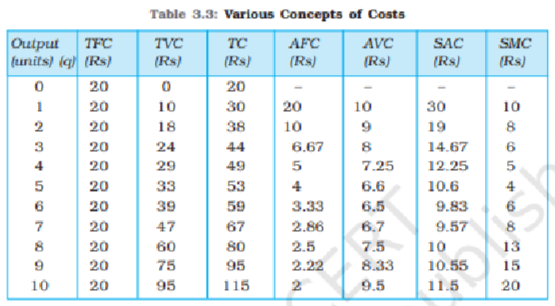
Using the sequential computation logic in the passage, if TC at q = 6 is Rs 59 and TC at q = 5 is Rs 53, what is the SMC at q = 6?
QUESTION 20 OF 20
Based on the numerical cost schedules and principles in the passage, how can the Total Variable Cost (TVC) at q = 5 be computed using the SMC values?
Test Complete!
Answer Review
1 A firm produces 50 units of output and incurs Rs 500 as total cost, out of which Rs 200 is fixed. If the firm decides to increase production to 100 units, what will be the conceptual behavior of the constant production costs?
�� Total Fixed Cost (TFC) does not vary with output. �� Fixed costs are incurred even if output changes. �� Increasing production affects only variable costs.
Total Fixed Cost (TFC) refers to the expenditure on fixed factors such as factory rent, permanent machinery, and salaries of permanent staff. These costs remain unchanged throughout the short run regardless of the quantity of output produced. In this question, the firm's TFC is Rs 200 when output is 50 units. Even after output increases to 100 units, the fixed factors remain unchanged. Therefore, the TFC continues to be Rs 200. Option B is correct because TFC is independent of output. Option A is incorrect because TFC does not increase with production. Option C is incorrect because TFC never decreases as output rises. Option D is incorrect because fixed costs exist even if output changes. Hence, Option B is the correct answer according to NCERT.
- �� Option A → Fixed costs do not double when output doubles.
- �� Option C → Fixed costs remain constant and do not decrease proportionally.
- �� Option D → Fixed costs are incurred even when production changes.
Used
- Elimination
Application:
- Eliminate all options suggesting that fixed cost changes with output.
Final Logic:
- Since TFC is independent of production level, it remains Rs 200.
"Fixed Means Fixed."
2 Complete the following statement analytically:
Because TFC is independent of the amount of output produced, any change in total cost resulting from a change in output is entirely due to a change in __________.
�� TFC remains unchanged. �� Only TVC changes when output changes. �� Therefore, changes in TC occur because of TVC.
The relationship among the short-run costs is: TC = TFC + TVC Since TFC remains constant, any increase or decrease in Total Cost (TC) is caused only by changes in Total Variable Cost (TVC). Therefore: ΔTC = ΔTVC Option B correctly identifies TVC. Option A is incorrect because AFC changes due to output, not because TC changes. Option C relates to production theory, not cost accounting. Option D is incorrect because fixed inputs remain unchanged. Hence, Option B is correct.
- �� Option A → AFC is an average, not the source of TC changes.
- �� Option C → Factor proportions explain production, not cost changes.
- �� Option D → Fixed inputs do not change in the short run.
Used
- Substitution
Application:
- Use the identity TC = TFC + TVC.
Final Logic:
- Since TFC is constant, only TVC changes TC.
"Only Variable Cost Varies."
3 Complete the following statement:
The input-driven cost (TVC) at any given output level can be calculated as the area under the __________ up to that specific level of output.
�� Marginal Cost represents additional variable cost. �� Summing marginal costs gives TVC. �� Graphically, TVC equals the area under the SMC curve.
Short Run Marginal Cost (SMC) measures the additional cost of producing one more unit of output. When all marginal costs up to a particular output level are added together, they give the Total Variable Cost (TVC). Graphically, this cumulative addition is represented by the area under the SMC curve. Option B correctly represents this relationship. Option A refers to fixed cost per unit. Option C is a constant horizontal line. Option D measures average cost, not cumulative variable cost. Therefore, Option B is correct.
- �� Option A → AFC cannot generate TVC.
- �� Option C → TFC remains constant and is unrelated to accumulated variable cost.
- �� Option D → SAC is an average, not a cumulative measure.
Used
- Contextual/Tonal Matching
Application:
- Identify which curve accumulates additional production costs.
Final Logic:
- The area under the SMC curve equals Total Variable Cost.
"Sum of MC = TVC."
4 Consider the assertion (A) and reason (R) for the zero output cost state.
Assertion (A): At zero output, the firm's Short Run Average Cost (SAC) is exactly equal to its Total Fixed Cost (TFC).
Reason (R): Both AFC and AVC are undefined at zero output level, making SAC undefined rather than equal to TFC.
Select the correct condition:
�� SAC = TC/q. �� At q = 0, division by zero is impossible. �� Therefore, SAC is undefined.
Short Run Average Cost is calculated as: SAC = TC / q At zero output (q = 0), this expression becomes undefined because division by zero is not possible. Similarly, AFC = TFC/q → Undefined AVC = TVC/q → Undefined Therefore: The Assertion is false because SAC is not equal to TFC. The Reason is true because average costs are undefined at zero output. Hence, Option C is correct.
- �� Option A → Assertion is false.
- �� Option B → Reason is actually true.
- �� Option D → Reason is correct.
Used
- Dimensional/Unit Analysis
Application:
- Check whether division by zero is mathematically valid.
Final Logic:
- Average costs are undefined when output is zero.
"Average Needs Output."
5 Which of the following equations accurately reflects the summation of costs when calculating the change in Total Cost (ΔTC) in the short run?
�� Fixed cost does not change. �� Therefore, ΔTFC = 0. �� Any change in TC equals the change in TVC.
The short-run cost identity is: TC = TFC + TVC Taking changes on both sides: ΔTC = ΔTFC + ΔTVC Since Total Fixed Cost remains constant, ΔTFC = 0 Therefore, ΔTC = ΔTVC Thus, Option B is the simplified and correct expression. Option A is the general identity, but in the short run ΔTFC = 0. Option C incorrectly combines average and marginal costs. Option D combines averages rather than total costs. Hence, Option B is correct.
- �� Option A → True as a general identity, but simplifies because ΔTFC = 0.
- �� Option C → SAC and SMC do not determine ΔTC directly.
- �� Option D → Average costs do not calculate changes in Total Cost.
Used
- Substitution
Application:
- Substitute ΔTFC = 0 into the cost identity.
Final Logic:
- ΔTC equals ΔTVC because fixed cost never changes.
"Fixed Never Changes → ΔTC = ΔTVC."
6 Choose the correct statements regarding the Total Cost (TC) base at zero level of output:
I. At zero level of output, the total variable cost is zero.
II. At zero level of output, the total cost is equal to the total fixed cost.
III. At zero level of output, both total cost and total variable cost are undefined.
�� TVC is zero when output is zero. �� TC = TFC + TVC. �� Therefore, TC equals TFC at zero output.
In the short run: TC = TFC + TVC When output (q) = 0: No variable inputs are employed. Therefore, TVC = 0. Fixed costs are still incurred. Hence, TC = TFC + 0 = TFC Therefore: Statement I is correct. Statement II is correct. Statement III is incorrect because TC and TVC are well defined at zero output. Hence, Option D is the correct answer.
- �� Option A → Statement III is false.
- �� Option B → Statement III is incorrect because neither TC nor TVC is undefined.
- �� Option C → Statement II is also correct, so this option is incomplete.
Used
- Option Grouping
Application:
- Evaluate each statement separately and eliminate options containing the false statement.
Final Logic:
- Only Statements I and II are correct.
"Zero Output → TVC = 0 → TC = TFC."
7 Match the cost components in List-I with their corresponding formulas in List-II.
| List I | List II |
|---|---|
| I. Short Run Average Cost (SAC) | 1. TVC / q |
| II. Average Variable Cost (AVC) | 2. TFC / q |
| III. Average Fixed Cost (AFC) | 3. TC / q |
�� SAC = TC/q. �� AVC = TVC/q. �� AFC = TFC/q.
The standard short-run cost formulas are: SAC = TC ÷ q AVC = TVC ÷ q AFC = TFC ÷ q Thus, I → 3 II → 1 III → 2 Hence Option A correctly matches every formula.
- �� Option B → Interchanges SAC and AVC incorrectly.
- �� Option C → Matches AFC and SAC wrongly.
- �� Option D → Incorrectly assigns AVC.
Used
- Substitution
Application:
- Recall each cost formula and substitute directly.
Final Logic:
- Only Option A matches all three formulas correctly.
(SAC→TC, AVC→TVC, AFC→TFC)
8 Complete the following statement:
Because total fixed cost is a constant, the Average Fixed Cost (AFC) curve is graphically represented as a __________.
�� AFC = TFC/q. �� TFC is constant. �� AFC continuously declines as output increases.
Average Fixed Cost is calculated as: AFC = TFC / q Since TFC remains constant, increasing output continuously reduces AFC. Graphically, this creates a rectangular hyperbola, which falls continuously but never touches either axis. Option C correctly identifies the curve. Option A is incorrect because AFC is downward, not upward sloping. Option B represents the TFC curve. Option D represents AVC or SAC, not AFC. Therefore, Option C is correct.
- �� Option A → AFC never rises.
- �� Option B → Horizontal line represents TFC, not AFC.
- �� Option D → AFC is never U-shaped.
Used
- Contextual/Tonal Matching
Application:
- Associate the known geometric shape with AFC.
Final Logic:
- Constant numerator divided by increasing denominator forms a rectangular hyperbola.
"Fixed ÷ More Output = Hyperbola."
9 Arrange the following steps in the correct logical sequence to compute the Average Variable Cost (AVC) per unit of output:
I. Determine the total variable cost (TVC) for the given output.
II. Divide the TVC by the number of units of output (q).
III. Identify the quantity of output produced (q).
�� Identify output. �� Find corresponding TVC. �� Divide TVC by output.
The formula is: AVC = TVC / q The logical order is: 1. Identify the output level (q). 2. Find the corresponding TVC. 3. Divide TVC by q. Thus, III → I → II Hence Option B is correct.
- �� Option A → Output should be identified before calculation.
- �� Option C → Division cannot be done before determining TVC.
- �� Option D → Output must be identified first.
Used
- Contextual/Tonal Matching
Application:
- Arrange the procedural steps logically.
Final Logic:
- Identify quantity → obtain TVC → compute AVC.
"Output → TVC → Divide."
10 Match the marginal relationships in List-I with their resulting average behaviors in List-II.
| List I | List II |
|---|---|
| 1. SMC falls because MP initially increases | a. AVC starts rising once SMC becomes greater than AVC |
| 2. SMC rises because MP eventually decreases | b. AVC continues to fall if SMC is less than AVC |
| 3. SMC cuts AVC | c. AVC is at its minimum point |
| 4. MP and SMC | d. Inversely related |
�� Rising MP lowers SMC. �� Falling SMC keeps AVC falling. �� Higher SMC makes AVC rise.
According to NCERT, Marginal Product (MP) and Short Run Marginal Cost (SMC) are inversely related. 1 → b Initially, Marginal Product (MP) rises. Therefore, Short Run Marginal Cost (SMC) falls. When SMC is less than AVC, it pulls AVC downward. Therefore, 1 → b. 2 → a Later, Marginal Product begins to fall because of diminishing marginal returns. Consequently, SMC rises. Once SMC becomes greater than AVC, AVC starts rising. Therefore, 2 → a. 3 → c The SMC curve intersects the AVC curve at the minimum point of AVC. Therefore, 3 → c. 4 → d Marginal Product and Marginal Cost are inversely related. As MP rises, SMC falls, and as MP falls, SMC rises. Therefore, 4 → d. Thus, the correct matching is: 1 → b 2 → a 3 → c 4 → d Hence, Option C is correct.
- �� Option A → Incorrect because it ignores the stage where SMC exceeds AVC and AVC begins to rise.
- �� Option B → Incorrect because the relationships between falling and rising SMC are interchanged.
- �� Option D → Incorrect because SMC below AVC cannot make AVC rise, and the remaining matches are also incorrect.
Used
- Option Grouping
Application:
- Use the NCERT rule that marginal values pull average values and the inverse relationship between MP and SMC.
Final Logic:
- SMC < AVC → AVC Falls
- SMC > AVC → AVC Rises
- SMC Cuts AVC → Minimum AVC
- MP ↑ → SMC ↓
Marginal Pulls Average
11 Match the phases of the SAC curve in List-I with the relative magnitudes of its components in List-II.
| List I | List II |
|---|---|
| 1. SAC initially falls | a. The rise in AVC becomes larger than the fall in AFC |
| 2. SAC eventually rises | b. The fall in AFC is greater than the rise in AVC |
| 3. Minimum point of SAC | c. Rise in AVC equals the fall in AFC |
| 4. Short Run Average Cost (SAC) | d. Sum of AFC and AVC |
�� SAC is the sum of AFC and AVC. �� Initially, the fall in AFC dominates the rise in AVC. �� Later, the rise in AVC exceeds the fall in AFC, causing SAC to rise.
According to NCERT, Short Run Average Cost (SAC) is given by SAC = AFC + AVC. 1 → b Initially, as output increases, Average Fixed Cost (AFC) falls rapidly, while Average Variable Cost (AVC) rises slowly. Since the fall in AFC is greater than the rise in AVC, SAC continues to fall. Therefore, 1 → b. 2 → a As output increases further, AVC rises rapidly because of the Law of Variable Proportions. When the rise in AVC becomes greater than the fall in AFC, SAC begins to rise. Therefore, 2 → a. 3 → c At the minimum point of the SAC curve, the increase in AVC exactly equals the decrease in AFC. Therefore, 3 → c. 4 → d Short Run Average Cost is the sum of Average Fixed Cost and Average Variable Cost. Therefore, 4 → d. Thus, the correct matching is: 1 → b 2 → a 3 → c 4 → d Hence, Option A is correct.
- �� Option B → Incorrect because it reverses the conditions responsible for the falling and rising phases of the SAC curve.
- �� Option C → Incorrect because SAC cannot both fall and rise under the same condition.
- �� Option D → Incorrect because both phases are matched with opposite conditions, and the remaining matches are incorrect.
Used
- Contextual/Tonal Matching
Application:
- Recall the relationship
- SAC = AFC + AVC
- and compare how AFC and AVC behave as output increases.
Final Logic:
- Fall in AFC > Rise in AVC → SAC Falls
- Rise in AVC > Fall in AFC → SAC Rises
- Rise in AVC = Fall in AFC → Minimum SAC
AVC Wins → SAC Rises
12 Given the equation SAC = AFC + AVC, select the correct logical condition regarding their minimum points:
�� SAC consists of both AFC and AVC. �� AFC continues to decline as output increases. �� Therefore, SAC reaches its minimum after AVC.
The Short Run Average Cost (SAC) is given by: SAC = AFC + AVC Since Average Fixed Cost (AFC) continuously falls as output increases, it keeps pulling the SAC curve downward even after the Average Variable Cost (AVC) has reached its minimum point and started rising. As a result: AVC reaches its minimum first. SAC reaches its minimum later, at a higher level of output. Therefore, the minimum point of the SAC curve lies to the right of the minimum point of the AVC curve. Hence, Option C is correct. Option A is incorrect because SAC and AVC do not attain their minimum points at the same output level. Option B is incorrect because SAC does not attain its minimum before AVC. Option D is incorrect because SAC directly depends on AVC through the relationship SAC = AFC + AVC.
- �� Option A → SAC reaches its minimum after AVC because AFC continues to decline.
- �� Option B → The minimum point of SAC cannot occur before the minimum point of AVC.
- �� Option D → SAC is directly related to AVC and therefore is not independent of it.
Used
- Contextual/Tonal Matching
Application:
- Use the relationship SAC = AFC + AVC and recall the behaviour of the AFC and AVC curves as output increases.
Final Logic:
- Since AFC keeps falling, SAC continues decreasing even after AVC reaches its minimum. Therefore, SAC attains its minimum at a higher output level than AVC.
"Falling AFC Delays SAC Minimum."
13 Complete the analytical statement:
Just like the marginal product is undefined at zero level of input employment, the Short Run Marginal Cost (SMC) is __________ at zero level of output.
�� SMC measures the additional cost of producing one more unit. �� At zero output, there is no previous unit for comparison. �� Hence, SMC is undefined at zero output.
Short Run Marginal Cost (SMC) measures the change in Total Cost resulting from producing one additional unit of output. Formula: SMC = Change in TC / Change in Output At zero output, there is no previous level of production from which a change can be measured. Therefore, the marginal cost of producing the "0th" unit is undefined. This is analogous to Marginal Product, which is also undefined when no input is employed. Therefore: Option C is correct. Option A is incorrect because SMC is not equal to fixed cost. Option B is incorrect because SMC is not zero at zero output. Option D is incorrect because AVC is also undefined at zero output and is conceptually different from SMC.
- �� Option A → Fixed Cost is a total cost concept and does not define marginal cost.
- �� Option B → SMC cannot be zero because it cannot be calculated at zero output.
- �� Option D → SMC and AVC are different cost concepts.
Used
- Contextual/Tonal Matching
Application:
- Relate SMC to the NCERT explanation that marginal values are undefined at the zero level because no additional unit exists.
Final Logic:
- Since there is no previous output level at zero production, SMC is undefined.
"No Output → No Marginal Cost."
14 Choose the correct statements regarding the link between SMC and incremental cost change:
I. Whatever change occurs to total cost when output changes is entirely due to the change in TVC.
II. SMC is the increase in Total Fixed Cost due to the production of an extra unit of output.
III. SMC measures the additional cost a firm incurs to produce one extra unit of output.
�� TFC remains constant in the short run. �� Only TVC changes with output. �� SMC measures the additional cost of one extra unit.
In the short run, TC = TFC + TVC Since Total Fixed Cost (TFC) remains constant, any change in Total Cost occurs only because Total Variable Cost (TVC) changes. Therefore: Statement I is correct. Statement III is also correct because SMC measures the extra cost of producing one additional unit of output. Statement II is incorrect because TFC never increases in the short run. Hence, Option B is correct.
- �� Option A → Statement II is incorrect because fixed cost does not change.
- �� Option C → Statement II is false.
- �� Option D → Includes the incorrect Statement II.
Used
- Option Grouping
Application:
- Evaluate each statement independently using the concepts of TFC, TVC and SMC.
Final Logic:
- Only Statements I and III are correct.
"Fixed Doesn't Change; Variable Creates MC."
15 Arrange the sequence of phenomena that cause the SMC curve to be U-shaped according to the law of variable proportions:
I. To produce an extra unit of output, the requirement of the factor becomes greater, causing SMC to rise.
II. The marginal product of a factor increases as employment increases initially.
III. The marginal product of the factor decreases after a certain point.
IV. To produce an extra unit of output, the requirement of the factor becomes less, causing SMC to fall initially.
�� Marginal Product initially increases. �� Less input is needed for each additional unit, reducing SMC. �� Later, Marginal Product decreases and SMC rises.
The U-shaped SMC curve is explained by the Law of Variable Proportions. The correct sequence is: 1. Marginal Product initially increases as more units of the variable factor are employed. (Statement II) 2. Because each additional unit of output requires less of the variable factor, SMC falls. (Statement IV) 3. After a certain stage, Marginal Product starts decreasing due to diminishing returns. (Statement III) 4. Now more of the variable factor is needed to produce each extra unit, causing SMC to rise. (Statement I) Thus, the correct order is: II → IV → III → I Hence, Option A is correct.
- �� Option B → Places the fall in marginal product before the fall in SMC, disrupting the correct sequence.
- �� Option C → Begins with SMC behaviour before explaining the rise in marginal product.
- �� Option D → Starts with diminishing returns instead of increasing marginal product.
Used
- Contextual/Tonal Matching
Application:
- Arrange the statements according to the NCERT explanation of the Law of Variable Proportions and the resulting U-shaped SMC curve.
Final Logic:
- Increasing Marginal Product lowers SMC initially; diminishing Marginal Product raises SMC later.
"MP Up → MC Down; MP Down → MC Up."
16 Match the geometric calculation methods in List-I with the corresponding cost metric in List-II.
| List I | List II |
|---|---|
| I. Area of rectangle OFCq₁ under the AFC curve | 1. Total Variable Cost (TVC) |
| II. Area of rectangle OVBq₀ under the AVC curve | 2. Total Fixed Cost (TFC) |
| III. Area under the SMC curve up to a given output | 3. Total Cost (TC) |
| IV. Sum of the areas representing TFC and TVC | 4. Total Cost (TC) obtained by adding TFC and TVC |
�� Area under the AFC rectangle gives Total Fixed Cost. �� Area under the AVC rectangle gives Total Variable Cost. �� The area under the SMC curve represents Total Cost (up to a given level of output). �� Total Cost equals the sum of Total Fixed Cost and Total Variable Cost.
According to the geometric interpretation of cost curves in NCERT: • The area of rectangle OFCq₁ under the AFC curve equals: AFC × Output = Total Fixed Cost (TFC). Therefore, I → 2 • The area of rectangle OVBq₀ under the AVC curve equals: AVC × Output = Total Variable Cost (TVC). Therefore, II → 1 • The area under the SMC curve up to a given level of output represents the Total Cost incurred in producing that output. Therefore, III → 3 • Total Cost is obtained by adding Total Fixed Cost and Total Variable Cost. Therefore, IV → 4 Hence, the correct matching is: • I → 2 • II → 1 • III → 3 • IV → 4 Therefore, Option A is correct.
- �� Option B → Incorrectly interchanges AFC and AVC rectangles and misidentifies Total Cost relationships.
- �� Option C → Incorrectly matches the AVC rectangle with Total Cost and the SMC area with TVC.
- �� Option D → Incorrectly identifies the AFC rectangle and the SMC area.
Used
- Contextual/Tonal Matching
Application:
- Recall the geometric interpretation of AFC, AVC, SMC, and Total Cost from the NCERT diagrams.
Final Logic:
- AFC Area → TFC
- AVC Area → TVC
- SMC Area → TC
- TFC + TVC → TC
SMC Area = Total Cost
17 Arrange the relationship phases between SMC and SAC in logical sequence as production increases from zero:
I. SAC is falling and SMC is less than SAC.
II. SMC cuts the SAC curve from below at its minimum point.
III. SAC is rising and SMC is greater than SAC.
�� Initially SMC is below SAC. �� SMC cuts SAC at its minimum point. �� Afterwards SMC exceeds SAC.
The relationship between Short Run Marginal Cost (SMC) and Short Run Average Cost (SAC) follows the standard marginal-average rule. Initially, SMC < SAC, so SAC keeps falling. (Statement I) As production increases, SMC cuts the SAC curve from below exactly at the minimum point of SAC. (Statement II) Beyond that point, SMC > SAC, causing SAC to rise. (Statement III) Therefore the correct sequence is: I → II → III Hence, Option B is correct.
- �� Option A → Begins with the intersection before SAC starts falling.
- �� Option C → Places the rising phase before the intersection.
- �� Option D → Starts with the final stage instead of the initial stage.
Used
- Contextual/Tonal Matching
Application:
- Arrange the stages according to the standard relationship between marginal and average cost curves.
Final Logic:
- SMC stays below SAC, cuts it at the minimum point, and then remains above it.
"Below → Touch → Above."
18 Choose the correct statements regarding how SMC influences the averages (AVC and SAC):
I. For the first unit of output, SMC and AVC are the same.
II. As long as the value of SMC remains less than the prevailing value of AVC, AVC continues to fall.
III. SMC pulls SAC downward only when SMC is strictly equal to AVC.
�� For the first unit, SMC equals AVC. �� AVC falls while SMC remains below it. �� Equality occurs only at AVC's minimum point.
For the first unit of output, Total Variable Cost equals Marginal Cost, so: SMC = AVC Thus, Statement I is correct. Whenever SMC remains below AVC, each additional unit costs less than the existing average, causing AVC to continue falling. Thus, Statement II is also correct. Statement III is incorrect because SMC pulls SAC downward whenever SMC is less than SAC, not only when they are equal. Equality occurs only at the minimum point of SAC. Hence, Option D is correct.
- �� Option A → Includes the incorrect Statement III.
- �� Option B → Statement III is false.
- �� Option C → Statement III is incorrect.
Used
- Option Grouping
Application:
- Evaluate each statement independently using the marginal-average relationship.
Final Logic:
- Only Statements I and II are correct.
"MC Below → Average Falls; MC Equal → Minimum."
19
Using the sequential computation logic in the passage, if TC at q = 6 is Rs 59 and TC at q = 5 is Rs 53, what is the SMC at q = 6?
�� SMC measures change in Total Cost. �� Compute the difference in TC. �� Divide by change in output.
Formula: SMC = Change in TC / Change in Output Given: TC at q = 6 = Rs 59 TC at q = 5 = Rs 53 Change in TC = 59 − 53 = 6 Change in output = 1 Therefore, SMC = 6 / 1 = Rs 6 Hence, Option C is correct.
- �� Option A → Incorrect difference in TC.
- �� Option B → Arithmetic error.
- �� Option D → Does not follow the SMC formula.
Used
- Substitution
Application:
- Substitute the numerical values into the SMC formula.
Final Logic:
- 59 − 53 = 6, therefore SMC = Rs 6.
"MC = Next TC − Previous TC."
20
Based on the numerical cost schedules and principles in the passage, how can the Total Variable Cost (TVC) at q = 5 be computed using the SMC values?
�� TVC accumulates marginal costs. �� Sum each unit's SMC. �� The cumulative sum equals TVC.
Short Run Marginal Cost (SMC) measures the additional cost of producing one extra unit of output. Therefore, the Total Variable Cost (TVC) at any output level is obtained by adding the marginal costs of all units produced up to that level. Thus, at q = 5, TVC equals the cumulative sum of SMC values from the first to the fifth unit. Hence, Option B is correct.
- �� Option A → Multiplying one SMC value by output does not give TVC.
- �� Option C → Dividing TC by output gives Average Cost, not TVC.
- �� Option D → Subtracting SMC from TC has no economic meaning for calculating TVC.
Used
- Contextual/Tonal Matching
Application:
- Apply the NCERT relationship between cumulative marginal cost and total variable cost.
Final Logic:
- Adding all marginal costs up to a given output gives Total Variable Cost.
"Add MCs = TVC."