
CUET UG Economics Booster Test 2 - Product Metrics and Laws
📌 Answers are locked once submitted — results and explanations appear at the end.
QUESTION 1 OF 20
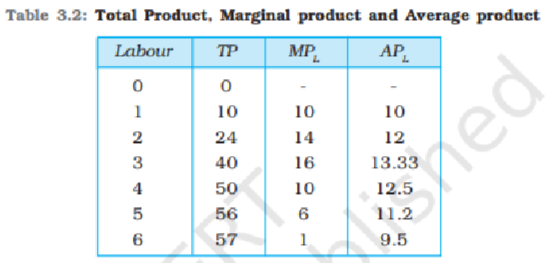
If capital is fixed at 4 units, and output is recorded for different values of labour as we move down the column, this schedule is specifically called the:
QUESTION 2 OF 20
Arrange the steps to identify the Variable Input Relationship from a production function table:
I. Keep one factor (e.g., capital) fixed at a specific unit.
II. Observe the corresponding output levels.
III. Increase the quantity of the other factor (e.g., labour) moving down the column.
QUESTION 3 OF 20
The values in the Average Product of labour column are mathematically obtained by dividing Total Product (TP) by ________.
QUESTION 4 OF 20
Which of the following are true about the Average Product at any level of employment?
I. It is the average of all marginal products up to that level.
II. It is obtained by dividing change in TP by change in L.
III. It is referred to as average return to the variable input.
QUESTION 5 OF 20
Assertion: MP is undefined at the zero level of input employment.
Reason: Inputs cannot take negative values, so marginal product is undefined at zero level of input employment.
QUESTION 6 OF 20
Match the calculation components for the MP formula when L changes from 1 to 2, and TP changes from 10 to 24.
| List I | List II |
|---|---|
| 1. Change in TP | a. 1 |
| 2. Change in L | b. 14 |
| 3. Marginal Product (MP) | c. 14 |
| 4. MP Formula | d. ΔTP ÷ ΔL |
QUESTION 7 OF 20
If the marginal product of the 1st unit is 10 and the 2nd unit is 14, what is the Total Product at 2 units of labour based on the summation rule?
QUESTION 8 OF 20
Match the TP growth rate to the state of MP.
| List I | List II |
|---|---|
| 1. TP increases by 10 then by 12 | a. MP is positive but decreasing. |
| 2. Rate at which TP increases | b. MP becomes zero. |
| 3. TP increases at a diminishing rate | c. Shown by the Marginal Product |
| 4. TP reaches its maximum | d. MP is increasing |
QUESTION 9 OF 20
The law of variable proportions states that the marginal product of a factor input initially rises with its employment level, but after reaching a certain level, it ________.
QUESTION 10 OF 20
Select the correct conditions regarding employment level thresholds:
I. The first phase shows MP increasing.
II. The next phase shows MP falling.
III. Output falls to zero when MP starts falling.
QUESTION 11 OF 20
As we hold one factor fixed and keep increasing the other, the factor proportions ________.
QUESTION 12 OF 20
Arrange the sequence of events as factor proportions change:
I. Factor proportions become more suitable for production.
II. The production process becomes too crowded.
III. Marginal product increases initially.
QUESTION 13 OF 20
QUESTION 14 OF 20
QUESTION 15 OF 20
Assertion: As long as AP increases, MP must be greater than AP.
Reason: If MP is lower than AP, AP cannot rise.
QUESTION 16 OF 20
Arrange the stages of AP and MP curve interaction from left to right on a typical firm's graph:
I. MP is greater than AP; AP is rising.
II. MP cuts AP from above at its maximum.
III. MP is less than AP; AP is falling.
QUESTION 17 OF 20
Match the curve morphology to its behaviour based on the Law of Variable Proportions.
| List I | List II |
|---|---|
| 1. MP curve initially | a. Rises |
| 2. MP curve after a certain point | b. Falls |
| 3. TP curve when MP is positive | c. Continues to increase, but eventually at a diminishing rate. |
| 4. TP curve when MP becomes zero | d. Reaches its maximum level. |
QUESTION 18 OF 20
In the input-output plane, the total product curve is a ________ sloped curve because an increase in the input amount results in an increase in output.
QUESTION 19 OF 20
Match the term to its alternative name.
| List I | List II |
|---|---|
| 1. Total Product | a. Average Returns |
| 2. Average Product | b. Total Physical Product |
| 3. Marginal Product | c. Marginal Returns |
| 4. Returns to a Variable Input | d. Change in Total Product due to one additional unit of the variable input. |
QUESTION 20 OF 20
Which of the following statements correctly describe Returns to Variable Input concepts?
I. Average returns refer to Average Product.
II. Marginal returns refer to Marginal Product.
III. Total physical product is the sum of average returns.
Test Complete!
Answer Review
1 If capital is fixed at 4 units, and output is recorded for different values of labour as we move down the column, this schedule is specifically called the:
�� Capital remains fixed while labour varies. �� Output is recorded for each level of labour. �� This forms the Total Product of Labour schedule.
When capital is held constant and the quantity of labour is increased, the resulting output at each labour level is recorded in a Total Product (TP) of Labour schedule. This schedule shows how total output changes as more units of labour are employed while other inputs remain fixed. Therefore, Option B is correct. Option A is incorrect because a long-run schedule allows all inputs to vary. Option C is incorrect because Average Fixed Cost is a cost concept, not a production schedule. Option D is incorrect because capital is fixed, so the schedule does not measure the marginal product of capital.
- �� Option A → In the long run, all factors of production are variable, whereas this schedule keeps capital fixed.
- �� Option C → Average Fixed Cost belongs to cost analysis and has no relation to the production schedule.
- �� Option D → Since labour varies and capital is fixed, the schedule represents Total Product of Labour, not Marginal Product of Capital.
Used
- Contextual/Tonal Matching
Application:
- Identify which factor is fixed and which factor varies to determine the type of production schedule.
Final Logic:
- Fixed Capital + Variable Labour = Total Product of Labour Schedule.
Fixed K + Changing L = TP of Labour
2 Arrange the steps to identify the Variable Input Relationship from a production function table:
I. Keep one factor (e.g., capital) fixed at a specific unit.
II. Observe the corresponding output levels.
III. Increase the quantity of the other factor (e.g., labour) moving down the column.
�� Fix one factor first. �� Increase the variable factor. �� Observe the resulting output.
To study the relationship between a variable input and output, the following sequence is followed: 1. Keep one factor (capital) fixed (I). 2. Increase the quantity of the other factor (labour) (III). 3. Observe the corresponding changes in output (II). This procedure helps analyze Total Product, Average Product and Marginal Product. Therefore, the correct order is: I → III → II Hence, Option A is correct.
- �� Option B → Labour cannot be increased before deciding which factor is fixed.
- �� Option C → Output is observed only after labour has been varied.
- �� Option D → Output cannot be observed before fixing the production conditions.
Used
- Contextual/Tonal Matching
Application:
- Arrange the production analysis steps according to the standard NCERT procedure.
Final Logic:
- Fix One Input → Increase Other Input → Observe Output.
Fix → Increase → Observe
3 The values in the Average Product of labour column are mathematically obtained by dividing Total Product (TP) by ________.
�� Average Product measures output per worker. �� It is calculated using Total Product and Labour. �� Labour is the variable input.
Average Product of Labour (APL) is calculated as: APL = Total Product (TP) ÷ Labour (L) It measures the average output produced by each unit of labour. Therefore, Option C is correct. Option A is incorrect because Marginal Product measures additional output. Option B is incorrect because Change in Labour is used in the Marginal Product formula. Option D is incorrect because fixed capital is not used in calculating Average Product.
- �� Option A → Marginal Product is a separate productivity measure and is not used to calculate Average Product.
- �� Option B → Change in Labour (ΔL) is used in the Marginal Product formula, not Average Product.
- �� Option D → Fixed capital does not appear in the Average Product formula.
Used
- Substitution
Application:
- Recall the NCERT formula AP = TP ÷ L and substitute it into the options.
Final Logic:
- Average Product = Total Product ÷ Labour.
("Average = Divide")
4 Which of the following are true about the Average Product at any level of employment?
I. It is the average of all marginal products up to that level.
II. It is obtained by dividing change in TP by change in L.
III. It is referred to as average return to the variable input.
�� Average Product is the average output per unit of labour. �� It can be viewed as the average of all marginal products up to that employment level. �� It is also called the average return to the variable input.
Average Product (AP) is calculated as: AP = Total Product (TP) ÷ Labour (L) Therefore: Statement I is correct because AP represents the average productivity of all units of labour employed, which is equivalent to the average of the marginal products up to that level. Statement II is incorrect because ΔTP ÷ ΔL is the formula for Marginal Product (MP), not Average Product. Statement III is correct because NCERT refers to Average Product as the average return to the variable input. Hence, Option B (I and III only) is correct.
- �� Option A → Statement II is incorrect because it represents the formula for Marginal Product.
- �� Option C → Statement II is incorrect, making this option wrong.
- �� Option D → All three statements are not correct because Statement II is false.
Used
- Option Grouping
Application:
- Evaluate each statement individually using the NCERT definitions of AP and MP.
Final Logic:
- AP = TP ÷ L and Average Return; MP = ΔTP ÷ ΔL.
MP = ΔTP ÷ ΔL
5 Assertion: MP is undefined at the zero level of input employment.
Reason: Inputs cannot take negative values, so marginal product is undefined at zero level of input employment.
�� Marginal Product measures the change in output from an additional unit of input. �� At zero input, there is no previous level from which a change can be measured. �� Therefore, MP is undefined at zero employment.
The Assertion is true because Marginal Product (MP) measures the additional output resulting from an additional unit of the variable input. At zero units of labour, there is no preceding input level from which to calculate the change in output. Since inputs cannot take negative values, MP cannot be computed at zero employment. Thus, the Reason correctly explains the Assertion. Therefore, Option A is correct.
- �� Option B → The Reason directly explains why MP is undefined at zero employment.
- �� Option C → The Reason is true according to NCERT.
- �� Option D → Both the Assertion and the Reason are true.
Used
- Elimination
Application:
- Evaluate the Assertion and the Reason separately, then determine whether the Reason explains the Assertion.
Final Logic:
- No Negative Inputs → MP Undefined at Zero.
Zero Labour = MP Undefined
6 Match the calculation components for the MP formula when L changes from 1 to 2, and TP changes from 10 to 24.
| List I | List II |
|---|---|
| 1. Change in TP | a. 1 |
| 2. Change in L | b. 14 |
| 3. Marginal Product (MP) | c. 14 |
| 4. MP Formula | d. ΔTP ÷ ΔL |
�� Change in Total Product = 24 − 10 = 14. �� Change in Labour = 2 − 1 = 1. �� Marginal Product is calculated as ΔTP ÷ ΔL.
According to NCERT, Marginal Product (MP) = ΔTP ÷ ΔL Given: Labour changes from 1 to 2. Total Product changes from 10 to 24. 1 → b Change in Total Product ΔTP = 24 − 10 = 14 Therefore, 1 → b. 2 → a Change in Labour ΔL = 2 − 1 = 1 Therefore, 2 → a. 3 → c Marginal Product MP = ΔTP ÷ ΔL = 14 ÷ 1 = 14 Therefore, 3 → c. 4 → d The formula used to calculate Marginal Product is MP = ΔTP ÷ ΔL. Therefore, 4 → d. Thus, the correct matching is: 1 → b 2 → a 3 → c 4 → d Hence, Option B is correct.
- �� Option A → Incorrect because the values of ΔTP and ΔL are interchanged.
- �� Option C → Incorrect because ΔTP is 14, not 1, and the MP formula is incorrectly matched.
- �� Option D → Incorrect because the change in labour is 1, not 14, and MP is 14.
Used: Substitution
Application:
- Substitute the given values of Total Product and Labour into the MP formula and compute each quantity before matching.
Final Logic:
- ΔTP = 14
- ΔL = 1
- MP = 14
- Formula = ΔTP ÷ ΔL
2 − 1 = 1
7 If the marginal product of the 1st unit is 10 and the 2nd unit is 14, what is the Total Product at 2 units of labour based on the summation rule?
�� Total Product equals the sum of Marginal Products. �� Add the MP of each unit of labour. �� TP = 10 + 14 = 24.
According to the summation rule, Total Product = Sum of Marginal Products Given: MP of the 1st unit = 10 MP of the 2nd unit = 14 Therefore, TP = 10 + 14 = 24 Hence, Option D is correct. Option A, B and C represent only partial values and do not equal the cumulative Total Product.
- �� Option A → 4 is not obtained from the given Marginal Products.
- �� Option B → 10 is only the first Marginal Product, not Total Product.
- �� Option C → 14 is only the second Marginal Product.
Used
- Substitution
Application:
- Apply the TP summation rule directly to the given Marginal Products.
Final Logic:
- TP = 10 + 14 = 24.
TP = Σ MP
8 Match the TP growth rate to the state of MP.
| List I | List II |
|---|---|
| 1. TP increases by 10 then by 12 | a. MP is positive but decreasing. |
| 2. Rate at which TP increases | b. MP becomes zero. |
| 3. TP increases at a diminishing rate | c. Shown by the Marginal Product |
| 4. TP reaches its maximum | d. MP is increasing |
�� Increasing additions to TP indicate a rising Marginal Product. �� Marginal Product measures the rate of increase in Total Product. �� When TP reaches its maximum, MP becomes zero.
According to NCERT, Marginal Product (MP) measures the change in Total Product (TP) resulting from employing one additional unit of the variable factor. 1 → d If TP first increases by 10 units and then by 12 units, the additional output contributed by successive units of labour is increasing. Therefore, MP is increasing. Hence, 1 → d. 2 → c The rate at which Total Product increases is measured by Marginal Product. Therefore, 2 → c. 3 → a When Total Product continues to increase but at a diminishing rate, Marginal Product remains positive but starts decreasing. Therefore, 3 → a. 4 → b Total Product reaches its maximum when Marginal Product becomes zero. Beyond this point, additional labour causes Total Product to decline. Therefore, 4 → b. Thus, the correct matching is: 1 → d 2 → c 3 → a 4 → b Hence, Option A is correct.
- �� Option B → Incorrect because increasing additions to TP indicate increasing MP, while the last two concepts are also mismatched.
- �� Option C → Incorrect because TP increasing by larger increments does not merely indicate that MP measures TP growth; it specifically indicates that MP is increasing.
- �� Option D → Incorrect because the rate of TP increase is measured by MP, not that both statements correspond to increasing MP.
Used: Option Grouping
Application:
- Relate each stage of Total Product with the corresponding behaviour of Marginal Product using the standard NCERT TP–MP relationship.
Final Logic:
- Increasing TP additions → MP Increasing.
- TP Growth Rate → MP.
- TP Maximum → MP = 0.
TP Maximum → MP = 0
9 The law of variable proportions states that the marginal product of a factor input initially rises with its employment level, but after reaching a certain level, it ________.
�� Marginal Product rises initially. �� After the optimum stage, it begins to decline. �� This is the essence of the Law of Variable Proportions.
The Law of Variable Proportions states that as additional units of a variable factor are employed with other factors fixed, Marginal Product initially increases because factor proportions improve. After a certain point, the fixed factor becomes crowded, causing Marginal Product to start falling. Therefore, Option B is correct. Option A is incorrect because MP does not remain constant. Option C is incorrect because MP does not become zero immediately after the optimum stage. Option D is incorrect because Marginal Product has no relationship with fixed cost.
- �� Option A → MP eventually declines rather than remaining constant.
- �� Option C → MP declines gradually and does not become zero immediately.
- �� Option D → Fixed cost is unrelated to Marginal Product.
Used
- Contextual/Tonal Matching
Application:
- Recall the central principle of the Law of Variable Proportions.
Final Logic:
- Initial Rise → Eventual Fall.
Rise First, Fall Later
10 Select the correct conditions regarding employment level thresholds:
I. The first phase shows MP increasing.
II. The next phase shows MP falling.
III. Output falls to zero when MP starts falling.
�� MP rises initially. �� MP later begins to decline. �� Output does not become zero merely because MP starts falling.
Under the Law of Variable Proportions: Statement I is correct because Marginal Product initially increases as factor proportions improve. Statement II is correct because after a certain employment level, the fixed factor becomes crowded and Marginal Product starts falling. Statement III is incorrect because Total Product continues to increase as long as Marginal Product remains positive. Output does not fall to zero simply because MP starts declining. Therefore, Option C (I and II only) is correct.
- �� Option A → Statement II is also correct.
- �� Option B → Statement III is incorrect.
- �� Option D → All three statements are not correct because Statement III is false.
Used
- Option Grouping
Application:
- Evaluate each statement independently using the stages of the Law of Variable Proportions.
Final Logic:
- MP Falls ≠ Output Falls to Zero.
MP Falls, TP Still Rises (Until MP = 0)
11 As we hold one factor fixed and keep increasing the other, the factor proportions ________.
�� One factor remains fixed while the other increases. �� The ratio between the two inputs changes. �� This changing ratio is called changing factor proportions.
The Law of Variable Proportions studies production when one factor is fixed and the other factor is varied. As additional units of the variable factor are employed, the ratio (proportion) between the two inputs changes continuously. Therefore, Option B (Change) is correct. Option A is incorrect because the proportions do not remain fixed. Option C is incorrect because there is no concept of factor proportions "reaching equilibrium." Option D is incorrect because the proportions do not decline to zero.
- �� Option A → Factor proportions change because only one input is increased.
- �� Option C → Production theory does not define factor proportions in terms of equilibrium.
- �� Option D → The ratio changes but does not become zero.
Used
- Contextual/Tonal Matching
Application:
- Recall the basic idea of the Law of Variable Proportions where one factor changes while another remains fixed.
Final Logic:
- Fixed One Input + Increase Other Input = Changing Factor Proportions.
Fixed One → Ratio Changes
12 Arrange the sequence of events as factor proportions change:
I. Factor proportions become more suitable for production.
II. The production process becomes too crowded.
III. Marginal product increases initially.
�� Initially, factor proportions improve. �� Better proportions increase Marginal Product. �� Later, crowding causes productivity to decline.
As labour is added while capital remains fixed: Factor proportions first become more suitable for production (I). Due to this better utilization of the fixed factor, Marginal Product increases initially (III). After further additions of labour, the fixed factor becomes crowded, reducing efficiency (II). Thus, the correct sequence is: I → III → II Therefore, Option A is correct.
- �� Option B → Marginal Product increases because factor proportions first become more suitable.
- �� Option C → Crowding occurs only after the stage of improving factor proportions.
- �� Option D → Crowding occurs after the rise in Marginal Product, not immediately after improved proportions.
Used
- Contextual/Tonal Matching
Application:
- Arrange the events according to the NCERT explanation of the Law of Variable Proportions.
Final Logic:
- Better Proportions → Rising MP → Crowding.
Suitable → Rising MP → Crowding
13
�� One worker cannot fully utilize four hectares. �� Land remains underutilized. �� This is the initial stage of production.
The passage clearly states that when there is only one worker on four hectares, there is too much land for that worker to cultivate. This means the fixed factor (land) is underutilized. Therefore, Option B is correct. Option A refers to the beginning of crowding. Option C represents a later stage where land becomes crowded. Option D is a consequence of crowding, not underutilization.
- �� Option A → Hiring the fourth worker represents the beginning of crowding rather than underutilization.
- �� Option C → Four workers on four hectares indicate crowding, not unused resources.
- �� Option D → Falling Marginal Product results from crowding, not from underutilization.
Used
- Contextual/Tonal Matching
Application:
- Use the passage to identify the situation where land is not fully utilized.
Final Logic:
- Too Much Land + Too Few Workers = Underutilization.
1 Worker = Empty Land
14
�� Crowding reduces worker efficiency. �� Additional workers contribute less output. �� Marginal Product starts declining.
According to the passage, after the fourth worker is employed, the land becomes crowded. Because each worker has less land available, every additional worker contributes less output than before, causing the Marginal Product to begin falling. Therefore, Option B is correct. Option A is incorrect because Total Product does not become zero. Option C describes the earlier stage before crowding. Option D is unrelated to the explanation.
- �� Option A → Total Product does not become zero when crowding begins.
- �� Option C → Workers add proportionally more output only before crowding occurs.
- �� Option D → Land size remains fixed throughout the analysis.
Used
- Contextual/Tonal Matching
Application:
- Identify the exact indicator of efficiency loss mentioned in the passage.
Final Logic:
- Crowding → Falling Marginal Product.
Crowding = MP Falls
15 Assertion: As long as AP increases, MP must be greater than AP.
Reason: If MP is lower than AP, AP cannot rise.
�� MP influences the movement of AP. �� AP rises only when MP exceeds AP. �� The Reason correctly explains the Assertion.
The relationship between Average Product (AP) and Marginal Product (MP) is one of the most important concepts in production theory. When MP > AP, the Average Product rises. When MP = AP, AP reaches its maximum. When MP < AP, AP falls. Therefore, the Assertion is true because AP continues to rise only when MP is greater than AP. The Reason is also true because if MP falls below AP, the average can no longer increase. Thus, the Reason correctly explains the Assertion. Hence, Option A is correct.
- �� Option B → The Reason directly explains the Assertion.
- �� Option C → The Reason is true according to the AP–MP relationship.
- �� Option D → Both the Assertion and the Reason are true.
Used
- Elimination
Application:
- Evaluate both statements and verify whether the Reason explains the Assertion.
Final Logic:
- MP Above AP → AP Rises.
Below = Fall
16 Arrange the stages of AP and MP curve interaction from left to right on a typical firm's graph:
I. MP is greater than AP; AP is rising.
II. MP cuts AP from above at its maximum.
III. MP is less than AP; AP is falling.
�� Initially, MP is above AP. �� MP intersects AP at AP's maximum point. �� Afterwards, MP falls below AP and AP declines.
The relationship between Average Product (AP) and Marginal Product (MP) follows a definite sequence: Stage I: MP is greater than AP, so AP rises. Stage II: MP cuts the AP curve from above at the maximum point of AP. Stage III: MP becomes less than AP, causing AP to decline. Thus, the correct order is: I → II → III Therefore, Option B is correct.
- �� Option A → The intersection cannot occur before AP has been rising.
- �� Option C → AP does not begin by falling.
- �� Option D → MP must first intersect AP before AP starts falling.
Used
- Contextual/Tonal Matching
Application:
- Recall the standard AP–MP relationship explained in NCERT.
Final Logic:
- MP Above AP → MP = AP → MP Below AP.
Above → Equal → Below
17 Match the curve morphology to its behaviour based on the Law of Variable Proportions.
| List I | List II |
|---|---|
| 1. MP curve initially | a. Rises |
| 2. MP curve after a certain point | b. Falls |
| 3. TP curve when MP is positive | c. Continues to increase, but eventually at a diminishing rate. |
| 4. TP curve when MP becomes zero | d. Reaches its maximum level. |
�� Marginal Product initially rises due to better utilization of the fixed factor. �� After a certain stage, Marginal Product begins to fall because of diminishing returns. �� Total Product continues to increase until Marginal Product becomes zero.
According to the Law of Variable Proportions in NCERT, the behaviour of the TP and MP curves depends on changes in the marginal product of the variable factor. 1 → a Initially, as more units of the variable factor are employed, the fixed factor is utilized more efficiently. Consequently, the Marginal Product (MP) rises. Therefore, 1 → a. 2 → b After a certain level of employment, the fixed factor becomes crowded. As a result, the Marginal Product begins to fall because of the Law of Diminishing Marginal Returns. Therefore, 2 → b. 3 → c As long as Marginal Product remains positive, Total Product continues to increase. However, once MP starts declining, TP increases at a diminishing rate. Therefore, 3 → c. 4 → d When Marginal Product becomes zero, Total Product reaches its maximum level. Therefore, 4 → d. Thus, the correct matching is: 1 → a 2 → b 3 → c 4 → d Hence, Option D is correct.
- �� Option A → Incorrect because the MP curve does not begin by falling.
- �� Option B → Incorrect because the MP curve initially rises, and the TP-related concepts are incorrectly matched.
- �� Option C → Incorrect because the MP curve does not continue rising indefinitely; it eventually falls due to diminishing marginal returns.
Used: Option Grouping
Application:
- Recall the NCERT behaviour of the TP and MP curves under the Law of Variable Proportions and match each stage with its corresponding characteristic.
Final Logic:
- MP Initially → Rises.
- MP Later → Falls.
- MP Positive → TP Increases.
- MP = 0 → TP Maximum.
MP = 0 → TP Maximum
18 In the input-output plane, the total product curve is a ________ sloped curve because an increase in the input amount results in an increase in output.
�� Labour is measured on the X-axis. �� Output is measured on the Y-axis. �� Increasing labour generally increases Total Product.
The Total Product (TP) curve shows the relationship between the quantity of the variable input and total output. As more units of labour are employed, Total Product generally increases (at least until the later stages), giving the TP curve a positive slope. Therefore, Option B is correct. Option A is incorrect because TP does not normally slope downward. Option C is incorrect because output changes with labour. Option D is incorrect because the TP curve is not vertical.
- �� Option A → A negative slope would imply that increasing labour always reduces output, which is incorrect.
- �� Option C → A horizontal line would imply output never changes.
- �� Option D → A vertical line would imply labour never changes.
Used
- Contextual/Tonal Matching
Application:
- Recall the graphical representation of the Total Product curve.
Final Logic:
- More Labour → More Output → Positive Slope.
TP Climbs Up
19 Match the term to its alternative name.
| List I | List II |
|---|---|
| 1. Total Product | a. Average Returns |
| 2. Average Product | b. Total Physical Product |
| 3. Marginal Product | c. Marginal Returns |
| 4. Returns to a Variable Input | d. Change in Total Product due to one additional unit of the variable input. |
�� Total Product is also known as Total Physical Product. �� Average Product is also called Average Returns. �� Marginal Product measures the additional output produced by an additional unit of the variable input.
According to NCERT, the following alternative names are commonly used in production theory. 1 → b Total Product (TP) is also known as Total Physical Product (TPP), representing the total output produced by all units of the variable factor. Therefore, 1 → b. 2 → a Average Product (AP) is also called Average Returns to the Variable Input because it represents the output produced per unit of the variable factor. Therefore, 2 → a. 3 → d Marginal Product (MP) is the change in Total Product resulting from employing one additional unit of the variable input. Therefore, 3 → d. 4 → c Returns to a Variable Input are also referred to as Marginal Returns because they describe how output changes as additional units of the variable factor are employed while keeping other factors fixed. Therefore, 4 → c. Thus, the correct matching is: 1 → b 2 → a 3 → d 4 → c Hence, Option B is correct.
- �� Option A → Incorrect because the alternative names of Total Product and Average Product are interchanged.
- �� Option C → Incorrect because Average Product is not called Total Physical Product, and Marginal Product is incorrectly matched.
- �� Option D → Incorrect because Total Product is not called Average Returns, and the remaining concepts are also incorrectly matched.
Used: Option Grouping
Application:
- Recall the standard NCERT terminology used for Total Product, Average Product, Marginal Product, and Returns to a Variable Input, then match each concept accordingly.
Final Logic:
- TP → Total Physical Product.
- AP → Average Returns.
- MP → Additional Output.
- Returns to Variable Input → Marginal Returns.
MP → More Product
20 Which of the following statements correctly describe Returns to Variable Input concepts?
I. Average returns refer to Average Product.
II. Marginal returns refer to Marginal Product.
III. Total physical product is the sum of average returns.
�� Average Returns = Average Product. �� Marginal Returns = Marginal Product. �� Total Physical Product is Total Product, not the sum of Average Returns.
Statement I is correct because Average Returns is another name for Average Product (AP). Statement II is correct because Marginal Returns refers to Marginal Product (MP). Statement III is incorrect because Total Physical Product (TPP) is another name for Total Product (TP). It is not obtained by summing Average Returns. Instead, Total Product is the cumulative sum of Marginal Products, not Average Products. Therefore, the correct answer is Option C (I and II only).
- �� Option A → Statement II is also correct.
- �� Option B → Statement III is incorrect because TPP is not the sum of Average Returns.
- �� Option D → All three statements are not correct because Statement III is false.
Used
- Option Grouping
Application:
- Evaluate each statement individually using NCERT terminology.
Final Logic:
- Average Returns = AP; Marginal Returns = MP; TPP = TP.
TP = Total Physical Product